Novo Samuel G, Faranda Adam P, D'Antin Justin C, Wang Yan, Shihan Mahbubul, Barraquer Rafael I, Michael Ralph, Duncan Melinda K
Department of Biological Sciences, University of Delaware, Newark, DE.
Centro de Oftalmología Barraquer, Barcelona, Spain.
Mol Vis. 2024 Oct 8;30:348-367. eCollection 2024.
Cataracts are typically treated by phacoemulsification followed by intraocular lens implantation. Studies of mouse models of cataract surgery have revealed that lens epithelial cells rapidly remodel their transcriptome to express proinflammatory cytokines after lens fiber cell removal, but it is currently unknown whether this response is conserved in human lenses. This study seeks to fill this knowledge gap.
Human cadaver eyes from 70 to 89 year old individuals were prepared for the human capsular bag model of cataract surgery. The central epithelium was preserved in RNAlater during culture preparation, then the equatorial epithelium was either immediately preserved in RNAlater after the culture was created, or 24 h later. Gene expression profiles were generated by bulk sequencing of RNA isolated from these tissue samples. The transcriptomic response of human cadaver-derived lens epithelial cells to culture in this "capsular bag" model was characterized by bioinformatic analysis. The human response was directly compared to that of 24-month-old mouse lens epithelial cells subjected to fiber cell removal surgery.
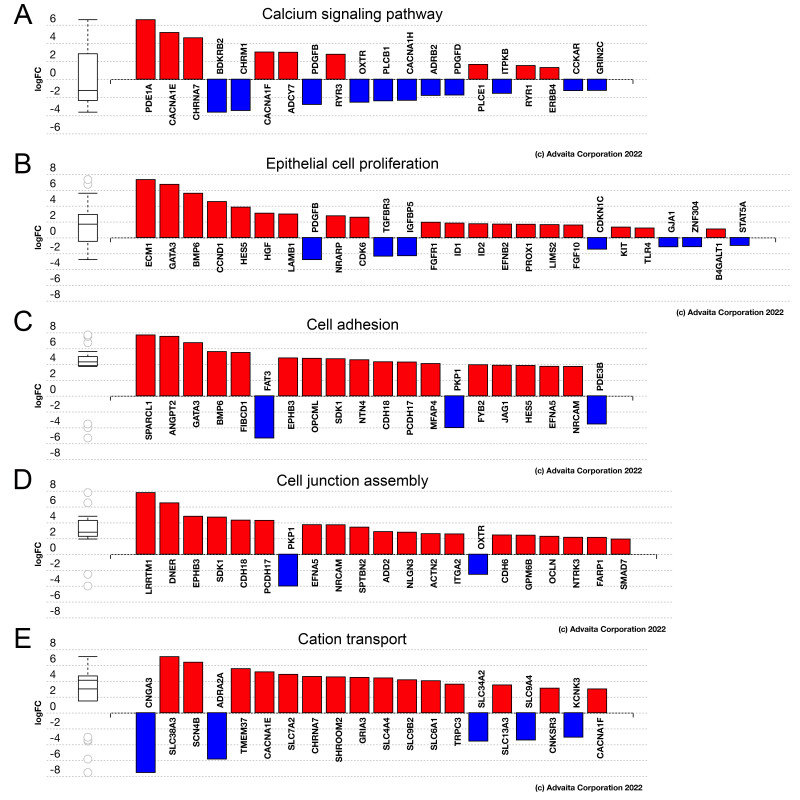
Human lens epithelial cells remodel approximately a third of their transcriptome by 24 h after surgery, and like mice, this response consists of induction of proinflammatory cytokine genes, upregulation of fibrotic markers and downregulation of genes controlling the lens epithelial phenotype.
These observations demonstrate that humans and mice have similar responses to cataract surgery and support the use of mice to study the response of lens epithelial cells to cataract surgery, suggesting that identified injury response mechanisms can be leveraged to elucidate new approaches to improve the outcomes of cataract surgery.
白内障通常通过超声乳化术联合人工晶状体植入术进行治疗。对白内障手术小鼠模型的研究表明,晶状体纤维细胞移除后,晶状体上皮细胞会迅速重塑其转录组以表达促炎细胞因子,但目前尚不清楚这种反应在人类晶状体中是否保守。本研究旨在填补这一知识空白。
制备70至89岁个体的人尸体眼用于白内障手术的人囊袋模型。在培养准备过程中,中央上皮保存在RNA保护剂中,然后在培养建立后,赤道上皮要么立即保存在RNA保护剂中,要么在24小时后保存。通过对从这些组织样本中分离的RNA进行批量测序来生成基因表达谱。通过生物信息学分析对人尸体来源的晶状体上皮细胞在这种“囊袋”模型中培养的转录组反应进行表征。将人类的反应与接受纤维细胞移除手术的24个月大小鼠的晶状体上皮细胞的反应进行直接比较。
人类晶状体上皮细胞在手术后24小时内会重塑其约三分之一的转录组,与小鼠一样,这种反应包括促炎细胞因子基因的诱导、纤维化标志物的上调以及控制晶状体上皮表型的基因的下调。
这些观察结果表明,人类和小鼠对白内障手术有相似的反应,并支持使用小鼠来研究晶状体上皮细胞对白内障手术的反应,这表明可以利用已确定的损伤反应机制来阐明改善白内障手术结果的新方法。