Le Trinh Van, Dang Thanh Minh, Do Huy Quang, Holterman Ai-Xuan Le, Phan-Thi Hong-Thuy, Tran Thong Tan, Truong Nhung Hai
Laboratory of Stem Cell Research and Application, University of Science-VNUHCM, Ho Chi Minh City, Vietnam.
Vietnam National University, Ho Chi Minh City, Vietnam.
Liver Res. 2023 Mar 6;7(1):90-98. doi: 10.1016/j.livres.2023.02.004. eCollection 2023 Mar.
Biliary atresia is a rare congenital bile duct disease that is the leading cause of liver fibrosis in neonates. Granulocyte colony-stimulating factor (GCSF) is a potential therapy for hepatocellular diseases, but data on GCSF for cholestatic conditions remain limited.
The current study examines the role of GCSF in improving bile duct obstruction in mice. Two doses were administered: 10.0 μg/kg/day and 61.5 μg/kg/day, which is the animal equivalent dose of 5.0 μg/kg in humans. Seven days (D7) after bile duct ligation (BDL), Swiss mice were treated with phosphate buffered saline or GCSF for 5 days. The intrahepatic adaptive response of BDL mice was evaluated on postsurgical days D12, D19, and D26.
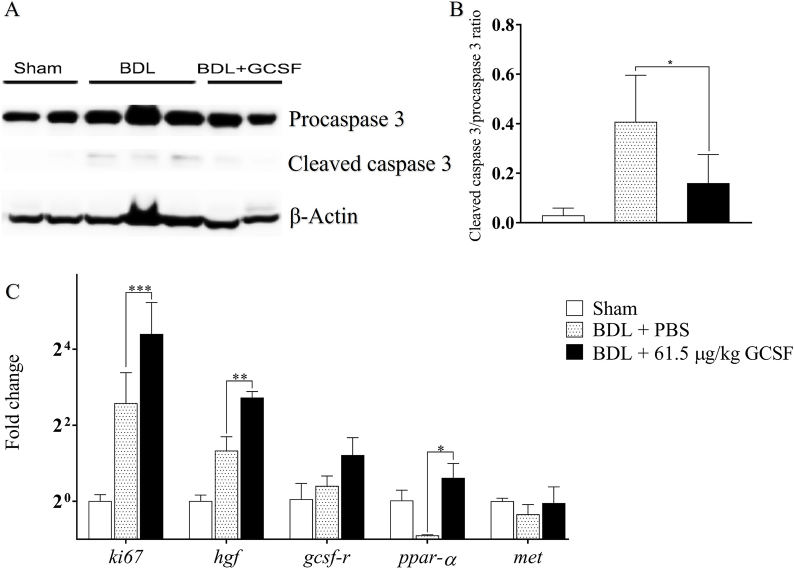
Treatment with 61.5 μg/kg of GCSF resulted in a significant increase in circulating leukocytes and neutrophils on D12. Amelioration of liver injury, as shown by reduced aspartate aminotransferase levels, increased albumin levels and survival rate, as well as reduced intrahepatic inflammation and hepatic myeloperoxidase expression, downregulated ductular proliferation, periportal fibroblast activation, and fibrosis, enhanced expressions of , , and , and suppressed expression of cleaved caspase-3 protein, was noted after treatment with 61.5 μg/kg of GCSF. Additionally, GCSF treatment was associated with an increased number of intrahepatic cd3Sca1c-Kit bone marrow cells.
Treatment with 61.5 μg/kg of GCSF resulted in liver regeneration and survival in BDL mice was seen, suggesting its potential use for human liver diseases.
胆道闭锁是一种罕见的先天性胆管疾病,是新生儿肝纤维化的主要原因。粒细胞集落刺激因子(GCSF)是一种治疗肝细胞疾病的潜在疗法,但关于GCSF用于胆汁淤积性疾病的数据仍然有限。
本研究探讨GCSF在改善小鼠胆管梗阻中的作用。给予两种剂量:10.0μg/kg/天和61.5μg/kg/天,这是人类5.0μg/kg的动物等效剂量。胆管结扎(BDL)7天后(D7),用磷酸盐缓冲盐水或GCSF对瑞士小鼠治疗5天。在术后第12、19和26天评估BDL小鼠的肝内适应性反应。
在第12天,用61.5μg/kg的GCSF治疗导致循环白细胞和中性粒细胞显著增加。用61.5μg/kg的GCSF治疗后,观察到肝损伤改善,表现为天冬氨酸转氨酶水平降低、白蛋白水平升高和存活率提高,以及肝内炎症和肝髓过氧化物酶表达降低,导管增生下调、门静脉周围成纤维细胞活化和纤维化减轻,、和的表达增强,以及裂解的半胱天冬酶-3蛋白表达受到抑制。此外,GCSF治疗与肝内cd3Sca1c-Kit骨髓细胞数量增加有关。
用61.5μg/kg的GCSF治疗可使BDL小鼠实现肝再生并存活,表明其在人类肝脏疾病中的潜在应用价值。