Frederiksen Kristian Steen, Hahn-Pedersen Julie, Crawford Rebecca, Morrison Ross, Jeppesen Rose, Doward Lynda, Weidner Wendy
Department of Neurology, Danish Dementia Research Centre, Copenhagen University Hospital, Rigshospitalet, Copenhagen, Denmark.
Department of Clinical Medicine, Faculty of Health and Medical Sciences, University of Copenhagen, Copenhagen, Denmark.
J Med Internet Res. 2025 Feb 18;27:e55468. doi: 10.2196/55468.
Social media data provide a valuable opportunity to explore the effects that Alzheimer disease (AD) has on care partners, including the aspects of providing care that have the greatest impacts on their lives and well-being and their priorities for their loved ones' treatment.
The objective of this social media review was to gain insight into the impact of caring for someone with AD, focusing particularly on impacts on psychological and emotional well-being, social functioning, daily life and ability to work, health-related quality of life, social functioning, and relationships.
We reviewed social media posts from 4 sources-YouTube (Google), Alzheimer's Association, Alzheimer Society of Canada, and Dementia UK-to gain insights into the impact of AD on care partners. English-language posts uploaded between May 2011 and May 2021 that discussed the impact of AD on care partners were included and analyzed thematically.
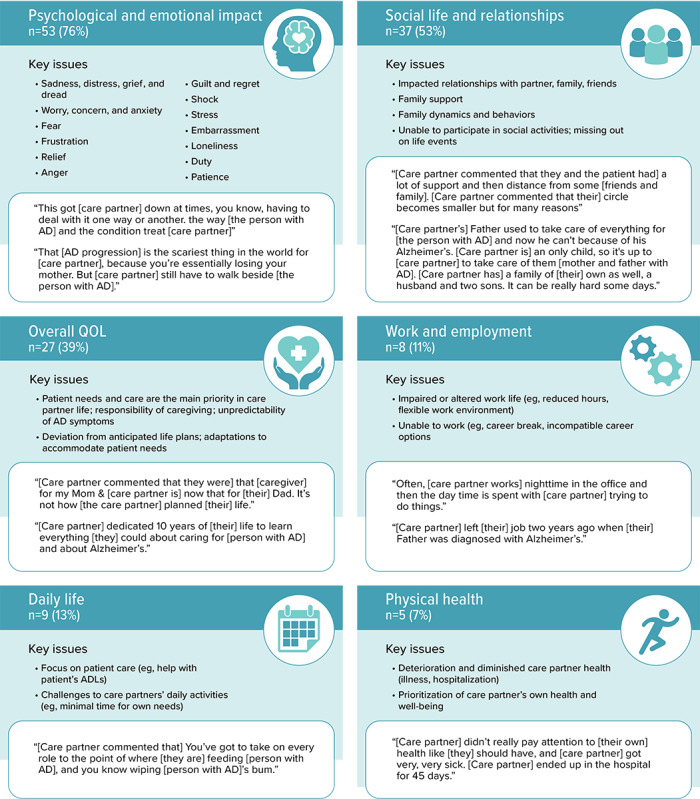
Of the 279 posts identified, 55 posts, shared by 70 contributors (4 people living with AD and 66 care partners or family members), met the review criteria. The top 3 reported or observed impacts of AD discussed by contributors were psychological and emotional well-being (53/70, 76%), social life and relationships (37/70, 53%), and care partner overall health-related quality of life (27/70, 39%). An important theme that emerged was the emotional distress and sadness (24/70, 34%) associated with the care partners' experience of "living bereavement" or "anticipatory grief." Contributors also reported impacts on care partners' daily life (9/70, 13%) and work and employment (8/70, 11%). Care partners' emotional distress was also exacerbated by loved ones' AD-related symptoms (eg, altered behavior and memory loss). Caregiving had long-term consequences for care partners, including diminished personal well-being, family and personal sacrifices, loss of employment, and unanticipated financial burdens.
Insights from social media emphasized the psychological, emotional, professional, and financial impacts on individuals providing informal care for a person with AD and the need for improved care partner support. A comprehensive understanding of care partners' experiences is needed to capture the true impact of AD.
社交媒体数据为探索阿尔茨海默病(AD)对照护者的影响提供了宝贵契机,包括对他们生活和幸福感影响最大的照护方面,以及他们对亲人治疗的优先考虑事项。
本次社交媒体综述的目的是深入了解照护AD患者的影响,尤其关注对心理和情绪幸福感、社会功能、日常生活和工作能力、与健康相关的生活质量、社会功能及人际关系的影响。
我们回顾了来自4个来源(YouTube(谷歌)、阿尔茨海默病协会、加拿大阿尔茨海默病协会和英国痴呆症协会)的社交媒体帖子,以深入了解AD对照护者的影响。纳入了2011年5月至2021年5月期间上传的讨论AD对照护者影响的英文帖子,并进行主题分析。
在确定的279篇帖子中,由70名贡献者(4名AD患者及66名照护者或家庭成员)分享的55篇帖子符合综述标准。贡献者讨论的AD最常报告或观察到的影响是心理和情绪幸福感(53/70,76%)、社交生活和人际关系(37/70,53%)以及照护者与整体健康相关的生活质量(27/70,39%)。出现的一个重要主题是与照护者“活着的丧亲之痛”或“预期性悲伤”经历相关的情绪困扰和悲伤(24/70,34%)。贡献者还报告了对照护者日常生活(9/70,13%)以及工作和就业(8/70,11%)的影响。亲人与AD相关的症状(如行为改变和记忆丧失)也加剧了照护者的情绪困扰。照护对照护者有长期影响,包括个人幸福感下降、家庭和个人牺牲、失业以及意外的经济负担。
社交媒体的见解强调了AD对为AD患者提供非正式照护的个人在心理、情绪、职业和经济方面的影响,以及改善对照护者支持的必要性。需要全面了解照护者的经历,以掌握AD的真正影响。