
居家办公时计算机工作者肌肉骨骼疼痛的变化
Changes in Musculoskeletal Pain Among Computer Workers When Working From Home.
作者信息
Casjens Swaantje, Griemsmann Stephanie, Hosbach Ingolf, Wechsler Konstantin, Weber Britta, Clarenbach Claudia, Petersen Jens, Neubauer Birger, Ellegast Rolf, Behrens Thomas
机构信息
From the Institute for Prevention and Occupational Medicine of the German Social Accident Insurance, Institute of the Ruhr University Bochum (IPA), Bochum, Germany (S.C., I.H., T.B.); Institute for Occupational Safety and Health of the German Social Accident Insurance (IFA), Sankt Augustin, Germany (S.G., K.W., B.W., R.E.); German Social Accident Insurance Institution for the Woodworking and Metalworking Industries (BGHM), Düsseldorf, Germany (C.C.); and German Social Accident Insurance Institution for the Administrative Sector (VBG), Hamburg, Germany (J.P., B.N.).
出版信息
J Occup Environ Med. 2025 May 1;67(5):363-370. doi: 10.1097/JOM.0000000000003337. Epub 2025 Feb 7.
OBJECTIVES
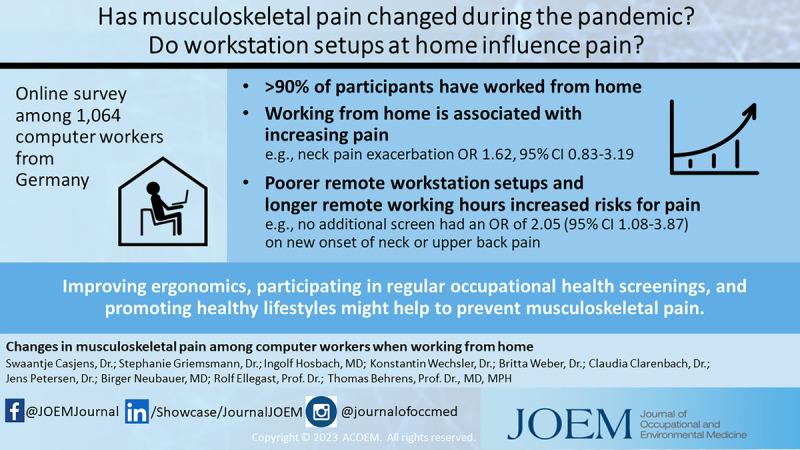
This study evaluated the impact of increased working from home on musculoskeletal pain before and after the SARS-CoV-2 pandemic.
METHODS
In an online survey (September 2023-April 2024), pain was rated on a numeric rating scale. The impact of working from home and covariates on new pain onset and exacerbation was modeled using logistic regression analyses.
RESULTS
Of 1064 participating computer workers, 968 were working from home. Working from home compared to office-only work showed a trend of increasing pain. Longer remote working hours and poorer workstation setups also increased the risks for pain (eg, new neck or upper back pain; odds ratio 2.02, 95% confidence interval 1.08-3.76).
CONCLUSIONS
Preventing musculoskeletal pain should involve improving remote workstation ergonomics, promoting healthy lifestyles, participation in regular occupational health screenings, and supporting employees with anxiety or depression symptoms.
目的
本研究评估了在严重急性呼吸综合征冠状病毒2(SARS-CoV-2)大流行前后,居家办公增加对肌肉骨骼疼痛的影响。
方法
在一项在线调查(2023年9月至2024年4月)中,疼痛采用数字评分量表进行评分。使用逻辑回归分析对居家办公及协变量对新疼痛发作和疼痛加重的影响进行建模。
结果
在1064名参与调查的计算机工作者中,968人居家办公。与仅在办公室工作相比,居家办公呈现出疼痛增加的趋势。更长的远程工作时间和较差的工作站设置也增加了疼痛风险(例如,新发颈部或上背部疼痛;比值比2.02,95%置信区间1.08 - 3.76)。
结论
预防肌肉骨骼疼痛应包括改善远程工作站人体工程学、促进健康的生活方式、参与定期职业健康筛查,以及为有焦虑或抑郁症状的员工提供支持。

 Zotero 插件