Centeno-Delphia Ruth Eunice, Long Erica A, Ellis Audrey C, Hofmann Sarah, Mosier Kara, Ulloa Noelmi, Cheng Johnnie Junior, Richards Andrew, Boerman Jacquelyn P, Koziol Jennifer, Verma Mohit S, Johnson Timothy A
Department of Animal Science, Purdue University, 270 S Russell St, West Lafayette, IN, USA.
Escuela Agrícola Panamericana Zamorano, Valle del Yeguare, Honduras.
Anim Microbiome. 2025 Feb 18;7(1):16. doi: 10.1186/s42523-025-00382-3.
Bovine respiratory disease (BRD) remains a significant health and economic problem to the dairy cattle industry. Multiple risk factors contribute to BRD susceptibility including the bacterial pathobionts Mannheimia haemolytica, Pasteurella multocida, Histophilus somni, and Mycoplasma bovis. Studies have characterized and quantified the abundance of these bacteria in the nasal cavity of cattle to infer and help disease diagnosis; nonetheless, there is still discrepancy in the results observed of when these microbes are commensal or pathogenic. Additionally, some of these studies are limited to a specific farm. The goal of this study is to compare the nasal microbiome community (diversity and composition) and the abundance of the four bacterial pathogens (by qPCR) in the nasal cavity to identify differences between dairy calves that are apparently healthy and those identified to have BRD. Nasal swabs were collected from approximately 50 apparently healthy and 50 BRD-affected calves sampled from five different dairy farms in the US (CA, IN, NY (two farms), and TX).
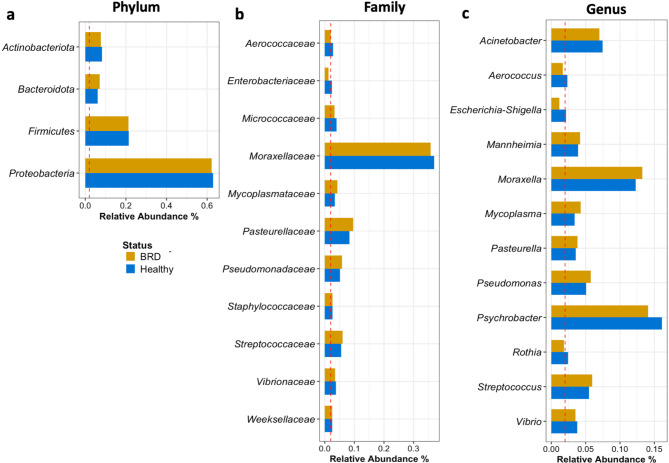
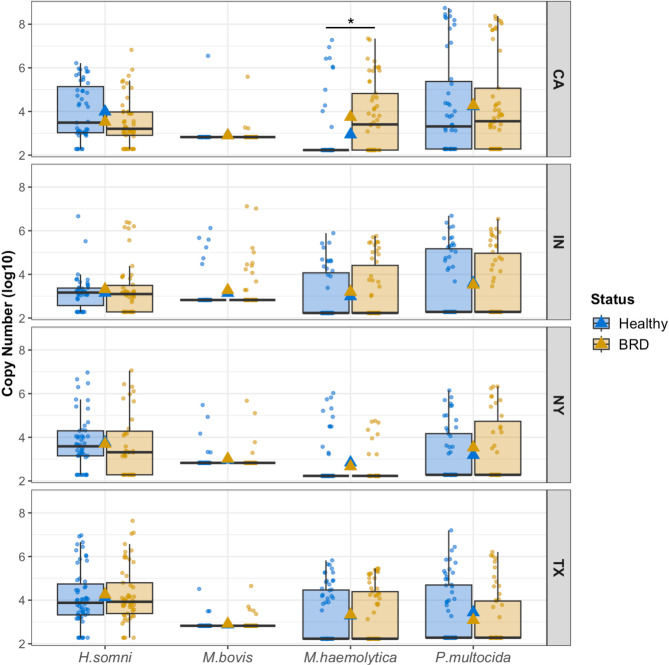
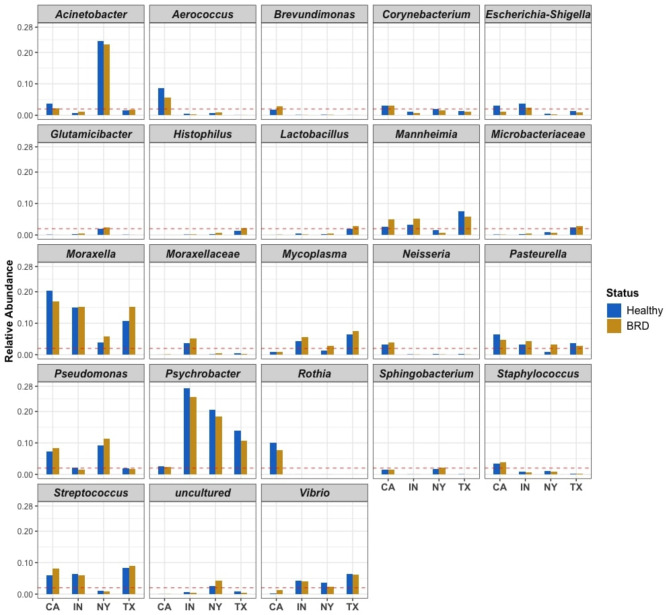
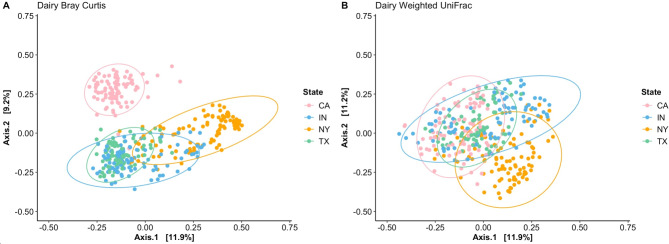
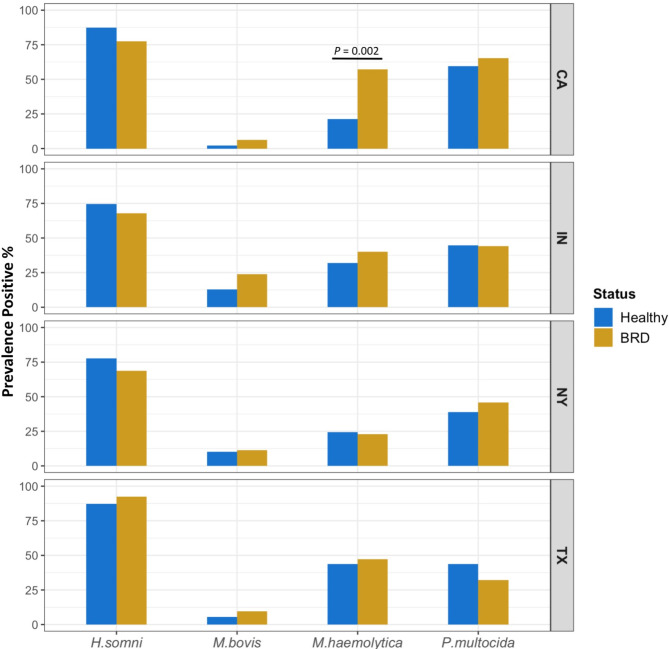
Calves diagnosed with BRD in NY, and TX had lower nasal microbiome diversity compared to the apparently healthy calves. Differences in the nasal microbiome composition were observed between the different farms predicted by Bray-Curtis and weighted UniFrac dissimilarities. Commensal and pathobiont genera Acinetobacter, Moraxella, Psychrobacter, Histophilus, Mannheimia, Mycoplasma, and Pasteurella were prevalent in the bovine nasal microbiome regardless of farm or disease status. The BRD-pathobiont H. somni was the most prevalent pathobiont among all the samples and M. bovis the least prevalent. Only in CA was the abundance of a pathobiont different according to disease status, where M. haemolytica was significantly more abundant in the BRD-affected animals than apparently healthy animals.
This study offers insight into the nasal microbiome community composition in both animals diagnosed with BRD and healthy animals, and shows that the farm effect plays a more significant role in determining the microbiome community than disease status in young dairy calves.
牛呼吸道疾病(BRD)仍然是奶牛养殖业中一个重大的健康和经济问题。多种风险因素导致牛对BRD易感,包括细菌性病原体溶血曼氏杆菌、多杀性巴氏杆菌、睡眠嗜组织菌和牛支原体。已有研究对牛鼻腔中这些细菌的丰度进行了表征和定量,以推断并辅助疾病诊断;然而,对于这些微生物何时处于共生状态或致病状态,观察结果仍存在差异。此外,其中一些研究仅限于特定农场。本研究的目的是比较鼻腔微生物群落(多样性和组成)以及鼻腔中四种细菌病原体的丰度(通过定量聚合酶链反应),以确定表面健康的奶牛犊与被诊断患有BRD的奶牛犊之间的差异。从美国五个不同奶牛场(加利福尼亚州、印第安纳州、纽约州(两个农场)和得克萨斯州)采集了约50头表面健康的奶牛犊和50头受BRD影响的奶牛犊的鼻拭子。
与表面健康的奶牛犊相比,纽约州和得克萨斯州被诊断患有BRD的奶牛犊鼻腔微生物群落多样性较低。根据Bray-Curtis和加权UniFrac差异预测,不同农场之间观察到鼻腔微生物群落组成存在差异。无论农场或疾病状态如何,共生菌和病原体属不动杆菌属、莫拉克斯氏菌属、嗜冷杆菌属、嗜组织菌属、曼氏杆菌属、支原体属和巴氏杆菌属在牛鼻腔微生物群落中普遍存在。BRD病原体睡眠嗜组织菌是所有样本中最普遍的病原体,而牛支原体最不普遍。仅在加利福尼亚州,一种病原体的丰度根据疾病状态有所不同,其中受BRD影响的动物中溶血曼氏杆菌的丰度明显高于表面健康的动物。
本研究深入了解了被诊断患有BRD的动物和健康动物的鼻腔微生物群落组成,并表明在年轻奶牛犊中,农场效应在决定微生物群落方面比疾病状态发挥着更重要的作用。