• 文献检索
  • 文档翻译
  • 深度研究
  • 学术资讯
  • Suppr Zotero 插件Zotero 插件
  • 邀请有礼
  • 套餐&价格
  • 历史记录
应用&插件
Suppr Zotero 插件Zotero 插件浏览器插件Mac 客户端Windows 客户端微信小程序
定价
高级版会员购买积分包购买API积分包
服务
文献检索文档翻译深度研究API 文档MCP 服务
关于我们
关于 Suppr公司介绍联系我们用户协议隐私条款
关注我们

Suppr 超能文献

核心技术专利:CN118964589B侵权必究
粤ICP备2023148730 号-1Suppr @ 2026

文献检索

告别复杂PubMed语法,用中文像聊天一样搜索,搜遍4000万医学文献。AI智能推荐,让科研检索更轻松。

立即免费搜索

文件翻译

保留排版,准确专业,支持PDF/Word/PPT等文件格式,支持 12+语言互译。

免费翻译文档

深度研究

AI帮你快速写综述,25分钟生成高质量综述,智能提取关键信息,辅助科研写作。

立即免费体验

偏头痛预防的行为干预措施:一项系统评价与荟萃分析。

Behavioral interventions for migraine prevention: A systematic review and meta-analysis.

作者信息

Treadwell Jonathan R, Tsou Amy Y, Rouse Benjamin, Ivlev Ilya, Fricke Julie, Buse Dawn C, Powers Scott W, Minen Mia, Szperka Christina L, Mull Nikhil K

机构信息

ECRI, Plymouth Meeting, Pennsylvania, USA.

Pacific Northwest Evidence-Based Practice Center, Portland, Oregon, USA.

出版信息

Headache. 2025 Apr;65(4):668-694. doi: 10.1111/head.14914. Epub 2025 Feb 19.

DOI:10.1111/head.14914
PMID:39968795
原文链接:https://pmc.ncbi.nlm.nih.gov/articles/PMC11951403/
Abstract

OBJECTIVES/BACKGROUND: This study was undertaken to synthesize evidence on the benefits and harms of behavioral interventions for migraine prevention in children and adults. The efficacy and safety of behavioral interventions for migraine prevention have not been tested in recent systematic reviews.

METHODS

An expert panel including clinical psychologists, neurologists, primary care physicians, researchers, funders, individuals with migraine, and their caregivers informed the scope and methods. We searched MEDLINE, Embase, PsycINFO, PubMed, the Cochrane Database of Systematic Reviews, clinicaltrials.gov, and gray literature for English-language randomized trials (January 1, 1975 to August 24, 2023) of behavioral interventions for preventing migraine attacks. Primary outcomes were migraine/headache frequency, migraine disability, and migraine-related quality of life. One reviewer extracted data and rated the risk of bias, and a second verified data for completeness and accuracy. Data were synthesized with meta-analysis when deemed appropriate, and we rated the strength of evidence (SOE) using established methods.

RESULTS

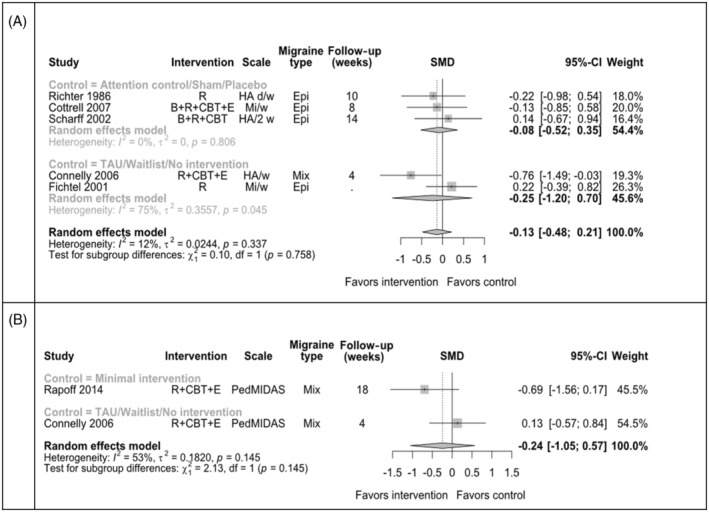
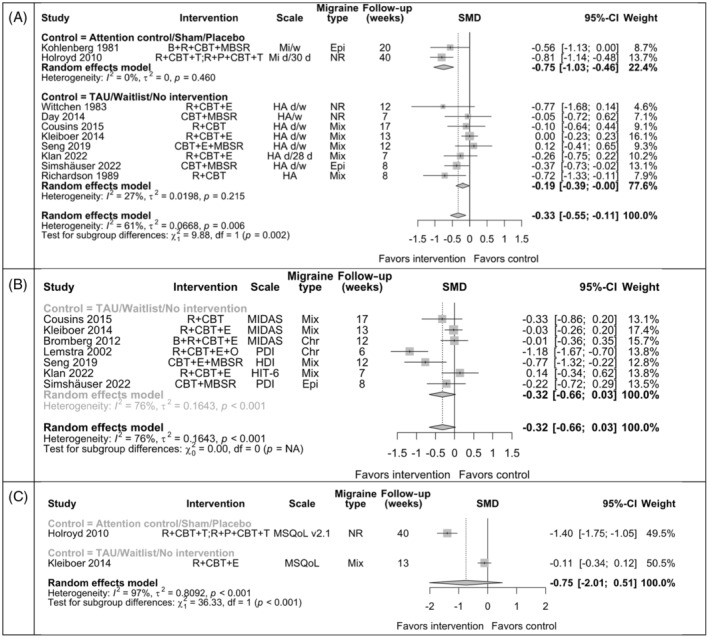
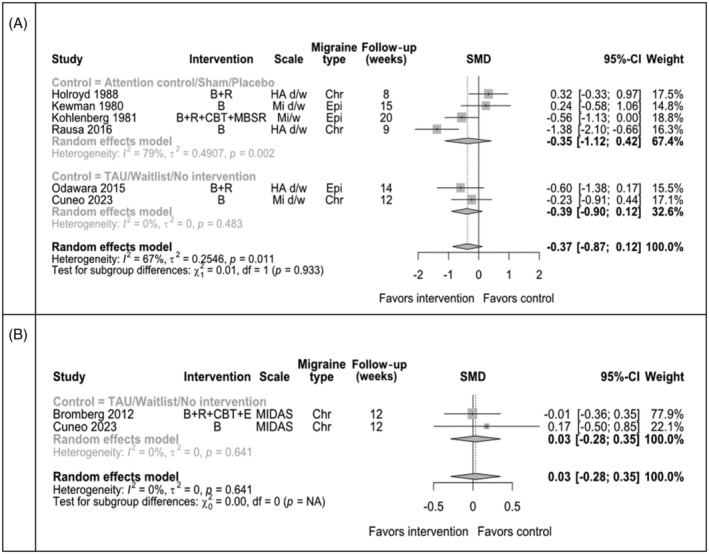
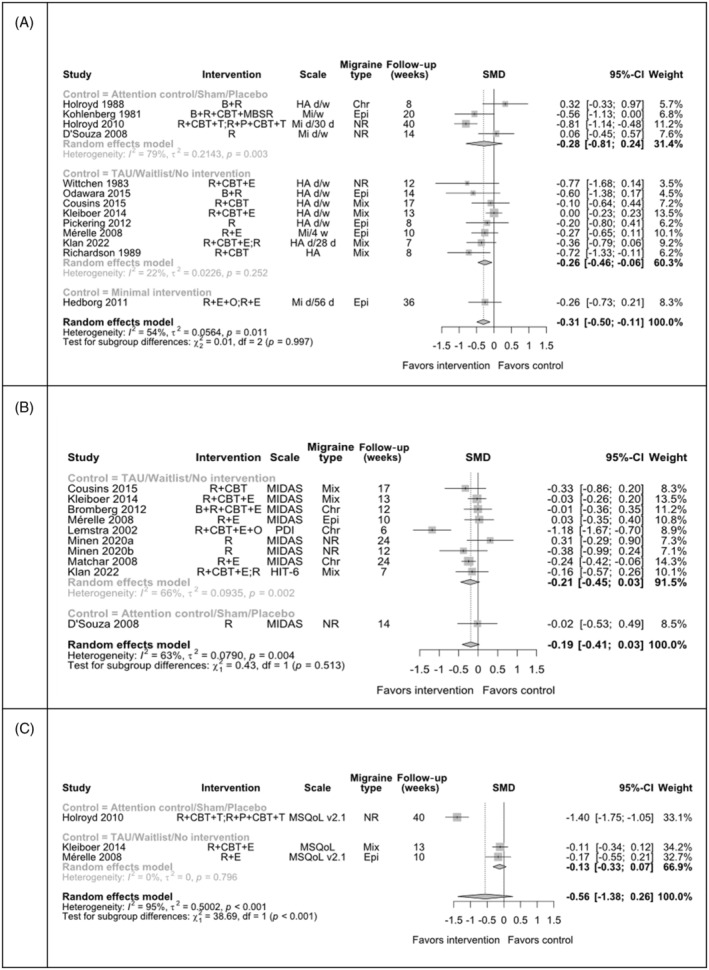
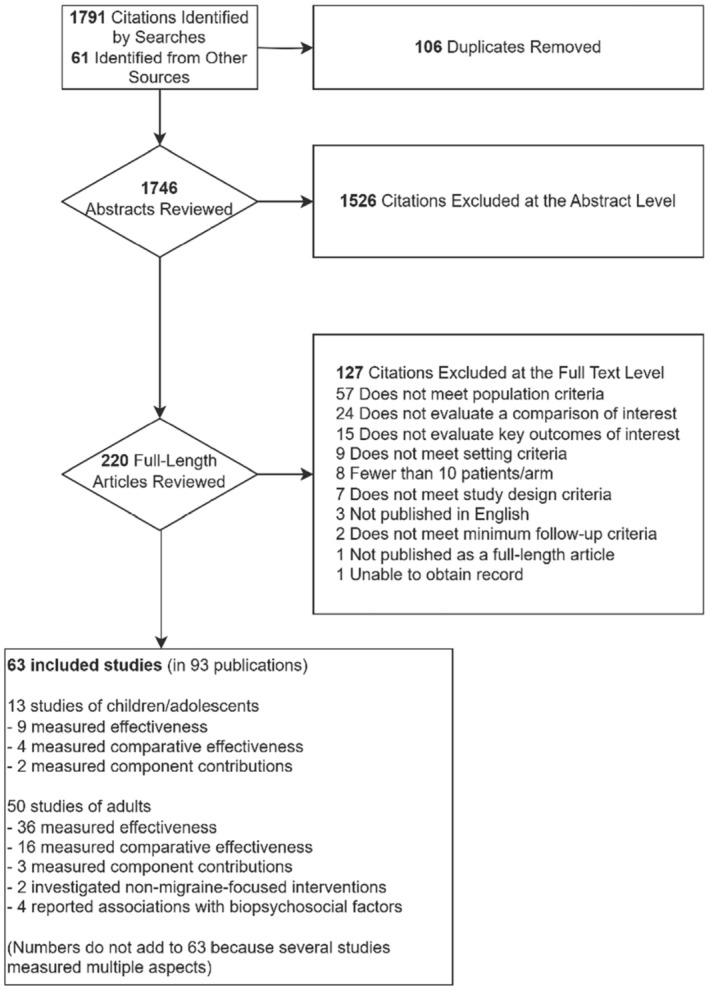
For adults, we included 50 trials (77 publications, N = 6024 adults). Most interventions were multicomponent (e.g., cognitive behavioral therapy [CBT], biofeedback, relaxation training, mindfulness-based therapies, and/or education). Most trials were at high risk of bias, primarily due to possible measurement bias and incomplete data. For adults, we found that any of three components (CBT, relaxation training, mindfulness-based therapies) may reduce migraine/headache attack frequency (SOE: low). Education alone that targets behavior may improve migraine-related disability (SOE: low). For three other interventions (biofeedback, acceptance and commitment therapy, and hypnotherapy), evidence was insufficient to permit conclusions. We also found that mindfulness-based therapies may reduce migraine disability more than education, and relaxation + education may improve migraine-related quality of life more than propranolol (SOE: low). For children/adolescents, we included 13 trials (16 publications, N = 1444 children), but the evidence was only sufficient to conclude that CBT + biofeedback + relaxation training may reduce migraine attack frequency and disability more than education alone (SOE: low).

CONCLUSION

Results suggest that for adults, CBT, relaxation training, and mindfulness-based therapies may each reduce the frequency of migraine/headache attacks, and education alone may reduce disability. For children/adolescents, CBT + biofeedback + relaxation training may reduce migraine attack frequency and disability more than education alone. Evidence consisted primarily of underpowered trials of multicomponent interventions compared with various types of control groups. Limitations include semantic inconsistencies in the literature since 1975, differential usage of treatment components, expectation effects for subjectively reported outcomes, incomplete data, and unclear dosing effects. Future research should enroll children and adolescents, standardize intervention components when possible to improve reproducibility, consider smart study designs and personalized therapies based on individual characteristics, use comparison groups that control for expectation, which is a known challenge in behavioral trials, enroll and retain larger samples, study emerging digital and telehealth modes of care delivery, improve the completeness of data collection, and establish or update clinical trial conduct and reporting guidelines that are appropriate for the conduct of studies of behavioral therapies.

摘要

目的/背景:本研究旨在综合关于儿童和成人偏头痛预防行为干预的益处和危害的证据。行为干预预防偏头痛的有效性和安全性在最近的系统评价中尚未得到检验。

方法

一个由临床心理学家、神经科医生、初级保健医生、研究人员、资助者、偏头痛患者及其护理人员组成的专家小组确定了研究范围和方法。我们在MEDLINE、Embase、PsycINFO、PubMed、Cochrane系统评价数据库、clinicaltrials.gov以及灰色文献中检索了1975年1月1日至2023年8月24日期间关于预防偏头痛发作行为干预的英文随机试验。主要结局包括偏头痛/头痛频率、偏头痛残疾程度以及与偏头痛相关的生活质量。一名评审员提取数据并评估偏倚风险,另一名评审员核实数据的完整性和准确性。在认为适当时,采用荟萃分析对数据进行综合,并使用既定方法评估证据强度(SOE)。

结果

对于成人,我们纳入了50项试验(77篇出版物,N = 6024名成人)。大多数干预措施是多成分的(例如,认知行为疗法[CBT]、生物反馈、放松训练、正念疗法和/或教育)。大多数试验存在较高的偏倚风险,主要是由于可能的测量偏倚和数据不完整。对于成人,我们发现三种成分(CBT、放松训练、正念疗法)中的任何一种都可能降低偏头痛/头痛发作频率(SOE:低)。仅针对行为的教育可能改善与偏头痛相关的残疾程度(SOE:低)。对于其他三种干预措施(生物反馈、接受与承诺疗法和催眠疗法),证据不足以得出结论。我们还发现,正念疗法可能比教育更能降低偏头痛残疾程度,放松训练 + 教育可能比普萘洛尔更能改善与偏头痛相关的生活质量(SOE:低)。对于儿童/青少年,我们纳入了13项试验(16篇出版物,N = 1444名儿童),但证据仅足以得出结论:CBT + 生物反馈 + 放松训练可能比单纯教育更能降低偏头痛发作频率和残疾程度(SOE:低)。

结论

结果表明,对于成人,CBT、放松训练和正念疗法可能各自降低偏头痛/头痛发作频率,仅教育可能降低残疾程度。对于儿童/青少年,CBT + 生物反馈 + 放松训练可能比单纯教育更能降低偏头痛发作频率和残疾程度。证据主要由与各种类型对照组相比的多成分干预的效能不足的试验组成。局限性包括自1975年以来文献中的语义不一致、治疗成分的不同用法、主观报告结局的期望效应、数据不完整以及剂量效应不明确。未来的研究应纳入儿童和青少年,尽可能标准化干预成分以提高可重复性,考虑基于个体特征的智能研究设计和个性化疗法,使用控制期望的对照组(这是行为试验中一个已知的挑战),纳入并保留更大的样本,研究新兴的数字和远程医疗护理模式,提高数据收集的完整性,并建立或更新适合行为疗法研究开展的临床试验实施和报告指南。
https://cdn.ncbi.nlm.nih.gov/pmc/blobs/aaec/11951403/d88f6071b112/HEAD-65-668-g004.jpg
https://cdn.ncbi.nlm.nih.gov/pmc/blobs/aaec/11951403/e5bb42492744/HEAD-65-668-g005.jpg
https://cdn.ncbi.nlm.nih.gov/pmc/blobs/aaec/11951403/24d6ffc29ea1/HEAD-65-668-g002.jpg
https://cdn.ncbi.nlm.nih.gov/pmc/blobs/aaec/11951403/b4c1c5519d97/HEAD-65-668-g001.jpg
https://cdn.ncbi.nlm.nih.gov/pmc/blobs/aaec/11951403/bcf8dd3956c1/HEAD-65-668-g003.jpg
https://cdn.ncbi.nlm.nih.gov/pmc/blobs/aaec/11951403/9ccc6258c9b4/HEAD-65-668-g006.jpg
https://cdn.ncbi.nlm.nih.gov/pmc/blobs/aaec/11951403/11ad6ee300b2/HEAD-65-668-g008.jpg
https://cdn.ncbi.nlm.nih.gov/pmc/blobs/aaec/11951403/b6f8ef5baebd/HEAD-65-668-g007.jpg
https://cdn.ncbi.nlm.nih.gov/pmc/blobs/aaec/11951403/d88f6071b112/HEAD-65-668-g004.jpg
https://cdn.ncbi.nlm.nih.gov/pmc/blobs/aaec/11951403/e5bb42492744/HEAD-65-668-g005.jpg
https://cdn.ncbi.nlm.nih.gov/pmc/blobs/aaec/11951403/24d6ffc29ea1/HEAD-65-668-g002.jpg
https://cdn.ncbi.nlm.nih.gov/pmc/blobs/aaec/11951403/b4c1c5519d97/HEAD-65-668-g001.jpg
https://cdn.ncbi.nlm.nih.gov/pmc/blobs/aaec/11951403/bcf8dd3956c1/HEAD-65-668-g003.jpg
https://cdn.ncbi.nlm.nih.gov/pmc/blobs/aaec/11951403/9ccc6258c9b4/HEAD-65-668-g006.jpg
https://cdn.ncbi.nlm.nih.gov/pmc/blobs/aaec/11951403/11ad6ee300b2/HEAD-65-668-g008.jpg
https://cdn.ncbi.nlm.nih.gov/pmc/blobs/aaec/11951403/b6f8ef5baebd/HEAD-65-668-g007.jpg
https://cdn.ncbi.nlm.nih.gov/pmc/blobs/aaec/11951403/d88f6071b112/HEAD-65-668-g004.jpg

相似文献

1
Behavioral interventions for migraine prevention: A systematic review and meta-analysis.偏头痛预防的行为干预措施:一项系统评价与荟萃分析。
Headache. 2025 Apr;65(4):668-694. doi: 10.1111/head.14914. Epub 2025 Feb 19.
2
Falls prevention interventions for community-dwelling older adults: systematic review and meta-analysis of benefits, harms, and patient values and preferences.社区居住的老年人跌倒预防干预措施:系统评价和荟萃分析的益处、危害以及患者的价值观和偏好。
Syst Rev. 2024 Nov 26;13(1):289. doi: 10.1186/s13643-024-02681-3.
3
4
Drugs for preventing postoperative nausea and vomiting in adults after general anaesthesia: a network meta-analysis.成人全身麻醉后预防术后恶心呕吐的药物:网状Meta分析
Cochrane Database Syst Rev. 2020 Oct 19;10(10):CD012859. doi: 10.1002/14651858.CD012859.pub2.
5
E-Health interventions for anxiety and depression in children and adolescents with long-term physical conditions.针对患有长期身体疾病的儿童和青少年焦虑与抑郁的电子健康干预措施。
Cochrane Database Syst Rev. 2018 Aug 15;8(8):CD012489. doi: 10.1002/14651858.CD012489.pub2.
6
Non-pharmacological interventions for somatoform disorders and medically unexplained physical symptoms (MUPS) in adults.成人躯体形式障碍和医学无法解释的身体症状(MUPS)的非药物干预措施。
Cochrane Database Syst Rev. 2014 Nov 1;2014(11):CD011142. doi: 10.1002/14651858.CD011142.pub2.
7
Botulinum toxins for the prevention of migraine in adults.用于预防成人偏头痛的肉毒杆菌毒素。
Cochrane Database Syst Rev. 2018 Jun 25;6(6):CD011616. doi: 10.1002/14651858.CD011616.pub2.
8
Psychological therapies for temporomandibular disorders (TMDs).心理疗法治疗颞下颌关节紊乱病(TMDs)。
Cochrane Database Syst Rev. 2022 Aug 11;8(8):CD013515. doi: 10.1002/14651858.CD013515.pub2.
9
Behavioural and cognitive-behavioural interventions for outwardly-directed aggressive behaviour in people with intellectual disabilities.针对智力残疾者外向攻击行为的行为和认知行为干预措施。
Cochrane Database Syst Rev. 2015 Apr 7;2015(4):CD003406. doi: 10.1002/14651858.CD003406.pub4.
10
Psychological therapies for the management of chronic and recurrent pain in children and adolescents.用于治疗儿童和青少年慢性复发性疼痛的心理疗法。
Cochrane Database Syst Rev. 2018 Sep 29;9(9):CD003968. doi: 10.1002/14651858.CD003968.pub5.

引用本文的文献

1
From Headache to Heart Health: Investigating the Migraine-Cardiovascular Disease Connection.从头痛到心脏健康:探究偏头痛与心血管疾病的关联。
Neurol Ther. 2025 Jun 20. doi: 10.1007/s40120-025-00785-z.

本文引用的文献

1
The Utility of a Novel, Combined Biofeedback-Virtual Reality Device as Add-on Treatment for Chronic Migraine: A Randomized Pilot Study.新型组合生物反馈-虚拟现实设备作为慢性偏头痛附加治疗的效用:一项随机先导研究。
Clin J Pain. 2023 Jun 1;39(6):286-296. doi: 10.1097/AJP.0000000000001114.
2
Supportive Self-Management Program for People With Chronic Headaches and Migraine: A Randomized Controlled Trial and Economic Evaluation.慢性头痛和偏头痛患者的支持性自我管理计划:一项随机对照试验和经济评估。
Neurology. 2023 Mar 28;100(13):e1339-e1352. doi: 10.1212/WNL.0000000000201518. Epub 2022 Dec 16.
3
Efficacy of Cognitive-Behavioral Therapy for the Prophylaxis of Migraine in Adults: A Three-Armed Randomized Controlled Trial.
认知行为疗法对成人偏头痛预防的疗效:一项三臂随机对照试验
Front Neurol. 2022 Apr 28;13:852616. doi: 10.3389/fneur.2022.852616. eCollection 2022.
4
Mindfulness-Based Cognitive Therapy as Migraine Intervention: a Randomized Waitlist Controlled Trial.基于正念认知疗法的偏头痛干预:一项随机等待期对照试验。
Int J Behav Med. 2022 Oct;29(5):597-609. doi: 10.1007/s12529-021-10044-8. Epub 2021 Dec 21.
5
The American Headache Society Consensus Statement: Update on integrating new migraine treatments into clinical practice.美国头痛协会共识声明:关于将新的偏头痛治疗方法纳入临床实践的更新
Headache. 2022 Jan;62(1):111-112. doi: 10.1111/head.14245. Epub 2021 Dec 7.
6
The American Headache Society Consensus Statement: Update on integrating new migraine treatments into clinical practice.美国头痛学会共识声明:更新将新的偏头痛治疗方法整合到临床实践中的建议。
Headache. 2021 Jul;61(7):1021-1039. doi: 10.1111/head.14153. Epub 2021 Jun 23.
7
Acceptance and commitment therapy for high frequency episodic migraine without aura: Findings from a randomized pilot investigation.接受和承诺疗法治疗高频发作无先兆偏头痛的随机试验研究结果。
Headache. 2021 Jun;61(6):895-905. doi: 10.1111/head.14139. Epub 2021 Jun 11.
8
Heartrate variability biofeedback for migraine using a smartphone application and sensor: A randomized controlled trial.使用智能手机应用程序和传感器的偏头痛心率变异性生物反馈:一项随机对照试验。
Gen Hosp Psychiatry. 2021 Mar-Apr;69:41-49. doi: 10.1016/j.genhosppsych.2020.12.008. Epub 2021 Jan 7.
9
Effectiveness of Mindfulness Meditation vs Headache Education for Adults With Migraine: A Randomized Clinical Trial.正念冥想与头痛教育对偏头痛成人有效性的随机临床试验。
JAMA Intern Med. 2021 Mar 1;181(3):317-328. doi: 10.1001/jamainternmed.2020.7090.
10
Migraine remains second among the world's causes of disability, and first among young women: findings from GBD2019.偏头痛仍是全球致残原因中的第二位,在年轻女性中则位居首位:全球疾病负担研究2019的结果。
J Headache Pain. 2020 Dec 2;21(1):137. doi: 10.1186/s10194-020-01208-0.