Rao Jin-Hui, Zhang Wen-Da, Zha Cheng-Peng, Zhang Min-Yue, Xing Yu-Jie, Wang Zai-Hui, Yu Jun-Xian, He Dong-Yan, Sun Chuan-Zheng, Li Lei
Department of Head and Neck Surgery Section II, The Yunnan Cancer Hospital, Third Affiliated Hospital of Kunming Medical University, 519 Kunzhou Road, Kunming, 650118, China.
Discov Oncol. 2025 Feb 19;16(1):202. doi: 10.1007/s12672-025-01983-9.
Although previous observational studies have highlighted a possible association between the gut microbiota (GM) and head and neck cancer (HNC), the causal relationships remain unclear, particularly regarding the role of plasma proteins as potential mediators. Clarifying these connections is essential for uncovering the underlying mechanisms of HNC progression and may lead to new therapeutic strategies.
First, we examined the causal link between the GM and HNC via a two-sample Mendelian randomization (MR) approach. We then investigated the causative relationships between plasma proteins and HNC via the same two-sample MR technique. The coefficient product approach was then used to clarify the role of plasma proteins in the causative pathway between the GM and HNC. Finally, sensitivity investigations were performed to assess the robustness and coherence of the results.
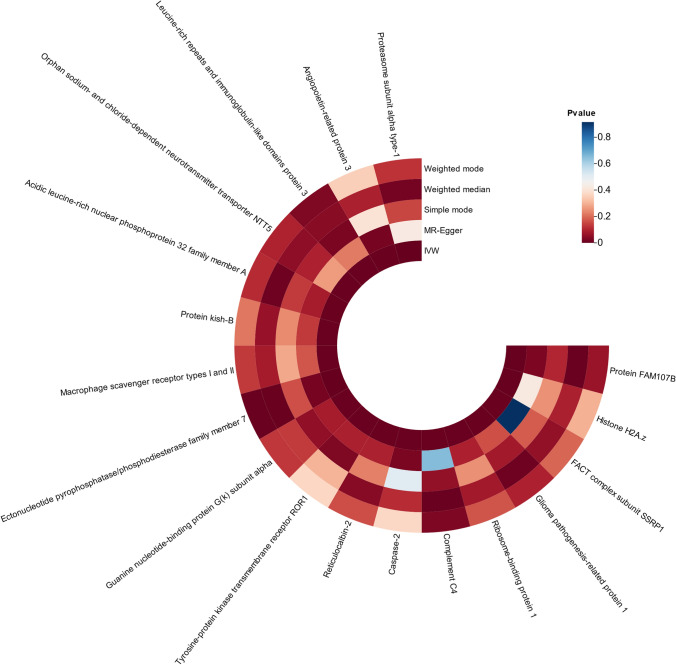
MR analyses revealed the protective effects of one family and six genera on HNC (Lachnospiraceae, Parabacteroides, Phascolarctobacterium, Alistipes, Sutterella, Roseburia and Alloprevotella). In contrast, three genera (Ruminococcus, Prevotella and Bacteroides) were significantly positively associated with HNC risk. Through further examination, researchers discovered 18 plasma proteins that have a causal relationship with HNC. Notably, the mediation MR illustrated that the causal protective effect of OTU97_86 (Phascolarctobacterium) on HNC (total effect IVW: OR = 0.879, 95% = 0.810-0.954, p = 0.002) was mediated by Proteasome subunit alpha type-1 (PSMA1) (- 0.020, 95% CI = - 0.039 ~ - 0.001, p = 0.036), accounting for 15.25% of the total effect. Similarly, the causal effect of OTU99_35 (Ruminococcus) on HNC risk (total effect IVW: OR = 1.109, 95% CI = 1.027-1.198, p = 0.008) was mediated by the protein FAM107B (0.015, 95% CI = 0.001-0.029, p = 0.031), accounting for 14.69% of the total effect.
MR and mediation analysis revealed that specific GMs influence HNC risk through plasma proteins: Phascolarctobacterium protects against HNC via PSMA1, whereas Ruminococcus increases HNC risk through FAM107B. These pathways suggest that Phascolarctobacterium is a potential preventative factor and that Ruminococcus is a risk factor. This highlights the possibility of using specific GM and plasma proteins as biomarkers or therapeutic targets for HNC prevention, diagnosis, and treatment.
尽管先前的观察性研究强调了肠道微生物群(GM)与头颈癌(HNC)之间可能存在关联,但因果关系仍不明确,尤其是血浆蛋白作为潜在介导因子的作用。阐明这些联系对于揭示HNC进展的潜在机制至关重要,并且可能会带来新的治疗策略。
首先,我们通过两样本孟德尔随机化(MR)方法研究了GM与HNC之间的因果关系。然后,我们通过相同的两样本MR技术研究了血浆蛋白与HNC之间的因果关系。接着使用系数乘积法来阐明血浆蛋白在GM与HNC之间的因果途径中的作用。最后,进行敏感性研究以评估结果的稳健性和一致性。
MR分析揭示了一个科和六个属对HNC具有保护作用(毛螺菌科、副拟杆菌属、考拉杆菌属、嗜胆菌属、萨特氏菌属、罗斯氏菌属和别样普雷沃氏菌属)。相比之下,三个属(瘤胃球菌属、普雷沃氏菌属和拟杆菌属)与HNC风险显著正相关。通过进一步研究,研究人员发现了18种与HNC存在因果关系的血浆蛋白。值得注意的是,中介MR表明OTU97_86(考拉杆菌属)对HNC的因果保护作用(总效应逆方差加权法:OR = 0.879,95% = 0.810 - 0.954,p = 0.002)由蛋白酶体α亚基1型(PSMA1)介导(-0.020,95%可信区间 = -0.039 ~ -0.001,p = 0.036),占总效应的15.25%。同样,OTU99_35(瘤胃球菌属)对HNC风险的因果效应(总效应逆方差加权法:OR = 1.109,95%可信区间 = 1.027 - 1.198,p = 0.008)由蛋白FAM107B介导(= 0.015, 95%可信区间 = 0.001 - 0.029,p = 0.031),占总效应的14.69%。
MR和中介分析表明,特定的GM通过血浆蛋白影响HNC风险:考拉杆菌属通过PSMA1预防HNC,而瘤胃球菌属通过FAM10