Doyle Alenka, Volkova Kamilla, Crotty Nicholas, Massa Nicole, Grubb Michael A
Trinity College, Hartford, CT, USA.
Mass General Brigham, Boston, MA, USA.
Atten Percept Psychophys. 2025 Apr;87(3):721-727. doi: 10.3758/s13414-024-03008-z. Epub 2025 Feb 19.
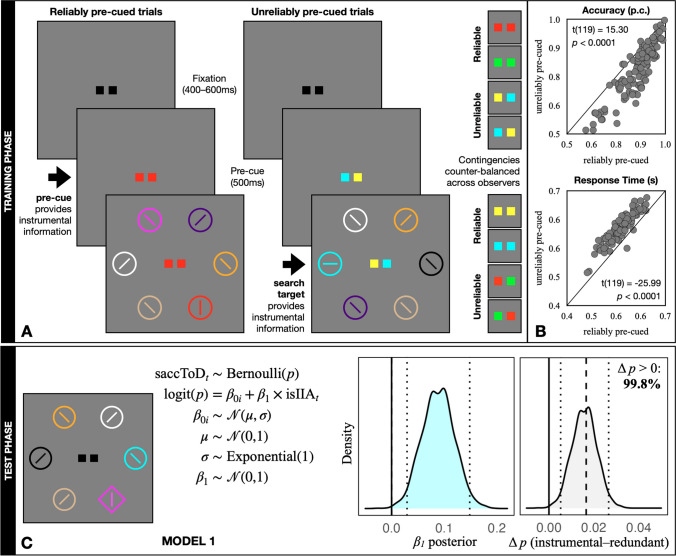
Visual attention, the selective prioritization of sensory information, is crucial in dynamic, information-rich environments. That both internal goals and external salience modulate the allocation of attention is well established. However, recent empirical work has found instances of experience-driven attention, wherein task-irrelevant, physically non-salient stimuli reflexively capture attention in ways that are contingent on an observer's unique history. The prototypical example of experience-driven attention relies on a history of reward associations, with evidence attributing the phenomenon to reward-prediction errors. However, a mechanistic account, differing from the reward-prediction error hypothesis, is needed to explain how, in the absence of monetary reward, a history of target-seeking leads to attentional capture. Here we propose that what drives attentional capture in such cases is not target-seeking, but an association with instrumental information. To test this hypothesis, we used pre-cues to render the information provided by a search target either instrumental or redundant. We found that task-irrelevant, physically non-salient distractors associated with instrumental information were more likely to draw eye movements (a sensitive metric of information sampling) than were distractors associated with redundant information. Furthermore, saccading to an instrumental-information-associated distractor led to a greater behavioral cost: response times were slowed more severely. Crucially, the distractors had equivalent histories as sought targets, so any attentional differences between them must be due to different information histories resulting from our experimental manipulation. These findings provide strong evidence for the information history hypothesis and offer a method for exploring the neural signature of information-driven attentional capture.
视觉注意力,即对感官信息的选择性优先处理,在动态、信息丰富的环境中至关重要。内部目标和外部显著性都会调节注意力的分配,这一点已得到充分证实。然而,最近的实证研究发现了经验驱动型注意力的实例,即任务无关、物理上不显著的刺激会以取决于观察者独特经历的方式反射性地吸引注意力。经验驱动型注意力的典型例子依赖于奖励关联的历史,有证据将这种现象归因于奖励预测误差。然而,需要一种与奖励预测误差假设不同的机制性解释,来解释在没有金钱奖励的情况下,寻找目标的历史如何导致注意力被吸引。在这里,我们提出,在这种情况下驱动注意力被吸引的不是寻找目标,而是与工具性信息的关联。为了验证这一假设,我们使用预线索使搜索目标提供的信息要么具有工具性,要么是冗余的。我们发现,与工具性信息相关的任务无关、物理上不显著的干扰物比与冗余信息相关的干扰物更有可能吸引眼球运动(信息采样的一个敏感指标)。此外,扫视与工具性信息相关的干扰物会导致更大的行为成本:反应时间会更严重地减慢。至关重要的是,干扰物与被寻找目标的经历相同,所以它们之间的任何注意力差异都必须归因于我们实验操作产生的不同信息历史。这些发现为信息历史假设提供了有力证据,并提供了一种探索信息驱动型注意力吸引的神经特征的方法。