Schramm Elisabeth, Elsaesser Moritz, Zehender Nadine, Reif Andreas, Lahmann Claas, Feuchtinger Manon, Deuschle Michael, Kahl Kai, Hillert Andreas, Thiel Nicola, Piosczyk Hannah, Mack Simon, Bausch Johannes, Graf Erika
Department of Psychiatry and Psychotherapy, Medical Center - University of Freiburg, Faculty of Medicine, University of Freiburg, Freiburg, Germany.
Department of Psychiatry, Psychosomatic Medicine and Psychotherapy, University Hospital Frankfurt-Goethe University, Frankfurt, Germany.
BMC Psychiatry. 2025 Feb 19;25(1):149. doi: 10.1186/s12888-025-06594-w.
Depression associated with occupational stress is highly prevalent, causing high rates of sick leave and thus posing significant societal and economic burden. Meta-analyses of the few studies on psychological and work-focused interventions for common mental disorders including depression report small effects on depressive symptomatology and occupational outcomes. There is an urgent need for more controlled studies on work-directed interventions assessing work outcomes.
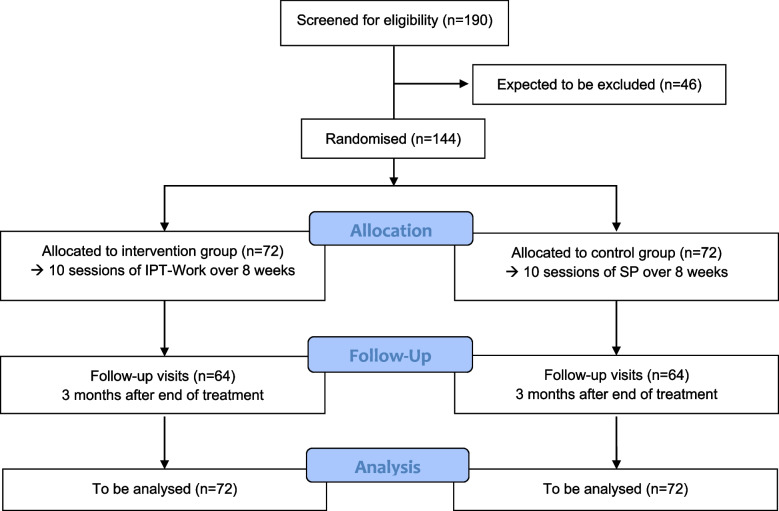
This is an interventional, multicentre, active-controlled, cluster-randomised, observer-blinded clinical trial with two parallel groups conducted in 6 clinical centres throughout Germany over the course of 3 years. A sample of 144 outpatients with work stress related depression will be cluster-randomised to either a specific interpersonal group intervention for depression and work stress (IPT-Work) or a nonspecific supportive group psychotherapy (SP). Each group consists of 10 sessions over 8 weeks of 90 min duration with 4-6 participants. Patients will be assessed at baseline, post-treatment and at 3 months follow-up. The primary endpoint is the relative change in HRSD-24 score from baseline to follow-up 3 months after end of treatment. Secondary outcome measures include the Occupational Depression Inventory (ODI), the Work Ability Index (WAI), the Return to Work Attitude (RTW-SE), the Effort-Reward-Imbalance (ERI), the Job Content Questionnaire 2 (JCQ2), and the Connor-Davidson Resilience Scale (CD-RISC). In addition, Quality of Life (WHOQOL-BREF) and days of sick leave throughout the study period will be assessed. Effects of treatment will be analysed with a linear mixed model for repeated measures including randomised arm, time point and their interaction as well as HRSD-24 baseline scores and their interaction with time point as fixed effects.
Results will provide a comparison of a nonwork-directed psychological intervention and a specific, work-directed approach with respect to symptom improvement and increase in work ability. The aim is to improve quality of mental health care for depressed employees to facilitate recovery, improve work ability, and reduce the risk of long-term occupational incapacity. Ultimately, findings will inform the practice of the efficiency of using psychological group treatment in depressed individuals with work stress.
German Clinical Trials Register (DRKS00035259); prospectively registered on 15th January 2025.
与职业压力相关的抑郁症非常普遍,导致高病假率,从而带来巨大的社会和经济负担。对包括抑郁症在内的常见精神障碍的心理和以工作为重点的干预措施的少数研究进行的荟萃分析报告称,对抑郁症状和职业结果的影响较小。迫切需要对评估工作结果的工作导向干预措施进行更多对照研究。
这是一项在德国6个临床中心进行的为期3年的干预性、多中心、积极对照、整群随机、观察者盲法的临床试验,有两个平行组。144名与工作压力相关抑郁症的门诊患者样本将被整群随机分为抑郁症和工作压力的特定人际小组干预(IPT-Work)或非特定支持性小组心理治疗(SP)。每组在8周内进行10次,每次90分钟,每组4-6名参与者。患者将在基线、治疗后和3个月随访时进行评估。主要终点是治疗结束后3个月随访时HRSD-24评分相对于基线的相对变化。次要结局指标包括职业抑郁量表(ODI)、工作能力指数(WAI)、重返工作态度(RTW-SE)、努力-回报失衡(ERI)、工作内容问卷2(JCQ2)和康纳-戴维森复原力量表(CD-RISC)。此外,将评估生活质量(WHOQOL-BREF)和整个研究期间的病假天数。治疗效果将采用重复测量的线性混合模型进行分析,包括随机分组、时间点及其交互作用,以及HRSD-24基线评分及其与时间点的交互作用作为固定效应。
结果将提供非工作导向心理干预和特定工作导向方法在症状改善和工作能力提高方面的比较。目的是改善抑郁症员工的心理健康护理质量,以促进康复、提高工作能力并降低长期职业失能的风险。最终,研究结果将为在有工作压力的抑郁症患者中使用心理小组治疗的效率提供实践依据。
德国临床试验注册中心(DRKS00035259);于2025年1月15日进行前瞻性注册。