
通过实验和网络药理学研究探索葵花籽油抗阿尔茨海默病的机制。
Exploring the mechanism of sunflower seed oil against Alzheimer's disease through experimental and network pharmacology studies.
作者信息
Desai Yashodhan, Karunakaran Deepak, Singh Juhi, Noronha Alric Raul, Poojary Gagan, Chettri Bijaya, Shenoy Rekha, Nampoothiri Madhavan, Bojja Sree Lalitha
机构信息
Department of Pharmacology, Manipal College of Pharmaceutical Sciences, Manipal Academy of Higher Education, Manipal, Karnataka, India.
出版信息
Indian J Pharmacol. 2024 Nov 1;56(6):396-404. doi: 10.4103/ijp.ijp_761_23. Epub 2025 Feb 19.
OBJECTIVES
With the prevalence of Alzheimer's disease (AD) increasing exponentially, there has been a shift in the focus of drug discovery for AD from treating the symptoms to preventing the development of the disease. Several natural compounds are extensively studied as neuroprotectives in preventing disease progression. Helianthus annuus seed oil (HA) is widely used as cooking oil and is abundant in antioxidant activity. Therefore, we evaluated the effect of HA in mice model of scopolamine-induced amnesia and explored the potential underlying mechanisms.
METHODS
Twenty-four male mice were administered orally with either distilled water (control and scopolamine groups) or treatment groups (HA 100 and HA 200 mg/kg) for 8 consecutive days. All groups, except the control group, received an intraperitoneal injection of scopolamine at a dose of 1 mg/kg. Subsequently, novel object recognition task for cognition assessment and open field tests for locomotory activity were performed. In addition, network analysis was performed to identify the key bioactives and targets of HA against AD. Further, the binding affinity of HA bioactives to the key targets was verified by molecular docking analysis.
RESULTS
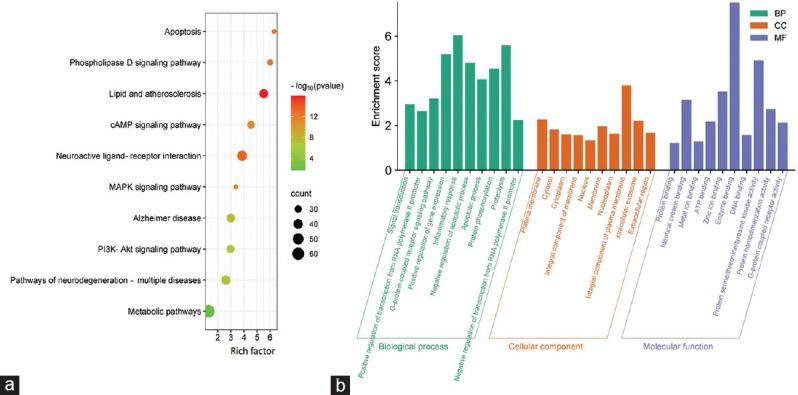
HA (100 mg/kg and 200 mg/kg) significantly ameliorated recognition memory compared to the scopolamine group, suggesting the protective effect of HA against cognitive impairment. Network analysis indicated that the key bioactives of HA, chlorogenic acid, and oleic acid act through multiple targets and pathways, particularly the mitogen-activated protein kinase (MAPK) pathway, to ameliorate AD symptoms. Importantly, chlorogenic acid showed good binding affinity with MAPKs, TP53, and EP300.
CONCLUSION
HA has therapeutic benefits in AD acting through the MAPK pathway. However, further studies need to be done to confirm the results derived and translate the potential use of HA as a dietary supplement for preventing AD.
目的
随着阿尔茨海默病(AD)患病率呈指数级增长,AD药物研发的重点已从治疗症状转向预防疾病发展。几种天然化合物作为神经保护剂在预防疾病进展方面得到了广泛研究。向日葵籽油(HA)被广泛用作食用油,且具有丰富的抗氧化活性。因此,我们评估了HA在东莨菪碱诱导的小鼠失忆模型中的作用,并探讨了其潜在的作用机制。
方法
24只雄性小鼠连续8天口服蒸馏水(对照组和东莨菪碱组)或治疗组(HA 100和HA 200 mg/kg)。除对照组外,所有组均腹腔注射1 mg/kg剂量的东莨菪碱。随后,进行用于认知评估的新物体识别任务和用于运动活动的旷场试验。此外,进行网络分析以确定HA抗AD的关键生物活性成分和靶点。进一步通过分子对接分析验证HA生物活性成分与关键靶点的结合亲和力。
结果
与东莨菪碱组相比,HA(100 mg/kg和200 mg/kg)显著改善了识别记忆,表明HA对认知障碍具有保护作用。网络分析表明,HA的关键生物活性成分绿原酸和油酸通过多个靶点和途径发挥作用,特别是丝裂原活化蛋白激酶(MAPK)途径,以改善AD症状。重要的是,绿原酸与MAPKs、TP53和EP300表现出良好的结合亲和力。
结论
HA通过MAPK途径对AD具有治疗作用。然而,需要进一步研究以证实所得结果,并将HA作为预防AD的膳食补充剂的潜在用途转化应用。



 Zotero 插件