Jia Yangjuan, Han Ning, Guo Hui, Li Hongling, Du Yunlei, Li Cancan, Li Jianguo
Department of Emergency Medicine, Hebei General Hospital, No. 348, Heping West Road, Xinhua District, Shijiazhuang City, 050051, Hebei Province, China.
Department of Neurointervention, Hebei General Hospital, Shijiazhuang, 050051, China.
Eur J Med Res. 2025 Feb 22;30(1):125. doi: 10.1186/s40001-025-02387-9.
This study aimed to evaluate the effects of coma on the prognosis and delayed encephalopathy in patients with acute carbon monoxide poisoning (DEACMP) and to analyze the predictive factors affecting the prognosis of these patients.
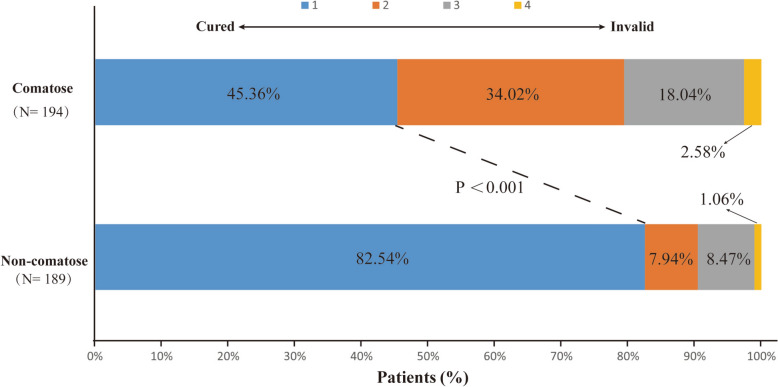
Patients with acute carbon monoxide poisoning were divided into comatose and non-comatose groups. The primary outcomes included clinical cure and the occurrence of DEACMP. Multivariate logistic regression analysis was performed to identify independent predictors of clinical outcome.
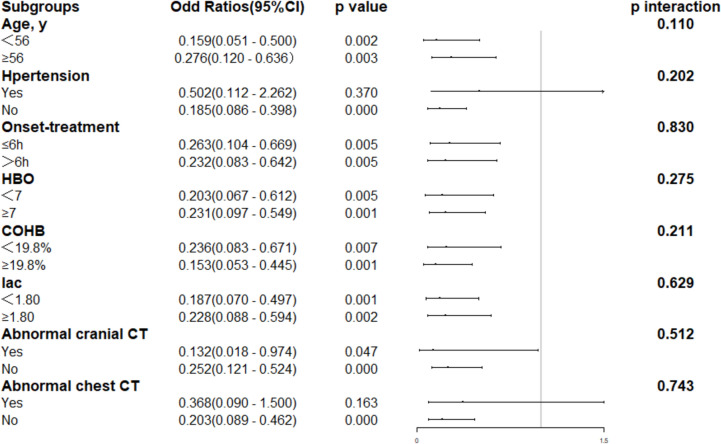
Multivariate analysis indicated that coma (clinical cure: adjusted odds ratio [aOR] 0.24, 95% CI 0.12-0.47; DEACMP: aOR 42.5, 95% CI 7.99-789), longer the time from onset to the first HBOT (clinical cure: aOR 0.43, 95% CI 0.24-0.77; DEACMP: aOR 3.21, 95% CI 1.56-6.78) and abnormal chest CT findings (clinical cure: aOR 0.23, 95% CI 0.12-0.45; DEACMP: aOR 5.36, 95% CI 2.41-12.60) were associated with a lower rate of clinical cure and a higher proportion of DEACMP; and lower age was an independent predictor of clinical cure (aOR 0.96, 95% CI 0.94-0.98), but not of DEACMP (aOR 0.99, 95% CI 0.96-1.01). In comatose patients, both the duration of coma and abnormal chest CT findings were an independent factor for clinial cure (aOR 0.96, 95% CI 0.93-0.99; aOR 0.34, 95% CI 0.15-0.74) and DEACMP (aOR 1.09, 95% CI 1.06-1.14; aOR 4.93, 95% CI 1.67-16.30).
Coma and the duration of coma were significant predictors of clinical cure and DEACMP in patients; the older the patient, the longer the duration of coma, and the longer the time from onset to the first hyperbaric oxygen therapy (> 6 h), indicating that the patient's prognosis is often worse; abnormal chest CT manifestations were also an independent risk factor for a poor patient's prognosis.
本研究旨在评估昏迷对急性一氧化碳中毒(ACMP)患者预后及迟发性脑病(DEACMP)的影响,并分析影响这些患者预后的预测因素。
将急性一氧化碳中毒患者分为昏迷组和非昏迷组。主要结局包括临床治愈和DEACMP的发生。进行多因素逻辑回归分析以确定临床结局的独立预测因素。
多因素分析表明,昏迷(临床治愈:调整优势比[aOR]0.24,95%可信区间[CI]0.12 - 0.47;DEACMP:aOR 42.5,95%CI 7.99 - 789)、从发病到首次高压氧治疗(HBOT)的时间越长(临床治愈:aOR 0.43,95%CI 0.24 -