Du Tianfeng, Wang Yiting, Liu Xiaoke, Zhao Weifang, Yang Bowen, Gan Kang, Zhu Juanfang
Department of Stomatology, The First Affiliated Hospital of Zhengzhou University, No.1 Jianshe East Road, Zhengzhou, 450052, Henan, China.
Department of Stomatology, People's Hospital of Zhengzhou, No.33 Yellow River Road, Zhengzhou, 450000, Henan, China.
BMC Oral Health. 2025 Feb 22;25(1):287. doi: 10.1186/s12903-025-05657-4.
The main cause of pulpal and periapical diseases is bacterial infection, but mechanical and chemical preparation in root canal therapy is difficult to completely remove the bacterial microorganism. Antibacterial photodynamic therapy (aPDT) is a medical method that kills microorganisms by activating a photoactive agent or photosensitizer by exposure to visible light of a specific wave-length in the presence of oxygen. The present study aimed to evaluate the killing in vitro effect of aPDT with 0.01% methylene blue (MB) against young and mature Enterococcus faecalis (E. faecalis) biofilms in bovine and human dentin with the long-term exposure using confocal laser scanning microscopy (CLSM).
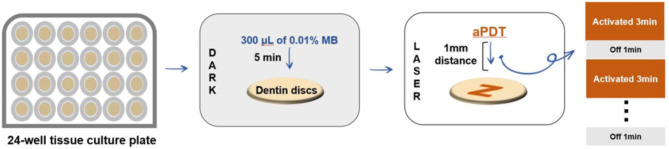
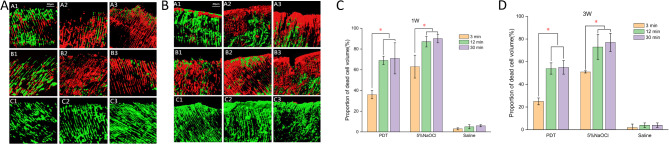
Prepared bovine and human dentin blocks and their structure were observed by scanning electron microscopy (SEM). Semicylindrical bovine dentin blocks and human root canal dentin blocks were inoculated with E. faecalis and incubated in air to form 1- and 3-week-old biofilms. The biofilms in dentin were subjected to aPDT with 0.01% MB, 5% NaOCl and saline with the exposure of 3, 12 and 30 min. The dead portions of bacterial cells in E. faecalis biofilms were analyzed with using LIVE/DEAD bacteria viability staining and CLSM.
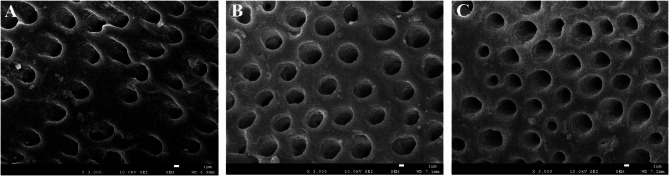
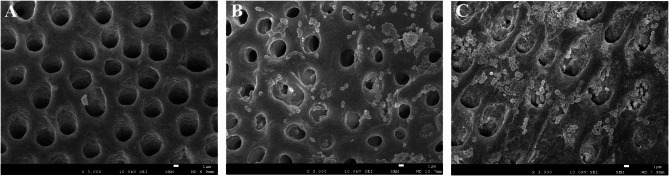
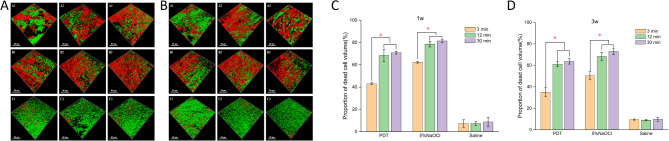
A clean dentin surface in bovine dentin blocks were verified with SEM. In bovine and human dentin blocks, significantly more bacteria were dead when aPDT with MB and 5% NaOCl were used with the long exposure time (12 and 30 min) than with 3 min (P < 0.05). The speed of killing was fastest during the first 3 min, and few more bacterial cells were killed after 12 min in the disinfection groups. 5% NaOCl exhibited the highest effectiveness of bacterial killing in dentin at each time point than aPDT with MB groups (P < 0.05). The proportion of killed bacteria was higher in young biofilms than in mature biofilms in aPDT with MB and NaOCl groups (P < 0.05). Moreover, there were no clearly visible changes in structure of bovine dentin surfaces subjected to aPDT with MB for 30 min.
aPDT with 0.01% MB has the capability to kill bacterial cells in E. faecalis biofilms on bovine and human dentin blocks. Young E. faecalis biofilms in dentin canals were more susceptible to disinfection approaches than mature biofilms.
牙髓病和根尖周病的主要病因是细菌感染,但根管治疗中的机械和化学预备难以完全清除细菌微生物。抗菌光动力疗法(aPDT)是一种通过在有氧存在的情况下,用特定波长的可见光激活光活性剂或光敏剂来杀死微生物的医学方法。本研究旨在使用共聚焦激光扫描显微镜(CLSM),通过长期暴露,评估0.01%亚甲蓝(MB)的aPDT对牛和人牙本质中年轻和成熟粪肠球菌(E. faecalis)生物膜的体外杀菌效果。
通过扫描电子显微镜(SEM)观察制备的牛和人牙本质块及其结构。将半圆柱形牛牙本质块和人根管牙本质块接种粪肠球菌,并在空气中孵育以形成1周龄和3周龄的生物膜。用0.01% MB、5%次氯酸钠(NaOCl)和生理盐水对牙本质中的生物膜进行3、12和30分钟的暴露处理。使用活/死细菌活力染色和CLSM分析粪肠球菌生物膜中细菌细胞的死亡部分。
SEM证实牛牙本质块中的牙本质表面清洁。在牛和人牙本质块中,与3分钟相比,使用MB和5% NaOCl进行长时间暴露(12和30分钟)时,死亡的细菌明显更多(P < 0.05)。杀菌速度在前3分钟最快,消毒组在12分钟后杀死的细菌细胞数量增加很少。在每个时间点,5% NaOCl在牙本质中的杀菌效果均高于MB的aPDT组(P < 0.05)。在MB和NaOCl组的aPDT中,年轻生物膜中被杀灭细菌的比例高于成熟生物膜(P < 0.05)。此外,用MB进行30分钟aPDT处理的牛牙本质表面结构没有明显可见的变化。
0.01% MB的aPDT有能力杀死牛和人牙本质块上粪肠球菌生物膜中的细菌细胞。牙本质管中的年轻粪肠球菌生物膜比成熟生物膜对消毒方法更敏感。