Khezri Rozhan, Rezaei Fatemeh, Jahanfar Shayesteh, Ebrahimi Kamran
Student Research Committee, Iran University of Medical Sciences, Tehran, Iran.
Research Center for Social Determinants of Health, Jahrom University of Medical Sciences, Jahrom, Iran.
Sci Rep. 2025 Feb 22;15(1):6446. doi: 10.1038/s41598-025-91316-1.
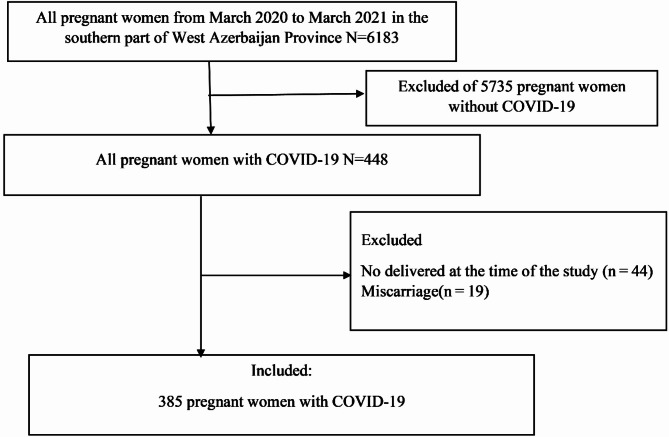
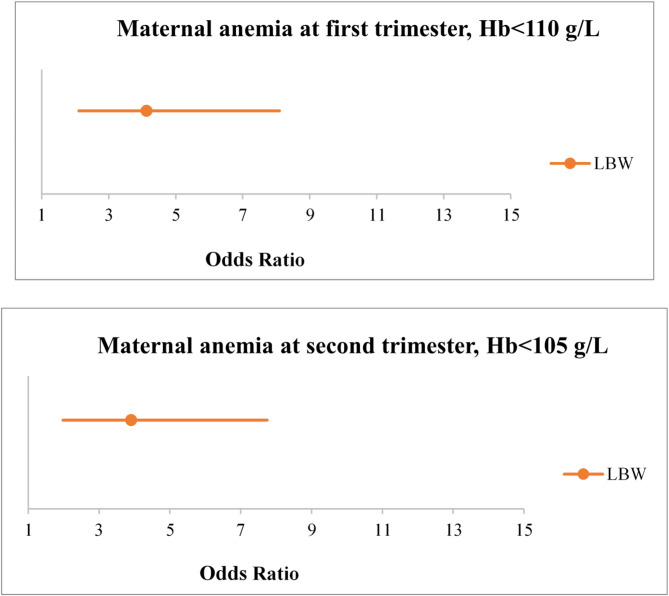
Low birth weight and anemia are significant public health challenges in developing countries. This study seeks to evaluate the relationship between hemoglobin levels during the first and second trimesters of pregnancy and the occurrence of low birth weight, while accounting for potential confounding factors. This multi-center cross-sectional study was conducted among all pregnant women with COVID-19 and with no history of receiving the COVID-19 vaccine who delivered in public and private hospitals in three counties, Mahabad, Miandoab, Bukan in Iran, using routinely collected maternity and health data on pregnancies. Hemoglobulin levels were measured during the first (6-10th weeks) and second (24-28th weeks) trimesters of pregnancy, and pregnancy outcomes were recorded in the health information system. Hb levels were categorized into four groups as follows: ≥110 g/L, 100-109 g/L, 90-99 g/L, and < 90 g/L for the first trimester and ≥ 105 g/L, 100-104 g/L, 90-99 g/L, and < 90 g/L for the second trimester. Multivariable logistic regression analysis determined the association between hemoglobin levels during pregnancy and low birth weight. P-values < 0.05 were considered statistically significant. A total of 385 mothers with COVID-19 were included. The mean age of COVID-19 pregnant women was 30.01 ± 6.24 years. After multivariable adjustment, Hb levels < 110 g/L in the first trimester had a significant association with low birth weight [OR, 4.13; (95% CI 2.11-8.10)]. Morevoer, Hb levels < 105 g/L in the second trimester was a significant association with low birth weight [OR:3.91; (95% CI:1.98-7.75)]. Maternal anemia during pregnancy, including first and second trimesters, was a significant association with Low birth weight even after adjusting for common confounders. Effective management and monitoring of anemia in pregnant women, particularly in low- and middle-income countries, are crucial for preventing low birth weight.
低出生体重和贫血是发展中国家面临的重大公共卫生挑战。本研究旨在评估妊娠前三个月和第二个三个月期间血红蛋白水平与低出生体重发生之间的关系,同时考虑潜在的混杂因素。这项多中心横断面研究是在伊朗马哈巴德、米安多阿卜、布坎三个县的公立和私立医院分娩的所有新冠病毒肺炎孕妇且无新冠病毒疫苗接种史的孕妇中进行的,使用常规收集的孕产妇和妊娠健康数据。在妊娠的第一个(第6 - 10周)和第二个(第24 - 28周)三个月期间测量血红蛋白水平,并在健康信息系统中记录妊娠结局。血红蛋白水平分为以下四组:妊娠早期≥110 g/L、100 - 109 g/L、90 - 99 g/L和<90 g/L,妊娠中期≥105 g/L、100 - 104 g/L、90 - 99 g/L和<90 g/L。多变量逻辑回归分析确定了孕期血红蛋白水平与低出生体重之间的关联。P值<0.05被认为具有统计学意义。总共纳入了385名新冠病毒肺炎母亲。新冠病毒肺炎孕妇的平均年龄为30.01±6.24岁。经过多变量调整后,妊娠早期血红蛋白水平<110 g/L与低出生体重有显著关联[比值比(OR),4.13;(95%置信区间2.11 - 8.10)]。此外,妊娠中期血红蛋白水平<105 g/L与低出生体重有显著关联[OR:3.91;(95%置信区间:1.九十八 - 7.75)]。即使在调整了常见混杂因素后,妊娠期间包括妊娠前三个月和第二个三个月的母体贫血与低出生体重也有显著关联。对孕妇贫血进行有效管理和监测,特别是在低收入和中等收入国家,对于预防低出生体重至关重要。