Kang Xue, Yang Qing, Ma Jiajie, Sun Qiangchao, Cheng Hongwei
Department of Chemical and Material Engineering, Lyuliang University, Lvliang 033001, China.
School of Materials Science and Engineering & State Key Laboratory of Advanced Special Steel, Shanghai University, Shanghai 200444, China.
Membranes (Basel). 2025 Feb 6;15(2):53. doi: 10.3390/membranes15020053.
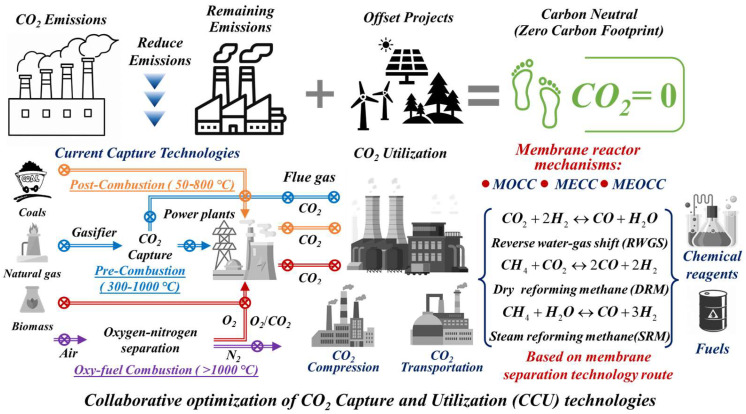
Excessive (carbon dioxide) CO emissions are a primary factor contributing to climate change. As one of the crucial technologies for alleviating CO emissions, carbon capture and utilization (CCU) technology has attracted considerable global attention. Technologies for capturing CO in extreme circumstances are indispensable for regulating CO levels in industrial processes. The unique separation characteristics of the ceramic-carbonate dual-phase (CCDP) membranes are increasingly employed for CO separation at high temperatures due to their outstanding chemical, thermal durability, and mechanical strength. This paper presents an overview of CO capture approaches and materials. It also elaborates on the research progress of three types of CCDP membranes with distinct permeation mechanisms, concentrating on their principles, materials, and structures. Additionally, several typical membrane reactors, such as the dry reforming of methane (DRM) and reverse water-gas shift (RWGS), are discussed to demonstrate how captured CO can function as a soft oxidant, converting feedstocks into valuable products through oxidation pathways designed within a single reactor. Finally, the future challenges and prospects of high-temperature CCDP membrane technologies and their related reactors are proposed.
过量的二氧化碳(CO)排放是导致气候变化的主要因素。作为缓解CO排放的关键技术之一,碳捕获与利用(CCU)技术已引起全球广泛关注。极端环境下的CO捕获技术对于调节工业过程中的CO水平不可或缺。陶瓷-碳酸盐双相(CCDP)膜独特的分离特性因其出色的化学、热耐久性和机械强度,越来越多地用于高温下的CO分离。本文概述了CO捕获方法和材料。还阐述了具有不同渗透机制的三种类型CCDP膜的研究进展,重点介绍了它们的原理、材料和结构。此外,还讨论了几种典型的膜反应器,如甲烷干重整(DRM)和逆水煤气变换(RWGS),以展示捕获的CO如何作为软氧化剂,通过在单个反应器内设计的氧化途径将原料转化为有价值的产品。最后,提出了高温CCDP膜技术及其相关反应器未来面临的挑战和前景。