Felipe-Dimog Eva Belingon, Yu Chia-Hung, Tumulak Ma-Am Joy Realce, Lu Tsung-Hsueh, Liang Fu-Wen
College of Health Sciences, Ifugao State University-Lamut Campus, Nayon, Lamut, Ifugao, 3605, Philippines.
Department of Anesthesiology, Chi Mei Medical Center, Tainan, 710, Taiwan.
BMC Pregnancy Childbirth. 2025 Feb 25;25(1):204. doi: 10.1186/s12884-025-07298-5.
Cesarean section (CS) rate has become increasingly prevalent worldwide, which has raised concerns about the possible risks as they often result in frequently longer recovery periods for mothers and possible complications for both the mother and the child. The World Health Organization (WHO) recommends a 10-15% CS rate to maintain its safe use. Conducting trends analysis of CS and its associated factors is crucial in understanding its utilization. There is currently a limited knowledge on the increasing trends of CS and factors related to it that might help improve procedures and practice standards. The present study examined the trends and associated factors of CS use in the Philippines over the last two decades.
We utilized the Philippine National Demographic and Health Survey (PNDHS) data collected in 1993, 1998, 2003, 2008, 2013, and 2017. Descriptive and univariate techniques were used to characterize the survey participants and the trends of CS use over time. The data of 2017 PNDHS was used in the logistic regression analysis to assess the associated factors of CS use. Significant factors (p < 0.05) in the univariate analysis were considered in the logistic regression analysis.
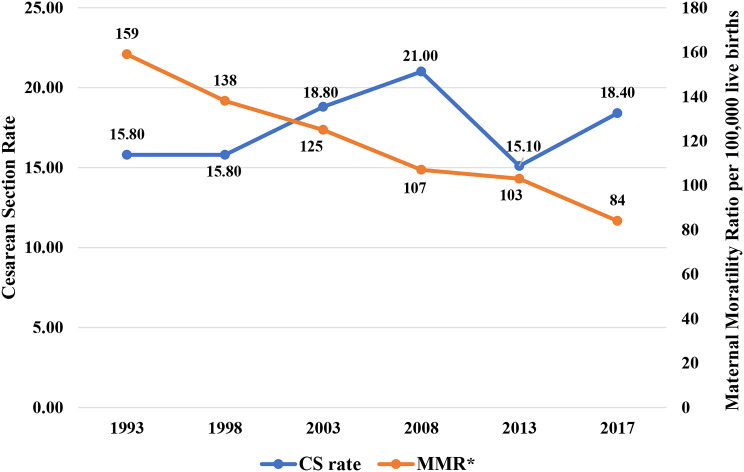
The overall use of CS has been significantly higher than the maximum cutoff of the WHO and increased from 15.8% in 1993 to 18.4% in 2017. Women aged 25 years or older, with higher education, belonged to middle or rich household, with newborn at 1 and 2-3 birth order, and with initial antenatal care visits (ANC) in the first or later trimester of pregnancy were significantly associated with CS use.
In the Philippines, the utilization of CS has continuously surpassed the recommended maximum cutoff of 15%. This increased rate is associated with maternal age, educational attainment, family income, birth order, and the timing of antenatal care visits. The socioeconomic factors demonstrate socioeconomic disparities in accessing CS services. Emphasizing the need for performing medically indicated CS can promote better maternal and child outcome and reduce the rate of unnecessary CS deliveries. Prioritizing initiatives to provide equitable access to CS services is imperative.
剖宫产率在全球范围内日益普遍,这引发了人们对其可能风险的担忧,因为剖宫产往往会导致母亲的恢复期更长,且母亲和孩子都可能出现并发症。世界卫生组织(WHO)建议剖宫产率保持在10%-15%以确保其安全使用。对剖宫产及其相关因素进行趋势分析对于了解其使用情况至关重要。目前,关于剖宫产上升趋势及其相关因素的了解有限,而这些因素可能有助于改进手术和实践标准。本研究调查了菲律宾过去二十年中剖宫产的趋势及其相关因素。
我们使用了1993年、1998年、2003年、2008年、2013年和2017年收集的菲律宾全国人口与健康调查(PNDHS)数据。描述性和单变量技术用于描述调查参与者以及剖宫产使用随时间的趋势。2017年PNDHS的数据用于逻辑回归分析,以评估剖宫产使用的相关因素。单变量分析中的显著因素(p < 0.05)被纳入逻辑回归分析。
剖宫产的总体使用率显著高于世界卫生组织的最高临界值,从1993年的15.8%上升至2017年的18.4%。年龄在25岁及以上、受过高等教育、属于中等或富裕家庭、新生儿为第一胎和第二或第三胎、在妊娠第一期或更晚开始进行首次产前检查的女性与剖宫产使用显著相关。
在菲律宾,剖宫产的使用率持续超过建议的最高临界值15%。这一上升率与产妇年龄、教育程度、家庭收入、产次以及产前检查时间有关。社会经济因素表明在获得剖宫产服务方面存在社会经济差异。强调进行有医学指征的剖宫产的必要性可以促进更好的母婴结局,并降低不必要的剖宫产分娩率。优先采取举措以公平获得剖宫产服务势在必行。