Al Shawan Deema
College of Public Health, Imam Abdulrahman Bin Faisal University, Dammam, Saudi Arabia.
J Healthc Leadersh. 2021 Feb 2;13:47-61. doi: 10.2147/JHL.S288682. eCollection 2021.
Saudi Arabia has one of the highest numbers of health organizations accredited by the Joint Commission International. This study aimed to measure this process's effectiveness in improving quality at King Fahd Hospital of the University in Khobar, Saudi Arabia. Additionally, the study investigated health providers' perceptions of this process.
This research utilized a convergent parallel mixed method. For the quantitative analysis, an interrupted time series was conducted to assess the changes in a total of 12 quality outcomes pre- and post-accreditation. Thematic analysis was utilized to collect and analyze qualitative data from hospital employees and health providers.
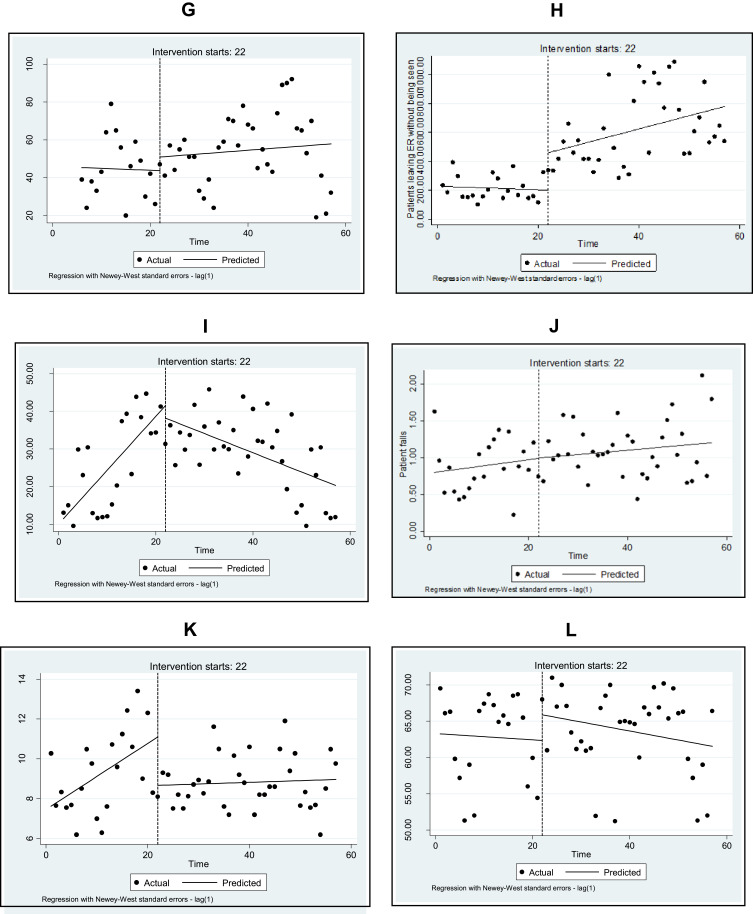
The quantitative results indicated that pursuing accreditation positively impacted nine out of 12 outcomes. The improved outcomes included: the average length of stay, the percentage of hand hygiene compliance, the rate of nosocomial infections, the percentage of radiology reporting outliers, the rate of pressure ulcers, the percentage of the correct identification of patients, the percentage of critical lab reporting, and the bed occupancy rate. The outcomes that did not improve were the rate of patients leaving the ER without being seen, the percentage of OR cancelations, and the rate of patient falls. The qualitative analysis suggested that the accreditation process was perceived positively by participants. Nevertheless, participants also highlighted some of the drawbacks of this process, including: the potential bias in observation-based key performance indicators, the focus on improving process without enhancing the hospital structure, and the increased workload.
International accreditation had a positive impact on quality and was received positively by providers. However, several issues need to be addressed by hospital administrators in future accreditation cycles. According to participants, the most notable issue during the first two accreditation cycles was the increased workload and paperwork, which can potentially distract from patient care.
沙特阿拉伯是获得国际联合委员会认证的卫生组织数量最多的国家之一。本研究旨在衡量这一过程在沙特阿拉伯胡拜尔法赫德国王大学医院提高质量方面的有效性。此外,该研究还调查了医疗服务提供者对这一过程的看法。
本研究采用了收敛平行混合方法。对于定量分析,进行了中断时间序列分析,以评估认证前后总共12项质量结果的变化。采用主题分析法收集和分析来自医院员工和医疗服务提供者的定性数据。
定量结果表明,追求认证对12项结果中的9项产生了积极影响。改善的结果包括:平均住院时间、手卫生依从率、医院感染率、放射学报告异常值百分比、压疮发生率、患者正确识别率、关键实验室报告率和床位占用率。未改善的结果是患者未就诊离开急诊室的比率、手术室取消率和患者跌倒率。定性分析表明,参与者对认证过程持积极看法。然而,参与者也强调了这一过程的一些缺点,包括:基于观察的关键绩效指标可能存在偏差、注重改善流程而未改善医院结构以及工作量增加。
国际认证对质量有积极影响,并得到了提供者的积极认可。然而,医院管理人员在未来的认证周期中需要解决几个问题。根据参与者的说法,在前两个认证周期中最显著的问题是工作量和文书工作的增加,这可能会分散对患者护理的注意力。