Chen Yan, Song Kaitai, Hu Huizhong, Wang Haiyan, Zheng Xinqiang
Key Laboratory of Nuclear Agricultural Sciences of Ministry of Agriculture, College of Agriculture and Biotechnology, Zhejiang University, Hangzhou 310058, China.
Biology (Basel). 2025 Feb 10;14(2):177. doi: 10.3390/biology14020177.
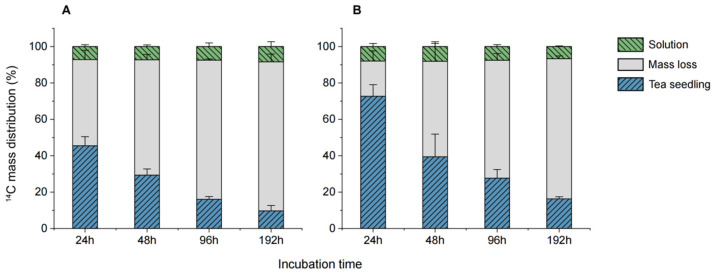
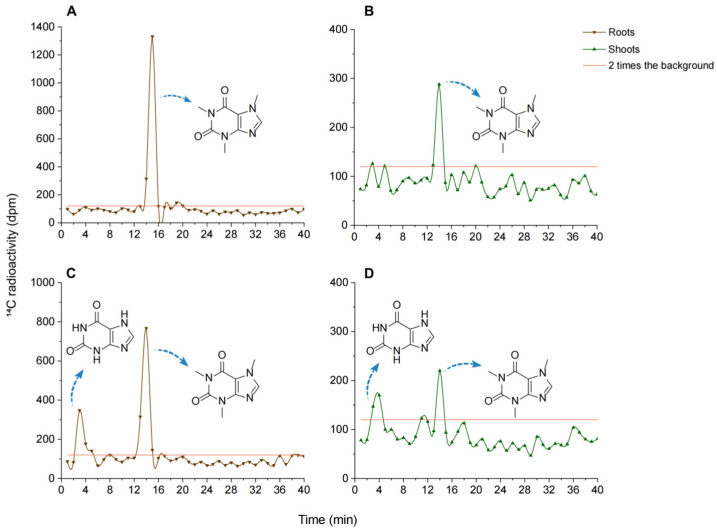
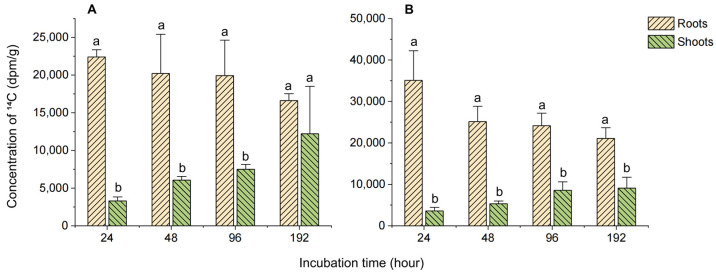
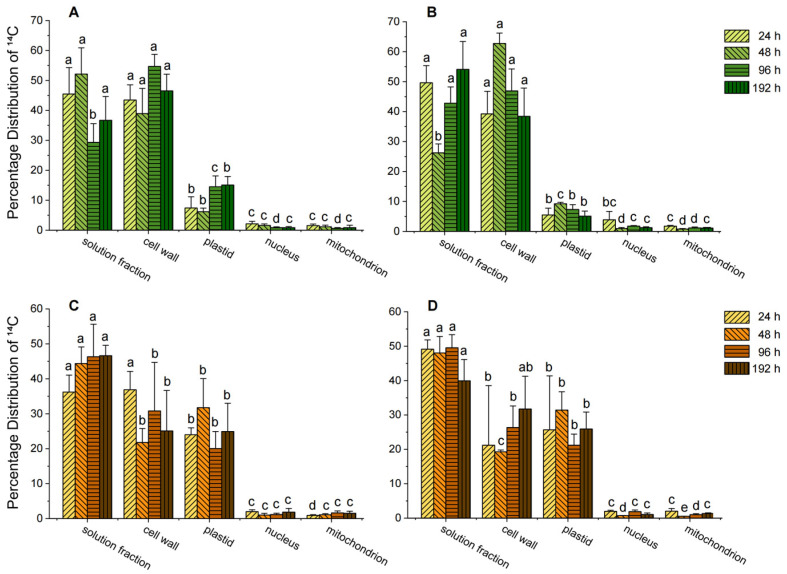
Caffeine contamination in water sources raises concerns about its transfer to agricultural products and potential risks to human health through the food chain. Despite these concerns, limited research has focused on the accumulation and distribution of exogenous caffeine in tea plants. This study explored the uptake, translocation, targeted accumulation, subcellular distribution, and preliminary metabolism of C-labeled caffeine in a hydroponic tea seedling system. After 192 h of cultivation, more than 83.8% of the caffeine had been removed from the nutrient solution. Within the plants, C-caffeine and its metabolites predominantly accumulated in the roots. Subcellular analysis indicates that in root cells, C was mainly distributed in the soluble fraction, cell walls, and plastids, while in shoot cells, it was concentrated in the soluble fraction and cell walls. Metabolic profiling reveals distinct varietal differences: in Longjing 43 tea seedlings, C was predominantly present as the caffeine parent compound, whereas in Jiaming No. 1 tea seedlings, C was found both as the parent compound and as its metabolite, xanthine. This study revealed differences in the uptake, translocation, and metabolism of exogenous caffeine among different tea plant varieties, providing broader insights into the impact of caffeine pollution on agricultural ecosystems.
水源中的咖啡因污染引发了人们对其向农产品转移以及通过食物链对人类健康造成潜在风险的担忧。尽管存在这些担忧,但针对外源咖啡因在茶树中的积累和分布的研究却很有限。本研究在水培茶苗系统中探究了¹⁴C标记咖啡因的吸收、转运、靶向积累、亚细胞分布及初步代谢情况。培养192小时后,超过83.8%的咖啡因已从营养液中去除。在植物体内,¹⁴C-咖啡因及其代谢产物主要积累在根部。亚细胞分析表明,在根细胞中,¹⁴C主要分布在可溶性部分、细胞壁和质体中,而在茎细胞中,它集中在可溶性部分和细胞壁中。代谢谱分析揭示了明显的品种差异:在龙井43茶苗中,¹⁴C主要以咖啡因母体化合物形式存在,而在嘉茗1号茶苗中,¹⁴C既以母体化合物形式存在,也以其代谢产物黄嘌呤形式存在。本研究揭示了不同茶树品种对外源咖啡因吸收、转运和代谢的差异,为咖啡因污染对农业生态系统的影响提供了更广泛深入的见解。