He Qi, Chen Yu-Pei, Li Junhao, Wu Hongtan, Chen Fangfang, Li Mingyu, Wu Chun
The School of Public Health, Fujian Medical University, Fuzhou 350122, China.
The School of Public Health and Medical Technology, Xiamen Medical College, Xiamen 361023, China.
Antioxidants (Basel). 2025 Feb 19;14(2):241. doi: 10.3390/antiox14020241.
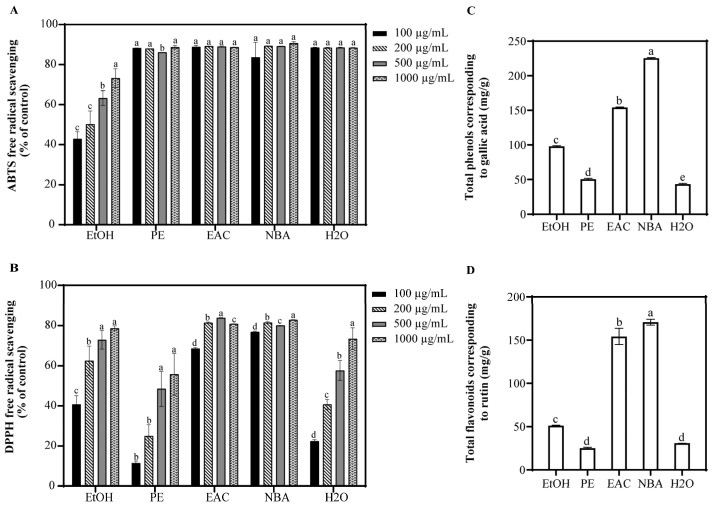
In traditional Chinese medicine, the root bark and leaves of are utilized to treat dysentery, parasitic infections, and digestive disorders. In this study, the n-butanol extract of (NBA) exhibited potent antioxidant properties, protecting HaCaT cells from UVB-induced damage, and was abundant in phenolic and flavonoid compounds. Using UPLC-QTOF-MS analysis, several antioxidants within NBA were identified. Among these, 3,4-dihydroxybenzoic acid, (+)-catechin, and procyanidin B2 effectively reduced ROS levels after 1 h post-UVB treatment (225 mJ/cm). Notably, all three compounds significantly decreased the phosphorylation of p38 and JNK in a dose-dependent manner. Additionally, the cell survival rate of these compounds was assessed after 12 h post-UVB treatment (225 mJ/cm). Both 3,4-dihydroxybenzoic acid and (+)-catechin significantly prevented UVB-induced apoptosis in HaCaT cells, as evidenced by MTT, Hoechst, Calcein/PI staining, and flow cytometry analyses. Proteomic analysis revealed that 3,4-dihydroxybenzoic acid achieved photoprotection by downregulating c-Fos and Jun and modulating cell cycle proteins, while (+)-catechin promoted cell repair through the PI3K-Akt and Wnt signaling pathways. These results demonstrated that both compounds can directly absorb UVB, scavenge ROS, and provide cell photoprotection by modulating multiple signaling pathways. The n-butanol extract of holds promising potential for future medical applications.
在传统中医中,[植物名称]的根皮和叶子被用于治疗痢疾、寄生虫感染和消化系统疾病。在本研究中,[植物名称]的正丁醇提取物(NBA)表现出强大的抗氧化性能,保护HaCaT细胞免受紫外线B(UVB)诱导的损伤,并且富含酚类和黄酮类化合物。通过超高效液相色谱-四极杆飞行时间质谱(UPLC-QTOF-MS)分析,鉴定出NBA中的几种抗氧化剂。其中,3,4-二羟基苯甲酸、(+)-儿茶素和原花青素B2在UVB处理(225 mJ/cm²)后1小时有效降低了活性氧(ROS)水平。值得注意的是,所有这三种化合物均以剂量依赖性方式显著降低了p38和JNK的磷酸化水平。此外,在UVB处理(225 mJ/cm²)后12小时评估了这些化合物的细胞存活率。MTT、Hoechst、钙黄绿素/碘化丙啶(Calcein/PI)染色和流式细胞术分析表明,3,4-二羟基苯甲酸和(+)-儿茶素均显著预防了UVB诱导的HaCaT细胞凋亡。蛋白质组学分析显示,3,4-二羟基苯甲酸通过下调c-Fos和Jun并调节细胞周期蛋白实现光保护作用,而(+)-儿茶素通过磷脂酰肌醇-3-激酶-蛋白激酶B(PI3K-Akt)和Wnt信号通路促进细胞修复。这些结果表明,这两种化合物均可直接吸收UVB、清除ROS,并通过调节多种信号通路提供细胞光保护作用。[植物名称]的正丁醇提取物在未来医学应用中具有广阔的前景。