Mohan Sivakumar, Azmi Wahizatul Afzan, Santhanam Rameshkumar, Abd Rahman Nor Ehsan, Ismail Wan Iryani Wan
Faculty of Science and Marine Environment, Universiti Malaysia Terengganu, 21030 Kuala Nerus, Terengganu, Malaysia.
Biological Security and Sustainability Research Group (BIOSES), Faculty of Science and Marine Environment, Universiti Malaysia Terengganu, 21030 Kuala Nerus, Terengganu, Malaysia.
Heliyon. 2024 Oct 10;10(20):e39164. doi: 10.1016/j.heliyon.2024.e39164. eCollection 2024 Oct 30.
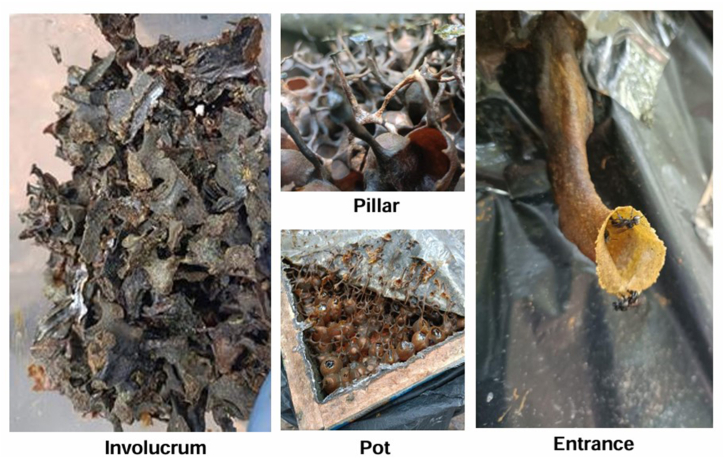
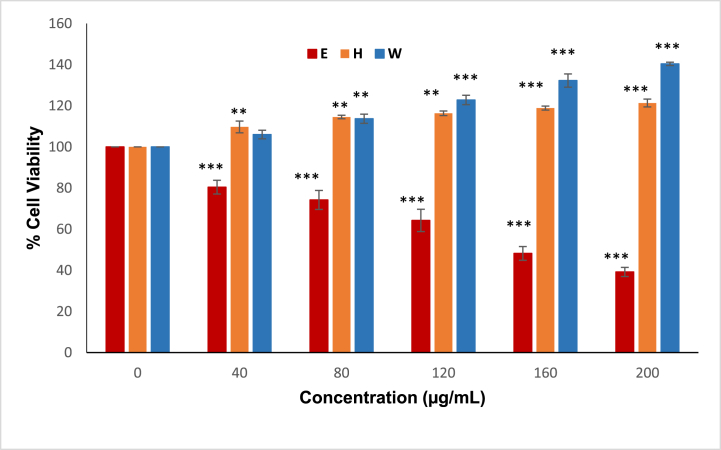
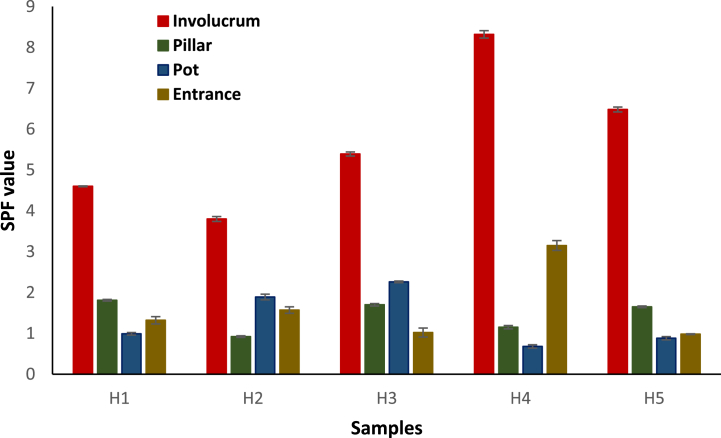
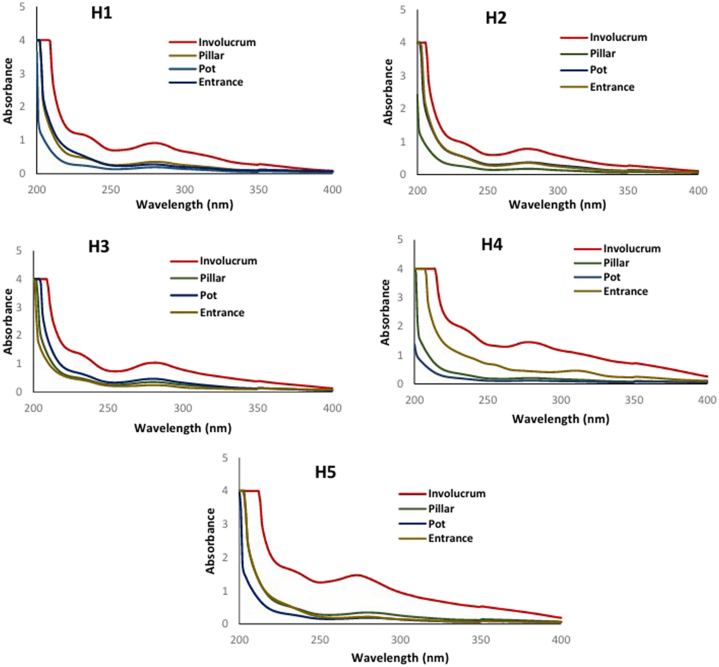
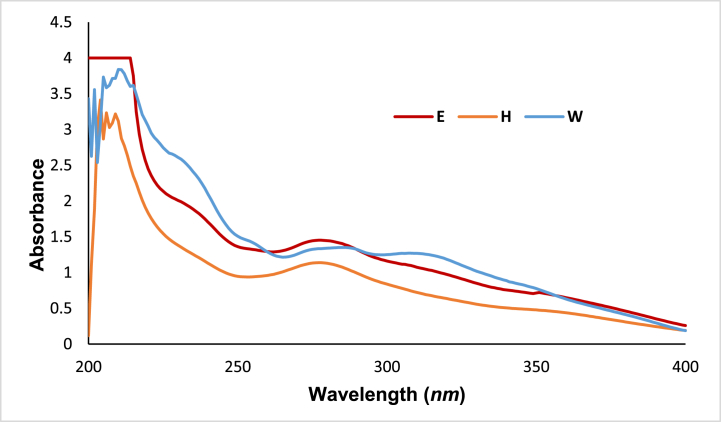
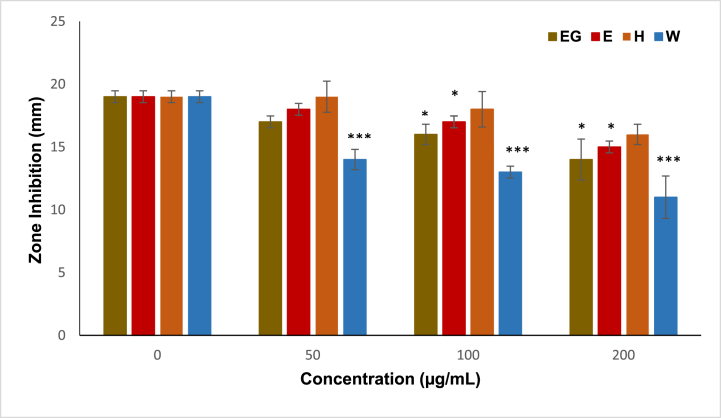
stingless bee propolis extract is known for its diverse bioactive compounds, making it a potential natural shield against UV radiation. This research assesses the photoprotective potential of crude ethanol extract from propolis collected from four structures (involucrum, pillar, pot, and entrance) of five bee hives (H1-H5), totalling 20 samples. Initially, the samples underwent testing for SPF value and UV absorption spectra. The crude ethanol extract (E) from the involucrum (H4) with the highest SPF value and broadest spectrum was selected for fractionation using hexane and water. Subsequently, the extract (E) and its hexane (H) and water (W) fractions were subjected to SPF analysis, UVA/UVB absorption assessment, determination of total phenolic and flavonoid content, free radical scavenging capacity, anti-collagenase effects, and cytotoxicity assessment. Additionally, LC-MS/MS analysis was performed to identify chemical constituents in the active fraction (W). The extract E demonstrated an SPF of 8.23 ± 0.09 and UV absorption. Notably, its fraction W exhibited the highest SPF (16.55 ± 0.24) at 100 μg/mL, surpassing the H fraction (SPF 5.7 ± 0.45). Phenolic content was highest in the H fraction (388.95 ± 4.54 mg/g GAE DW), followed by the W fraction (286.76 ± 6.48 mg/g GAE DW) and crude E (91.83 ± 4.12 mg/g GAE DW) from the involucrum. Regarding flavonoids, the fraction W led with 79.82 ± 6.21 mg/g QE DW, followed by the H fraction (45.56 ± 0.05 mg/g QE DW) and E (34.57 ± 1.11 mg/g QE DW). The extract E also exhibited modest DPPH scavenging (EC = 120 μg/mL), while the H fraction demonstrated stronger activity (EC = 4.37 μg/mL), and the W fraction displayed moderate effects (EC = 17.55 μg/mL). Notably, the W fraction showed remarkable anti-collagenase activity, outperforming the positive control, EG. HaCaT cell cytotoxicity revealed that the extract E was cytotoxic, whereas the H and W fractions showed no toxicity. LC-MS/MS analysis identified bioactive flavonoids (e.g., pratensein, quercetin) in the W fraction. These findings highlight the superior photoprotective properties of the water fraction from the involucrum of stingless bee propolis extract, suggesting its potential as a natural and effective ingredient for sunscreen and skincare formulations.
无刺蜂蜂胶提取物因其多种生物活性化合物而闻名,使其成为抵御紫外线辐射的潜在天然屏障。本研究评估了从五个蜂巢(H1 - H5)的四种结构(苞叶、支柱、蜂箱和入口)采集的蜂胶的粗乙醇提取物的光保护潜力,共20个样本。最初,对样本进行了防晒系数(SPF)值和紫外线吸收光谱测试。选择来自苞叶(H4)的具有最高SPF值和最宽光谱的粗乙醇提取物(E),用己烷和水进行分离。随后,对提取物(E)及其己烷(H)和水(W)馏分进行了SPF分析、UVA/UVB吸收评估、总酚和黄酮含量测定、自由基清除能力、抗胶原酶作用以及细胞毒性评估。此外,进行了液相色谱 - 串联质谱(LC - MS/MS)分析,以鉴定活性馏分(W)中的化学成分。提取物E的SPF为8.23±0.09,并具有紫外线吸收。值得注意的是,其馏分W在100μg/mL时表现出最高的SPF(16.55±0.24),超过了H馏分(SPF 5.7±0.45)。酚类含量在来自苞叶的H馏分中最高(388.95±4.54mg/g没食子酸当量干重),其次是W馏分(286.76±6.48mg/g没食子酸当量干重)和粗提取物E(91.83±4.12mg/g没食子酸当量干重)。关于黄酮类化合物,馏分W含量最高,为79.82±6.21mg/g槲皮素当量干重,其次是H馏分(45.56±0.05mg/g槲皮素当量干重)和E(34.57±1.11mg/g槲皮素当量干重)。提取物E也表现出适度的二苯基苦味酰基自由基(DPPH)清除能力(半数有效浓度(EC)=120μg/mL),而H馏分表现出更强的活性(EC =4.37μg/mL),W馏分表现出中等效果(EC =17.55μg/mL)。值得注意的是,W馏分表现出显著的抗胶原酶活性,优于阳性对照物乙二醇(EG)。人永生化角质形成细胞(HaCaT)细胞毒性显示,提取物E具有细胞毒性,而H和W馏分无毒性。LC - MS/MS分析在W馏分中鉴定出生物活性黄酮类化合物(如鹰嘴豆芽素A、槲皮素)。这些发现突出了无刺蜂蜂胶提取物苞叶水馏分优异的光保护特性,表明其作为防晒和护肤品配方中天然有效成分的潜力。