Cerino Eric S, Lininger Monica R, Seaton Thomasina J, Porter Gillian, Baldwin Julie A
Department of Psychological Sciences, Northern Arizona University, Flagstaff, AZ 86011, USA.
Center for Health Equity Research, Northern Arizona University, Flagstaff, AZ 86011, USA.
Int J Environ Res Public Health. 2025 Jan 23;22(2):150. doi: 10.3390/ijerph22020150.
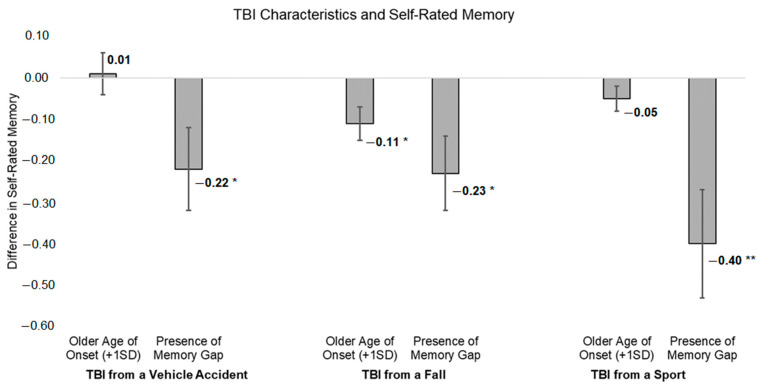
Traumatic brain injury (TBI) is an established risk factor for accelerated cognitive decline and increased dementia risk. The specific characteristics of TBI (e.g., type of head trauma, presence of a gap in memory, age of onset) that confer the greatest risk to cognitive health remain comparatively less clear. Using data from the 2014 Health and Retirement Study (HRS) experimental module, we examined associations between TBI characteristics and memory outcomes in a national adult lifespan sample. We tested whether the age of onset and presence of a memory gap in TBI resulting from a vehicle accident, from a fall or being hit, or from playing sports or playing on a playground were associated with self-rated memory and recall memory performance in a subsample of HRS respondents across the adult lifespan ( = 414, mean age = 66.28, SD = 9.70, 52% female). In cases where participants reported TBI from three different types of injury (vehicle accident, fall, and playing sports or playing on a playground), they shared whether they experienced a gap in their memory and their age when the head trauma occurred. Participants also reported on self-rated memory and performed a recall memory task. Hierarchical linear regression models were adjusted for age, sex, race, ethnicity, education, and self-rated health. Older age of onset for TBI from a fall was associated with worse self-rated memory (Est. = -0.11, SE = 0.04, = 0.01) and recall performance (Est. = -0.33, SE = 0.15, = 0.03). Encountering a memory gap from the TBI that resulted from a vehicle accident (Est. = -0.22, SE = 0.10, = 0.03), a fall (Est. = -0.23, SE = 0.09, = 0.01), and from playing sports or playing on a playground (Est. = -0.40, SE = -0.13, < 0.01) were all significantly associated with worse self-rated memory. Links between encountering a memory gap and recall performance were comparatively scant. Results indicate the impact of TBI on memory varies as a function of type of trauma, age of onset, and presence of memory gap from the head trauma. Our study takes a preclinical, preventative approach to inform public health efforts that target the mitigation of specific types of head trauma at different developmental phases of the lifespan.
创伤性脑损伤(TBI)是认知能力加速衰退和痴呆风险增加的既定风险因素。TBI的具体特征(如头部创伤类型、记忆空白的存在、发病年龄)对认知健康构成的最大风险仍相对不太明确。利用2014年健康与退休研究(HRS)实验模块的数据,我们在一个全国性的成年寿命样本中研究了TBI特征与记忆结果之间的关联。我们测试了因车祸、摔倒或被击中、运动或在操场玩耍导致的TBI的发病年龄和记忆空白的存在,是否与成年寿命期内HRS受访者子样本中的自评记忆和回忆记忆表现相关(n = 414,平均年龄 = 66.28,标准差 = 9.70,52%为女性)。在参与者报告因三种不同类型损伤(车祸、摔倒、运动或在操场玩耍)导致TBI的情况下,他们分享了头部创伤发生时是否经历过记忆空白以及年龄。参与者还报告了自评记忆并完成了一项回忆记忆任务。分层线性回归模型针对年龄、性别、种族、民族、教育程度和自评健康状况进行了调整。摔倒导致的TBI发病年龄较大与自评记忆较差(估计值 = -0.11,标准误 = 0.04,p = 0.01)和回忆表现较差(估计值 = -0.33,标准误 = 0.15,p = 0.03)相关。因车祸导致的TBI出现记忆空白(估计值 = -0.22,标准误 = 0.10,p = 0.03)、摔倒(估计值 = -0.23,标准误 = 0.09,p = 0.01)以及运动或在操场玩耍导致的TBI出现记忆空白(估计值 = -0.40,标准误 = 0.13,p < 0.01)均与自评记忆较差显著相关。记忆空白与回忆表现之间的联系相对较少。结果表明,TBI对记忆的影响因创伤类型、发病年龄以及头部创伤导致的记忆空白的存在而有所不同。我们的研究采用临床前、预防性方法,为针对在寿命期不同发育阶段减轻特定类型头部创伤的公共卫生努力提供信息。