• 文献检索
  • 文档翻译
  • 深度研究
  • 学术资讯
  • Suppr Zotero 插件Zotero 插件
  • 邀请有礼
  • 套餐&价格
  • 历史记录
应用&插件
Suppr Zotero 插件Zotero 插件浏览器插件Mac 客户端Windows 客户端微信小程序
定价
高级版会员购买积分包购买API积分包
服务
文献检索文档翻译深度研究API 文档MCP 服务
关于我们
关于 Suppr公司介绍联系我们用户协议隐私条款
关注我们

Suppr 超能文献

核心技术专利:CN118964589B侵权必究
粤ICP备2023148730 号-1Suppr @ 2026

文献检索

告别复杂PubMed语法,用中文像聊天一样搜索,搜遍4000万医学文献。AI智能推荐,让科研检索更轻松。

立即免费搜索

文件翻译

保留排版,准确专业,支持PDF/Word/PPT等文件格式,支持 12+语言互译。

免费翻译文档

深度研究

AI帮你快速写综述,25分钟生成高质量综述,智能提取关键信息,辅助科研写作。

立即免费体验

利用深度学习在计算机断层扫描中区分组织学类型的肾肿瘤。

Using deep learning to differentiate among histology renal tumor types in computed tomography scans.

作者信息

Kan Hung-Cheng, Lin Po-Hung, Shao I-Hung, Cheng Shih-Chun, Fan Tzuo-Yau, Chang Ying-Hsu, Huang Liang-Kang, Chu Yuan-Cheng, Yu Kai-Jie, Chuang Cheng-Keng, Wu Chun-Te, Pang See-Tong, Peng Syu-Jyun

机构信息

In-Service Master Program in Artificial Intelligence in Medicine, College of Medicine, Taipei Medical University, No.250, Wuxing St., Xinyi Dist., Taipei City, 110, Taiwan.

Division of Urology, Department of Surgery, Linkou Chang Gung Memorial Hospital, Taoyuan, Taiwan.

出版信息

BMC Med Imaging. 2025 Feb 26;25(1):66. doi: 10.1186/s12880-025-01606-3.

DOI:10.1186/s12880-025-01606-3
PMID:40011809
原文链接:https://pmc.ncbi.nlm.nih.gov/articles/PMC11866614/
Abstract

BACKGROUND

This study employed a convolutional neural network (CNN) to analyze computed tomography (CT) scans with the aim of differentiating among renal tumors according to histologic sub-type.

METHODS

Contrast-enhanced CT images were collected from patients with renal tumors. The patient cohort was randomly split to create a training dataset (90%) and a testing dataset (10%). Following image dataset augmentation, Inception V3 and Resnet50 models were used to differentiate between renal tumors subtypes, including angiomyolipoma (AML), oncocytoma, clear cell renal cell carcinoma (ccRCC), chromophobe renal cell carcinoma (chRCC), and papillary renal cell carcinoma (pRCC). 5-fold cross validation was then used to evaluate the models in terms of classification performance.

RESULTS

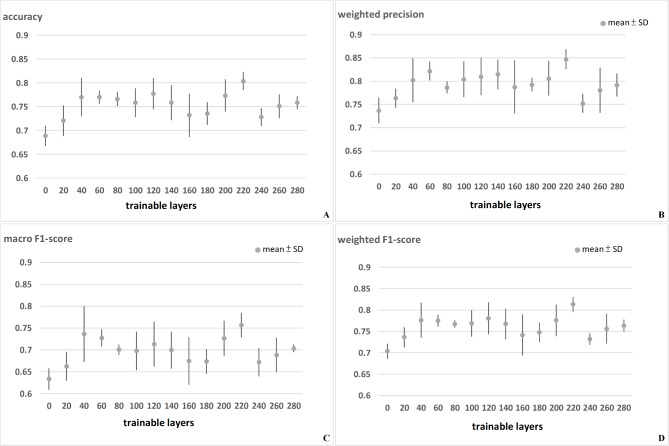
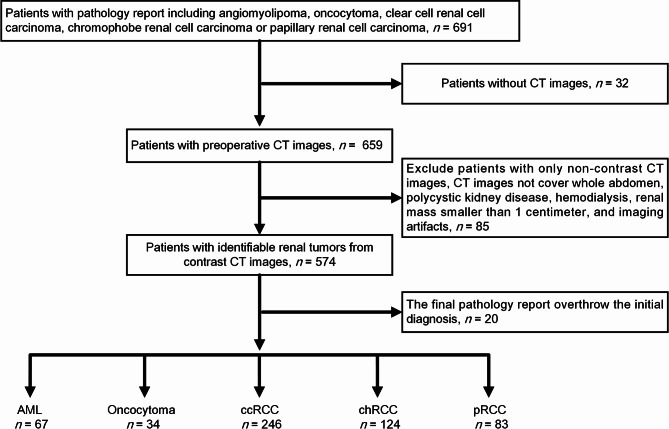
The study cohort comprised 554 patients, including those with angiomyolipoma (n = 67), oncocytoma (n = 34), clear cell renal cell carcinoma (n = 246), chromophobe renal cell carcinoma (n = 124), and papillary renal cell carcinoma (n = 83). Dataset augmentation of the training dataset included this to 4238 CT images for analysis. The accuracy of the models was as follows: Inception V3 (0.830) and Resnet 50 (0.849).

CONCLUSION

This study demonstrated the efficacy of using deep learning models for the classification of renal tumor subtypes from contrast-enhanced CT images. While the models showed promising accuracy, further development is necessary to improve their clinical applicability.

摘要

背景

本研究采用卷积神经网络(CNN)分析计算机断层扫描(CT)图像,旨在根据组织学亚型区分肾肿瘤。

方法

收集肾肿瘤患者的增强CT图像。将患者队列随机分为训练数据集(90%)和测试数据集(10%)。在对图像数据集进行扩充后,使用Inception V3和Resnet50模型区分肾肿瘤亚型,包括血管平滑肌脂肪瘤(AML)、嗜酸细胞瘤、透明细胞肾细胞癌(ccRCC)、嫌色细胞肾细胞癌(chRCC)和乳头状肾细胞癌(pRCC)。然后使用五折交叉验证来评估模型的分类性能。

结果

研究队列包括554例患者,其中血管平滑肌脂肪瘤患者67例、嗜酸细胞瘤患者34例、透明细胞肾细胞癌患者246例、嫌色细胞肾细胞癌患者124例、乳头状肾细胞癌患者83例。训练数据集扩充后,分析的CT图像增加到4238张。模型的准确率如下:Inception V3为0.830,Resnet 50为0.849。

结论

本研究证明了使用深度学习模型从增强CT图像中对肾肿瘤亚型进行分类的有效性。虽然模型显示出有前景的准确率,但仍需要进一步改进以提高其临床适用性。
https://cdn.ncbi.nlm.nih.gov/pmc/blobs/bad4/11866614/7644021c2d7f/12880_2025_1606_Fig4_HTML.jpg
https://cdn.ncbi.nlm.nih.gov/pmc/blobs/bad4/11866614/84277dfc47f0/12880_2025_1606_Fig1_HTML.jpg
https://cdn.ncbi.nlm.nih.gov/pmc/blobs/bad4/11866614/911043444f55/12880_2025_1606_Fig2_HTML.jpg
https://cdn.ncbi.nlm.nih.gov/pmc/blobs/bad4/11866614/d3a08c1451a7/12880_2025_1606_Fig3_HTML.jpg
https://cdn.ncbi.nlm.nih.gov/pmc/blobs/bad4/11866614/7644021c2d7f/12880_2025_1606_Fig4_HTML.jpg
https://cdn.ncbi.nlm.nih.gov/pmc/blobs/bad4/11866614/84277dfc47f0/12880_2025_1606_Fig1_HTML.jpg
https://cdn.ncbi.nlm.nih.gov/pmc/blobs/bad4/11866614/911043444f55/12880_2025_1606_Fig2_HTML.jpg
https://cdn.ncbi.nlm.nih.gov/pmc/blobs/bad4/11866614/d3a08c1451a7/12880_2025_1606_Fig3_HTML.jpg
https://cdn.ncbi.nlm.nih.gov/pmc/blobs/bad4/11866614/7644021c2d7f/12880_2025_1606_Fig4_HTML.jpg

相似文献

1
Using deep learning to differentiate among histology renal tumor types in computed tomography scans.利用深度学习在计算机断层扫描中区分组织学类型的肾肿瘤。
BMC Med Imaging. 2025 Feb 26;25(1):66. doi: 10.1186/s12880-025-01606-3.
2
Quantitative computer-aided diagnostic algorithm for automated detection of peak lesion attenuation in differentiating clear cell from papillary and chromophobe renal cell carcinoma, oncocytoma, and fat-poor angiomyolipoma on multiphasic multidetector computed tomography.多期多层多排 CT 定量计算机辅助诊断算法在自动检测峰值病变衰减方面的应用,有助于鉴别透明细胞癌与乳头状癌、嫌色细胞癌、嗜酸细胞瘤、乏脂肪性血管平滑肌脂肪瘤。
Abdom Radiol (NY). 2017 Jul;42(7):1919-1928. doi: 10.1007/s00261-017-1095-6.
3
Deep learning and radiomics: the utility of Google TensorFlow™ Inception in classifying clear cell renal cell carcinoma and oncocytoma on multiphasic CT.深度学习和放射组学:Google TensorFlow™ Inception 在多期 CT 上对透明细胞肾细胞癌和嗜酸细胞瘤分类的应用。
Abdom Radiol (NY). 2019 Jun;44(6):2009-2020. doi: 10.1007/s00261-019-01929-0.
4
Automated classification of solid renal masses on contrast-enhanced computed tomography images using convolutional neural network with decision fusion.基于决策融合卷积神经网络的增强 CT 图像中肾脏实性肿块的自动分类。
Eur Radiol. 2020 Sep;30(9):5183-5190. doi: 10.1007/s00330-020-06787-9. Epub 2020 Apr 29.
5
Multiphasic enhancement patterns of small renal masses (≤4 cm) on preoperative computed tomography: utility for distinguishing subtypes of renal cell carcinoma, angiomyolipoma, and oncocytoma.术前 CT 多期增强扫描对≤4cm 小肾脏肿块的强化模式:有助于鉴别肾细胞癌、血管平滑肌脂肪瘤和嗜酸细胞瘤的亚型。
Urology. 2013 Jun;81(6):1265-71. doi: 10.1016/j.urology.2012.12.049. Epub 2013 Apr 17.
6
Characterization of renal cell carcinoma, oncocytoma, and lipid-poor angiomyolipoma by unenhanced, nephrographic, and delayed phase contrast-enhanced computed tomography.通过平扫、肾实质期和延迟期对比增强计算机断层扫描对肾细胞癌、嗜酸细胞瘤和少脂性血管平滑肌脂肪瘤进行特征分析。
Clin Imaging. 2015 Jan-Feb;39(1):76-84. doi: 10.1016/j.clinimag.2014.09.008. Epub 2014 Oct 16.
7
Deep learning based classification of solid lipid-poor contrast enhancing renal masses using contrast enhanced CT.基于深度学习的对比增强 CT 对固体脂质贫脂性增强性肾肿块的分类。
Br J Radiol. 2020 Jul;93(1111):20200002. doi: 10.1259/bjr.20200002. Epub 2020 May 11.
8
Texture analysis as a radiomic marker for differentiating renal tumors.纹理分析作为一种放射组学标志物用于区分肾肿瘤。
Abdom Radiol (NY). 2017 Oct;42(10):2470-2478. doi: 10.1007/s00261-017-1144-1.
9
Automated differentiation of benign renal oncocytoma and chromophobe renal cell carcinoma on computed tomography using deep learning.基于深度学习的 CT 影像自动鉴别肾嗜酸细胞瘤和肾嫌色细胞癌。
BJU Int. 2020 Apr;125(4):553-560. doi: 10.1111/bju.14985. Epub 2020 Feb 6.
10
Small (< 4 cm) Renal Mass: Differentiation of Oncocytoma From Renal Cell Carcinoma on Biphasic Contrast-Enhanced CT.小(<4厘米)肾肿物:双期对比增强CT上肾嗜酸细胞瘤与肾细胞癌的鉴别
AJR Am J Roentgenol. 2015 Nov;205(5):999-1007. doi: 10.2214/AJR.14.13966.

引用本文的文献

1
Fusion-Based Deep Learning Approach for Renal Cell Carcinoma Subtype Detection Using Multi-Phasic MRI Data.基于融合的深度学习方法用于利用多期MRI数据检测肾细胞癌亚型
Diagnostics (Basel). 2025 Jun 26;15(13):1636. doi: 10.3390/diagnostics15131636.

本文引用的文献

1
Renal cell carcinoma T staging: Diagnostic accuracy of preoperative contrast-enhanced computed tomography.肾细胞癌T分期:术前增强计算机断层扫描的诊断准确性
Mol Clin Oncol. 2023 Jan 11;18(2):11. doi: 10.3892/mco.2023.2607. eCollection 2023 Feb.
2
Nomogram predictive model for differentiation between renal oncocytoma and chromophobe renal cell carcinoma at multi-phasic CT: a retrospective study.多期 CT 鉴别肾嗜酸细胞瘤和肾嫌色细胞癌的列线图预测模型:一项回顾性研究。
Clin Radiol. 2022 Oct;77(10):767-775. doi: 10.1016/j.crad.2022.05.024. Epub 2022 Jun 25.
3
A Radiomic-based Machine Learning Algorithm to Reliably Differentiate Benign Renal Masses from Renal Cell Carcinoma.
一种基于放射组学的机器学习算法,用于可靠地区分良性肾肿块与肾细胞癌。
Eur Urol Focus. 2022 Jul;8(4):988-994. doi: 10.1016/j.euf.2021.09.004. Epub 2021 Sep 16.
4
Text Data Augmentation for Deep Learning.用于深度学习的文本数据增强
J Big Data. 2021;8(1):101. doi: 10.1186/s40537-021-00492-0. Epub 2021 Jul 19.
5
Radiomic Features and Machine Learning for the Discrimination of Renal Tumor Histological Subtypes: A Pragmatic Study Using Clinical-Routine Computed Tomography.基于临床常规计算机断层扫描的肾脏肿瘤组织学亚型鉴别中的影像组学特征与机器学习:一项实用研究
Cancers (Basel). 2020 Oct 16;12(10):3010. doi: 10.3390/cancers12103010.
6
Discriminating malignant and benign clinical T1 renal masses on computed tomography: A pragmatic radiomics and machine learning approach.基于计算机断层扫描鉴别临床T1期肾肿块的良恶性:一种实用的放射组学和机器学习方法。
Medicine (Baltimore). 2020 Apr;99(16):e19725. doi: 10.1097/MD.0000000000019725.
7
Prediction of Benign and Malignant Solid Renal Masses: Machine Learning-Based CT Texture Analysis.基于机器学习的 CT 纹理分析对良恶性肾实质肿块的预测。
Acad Radiol. 2020 Oct;27(10):1422-1429. doi: 10.1016/j.acra.2019.12.015. Epub 2020 Feb 1.
8
Automated differentiation of benign renal oncocytoma and chromophobe renal cell carcinoma on computed tomography using deep learning.基于深度学习的 CT 影像自动鉴别肾嗜酸细胞瘤和肾嫌色细胞癌。
BJU Int. 2020 Apr;125(4):553-560. doi: 10.1111/bju.14985. Epub 2020 Feb 6.
9
The value of quantitative CT texture analysis in differentiation of angiomyolipoma without visible fat from clear cell renal cell carcinoma on four-phase contrast-enhanced CT images.在四期增强 CT 图像上,定量 CT 纹理分析在鉴别无可见脂肪的血管平滑肌脂肪瘤与透明细胞肾细胞癌中的价值。
Clin Radiol. 2019 Jul;74(7):547-554. doi: 10.1016/j.crad.2019.02.018. Epub 2019 Apr 20.
10
A Deep Learning-Based Radiomics Model for Differentiating Benign and Malignant Renal Tumors.一种基于深度学习的用于鉴别肾肿瘤良恶性的影像组学模型。
Transl Oncol. 2019 Feb;12(2):292-300. doi: 10.1016/j.tranon.2018.10.012. Epub 2018 Dec 17.