Teil Olivier, Roux Nathalie Le, Begue Anthony, Lefebvre Aline
Fondation Vallée - Paul Guiraud Hospital Group, GHT Psy Sud Paris, 54 Av. de la République, Villejuif, 94800, France.
Public Hospital of Psychiatry, EPS Erasme, GHT Psy Sud Paris, Antony, France.
BMC Nurs. 2025 Feb 26;24(1):215. doi: 10.1186/s12912-025-02820-8.
Every year, 134 million births are recorded worldwide. Nearly a third of women describe psychotraumatic symptoms related to childbirth. Post-traumatic stress disorder in the post-partum period affects between 3.1% and 6.3% of mothers. It can lead to relational disturbances in the mother-child bond and affect the child's development. Due to the under-detection of this disorder, early detection and treatment are necessary. This literature review aims to evaluate and compare the psychometric properties of screening and assessment tools for birth-related psychological trauma. The aim is to highlight the screening tools available for nurses and advanced practice nurses working in perinatal child psychiatry.
Systematic review.
A total of six databases, including PubMed, Scopus, CINAHL, MEDLINE, HAL, Web of Science, were screened during April and July 2023. Despite querying multiple databases due to the specificity of the subject, the exclusively relevant studies were identified through PubMed.
The Joanna Briggs Institute's Critical Appraisal Tool was used to conduct a critical appraisal of the selected articles.
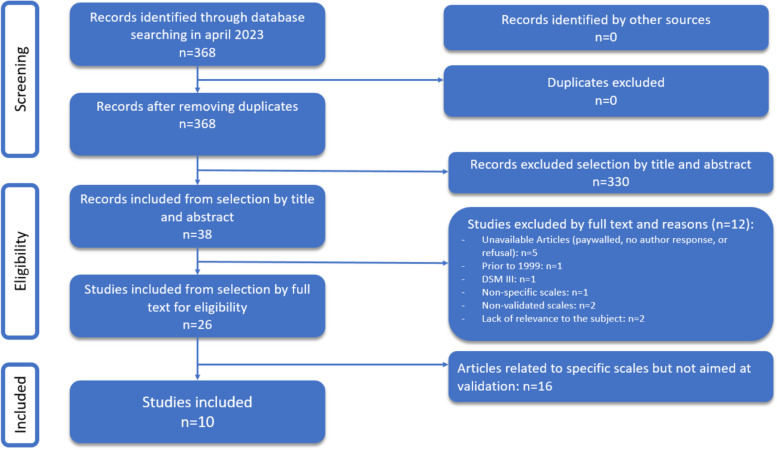
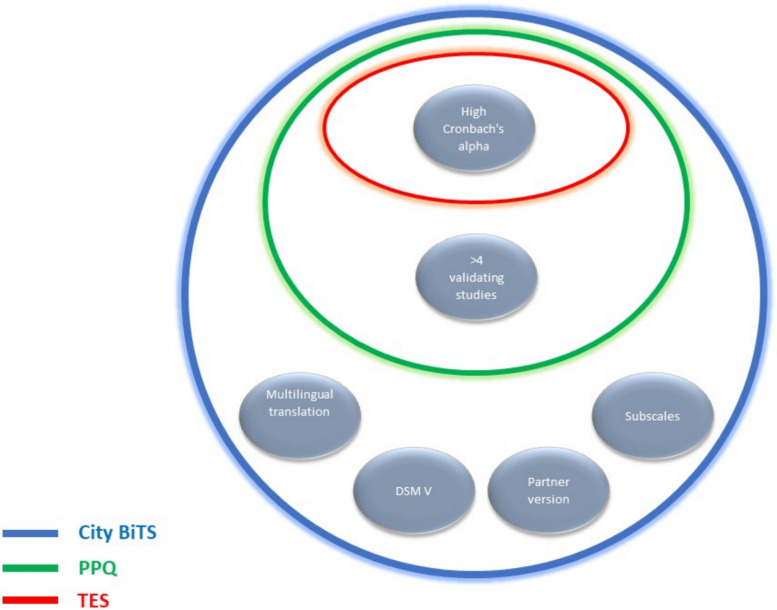
Among the 368 studies screened, 38 were selected after reviewing the titles and abstracts. 26 were assessed in full-text, and 10 were included in our results, highlighting 3 tools aimed at assessing postpartum psychological trauma: The "Traumatic Event Scale," the "Perinatal PTSD Questionnaire," and the "City Birth Trauma Scale."
These three scales and questionnaires have good psychometric properties. However, there is heterogeneity in the number and quality of studies used to validate these tools. Only one study aimed at validating the Traumatic Event Scale, which displayed some weaknesses. On the other hand, both the Perinatal PTSD Questionnaire and the City Birth Trauma Scale have shown a good level of validity with rigorous methodologies and incorporating a greater number of studies on the subject. Specifically, there are 4 and 5 studies respectively validating the psychometric properties of these tools. The results from these studies are consistently aligned with each other. These tools are well-suited for screening, prevention, and research in Advanced Practice Nursing in perinatal child psychiatry.
全球每年记录有1.34亿例分娩。近三分之一的女性描述了与分娩相关的精神创伤症状。产后创伤后应激障碍影响3.1%至6.3%的母亲。它可能导致母婴关系紊乱,并影响儿童发育。由于这种疾病检测不足,早期检测和治疗很有必要。本综述旨在评估和比较与分娩相关心理创伤的筛查和评估工具的心理测量特性。目的是突出可供围产期儿童精神病学领域的护士和高级执业护士使用的筛查工具。
系统综述。
2023年4月至7月期间,共筛选了六个数据库,包括PubMed、Scopus、CINAHL、MEDLINE、HAL、科学网。尽管由于主题的特殊性查询了多个数据库,但仅通过PubMed确定了完全相关的研究。
使用乔安娜·布里格斯研究所的批判性评价工具对所选文章进行批判性评价。
在筛选的368项研究中,38项在审阅标题和摘要后被选中。26项进行了全文评估,10项纳入我们的结果,突出了3种旨在评估产后心理创伤的工具:“创伤事件量表”、“围产期创伤后应激障碍问卷”和“城市分娩创伤量表”。
这三个量表和问卷具有良好的心理测量特性。然而,用于验证这些工具的研究数量和质量存在异质性。仅有一项研究旨在验证创伤事件量表,该研究显示出一些弱点。另一方面,围产期创伤后应激障碍问卷和城市分娩创伤量表在采用严谨方法且纳入更多该主题研究的情况下,显示出较高的效度水平。具体而言,分别有4项和5项研究验证了这些工具的心理测量特性。这些研究结果相互一致。这些工具非常适合围产期儿童精神病学高级实践护理中的筛查、预防和研究。