Lv Hua-Kun, Chen Xu, Xing Bo, Hu Xiao-Song, Zhang Xin-Pei, Shen Yu-Gang, Wang Yan, Liu Miao-Miao, Chen Ying-Ping, Liang Zhen-Zhen, Mao Yu
Zhejiang Provincial Center for Disease Control and Prevention, Hangzhou, China.
National Institute of Diagnostics and Vaccine Development in Infectious Diseases, State Key Laboratory of Molecular Vaccinology and Molecular Diagnostics, School of Public Health, Xiamen University, Xiamen, China.
Sci Rep. 2025 Feb 27;15(1):7079. doi: 10.1038/s41598-025-88361-1.
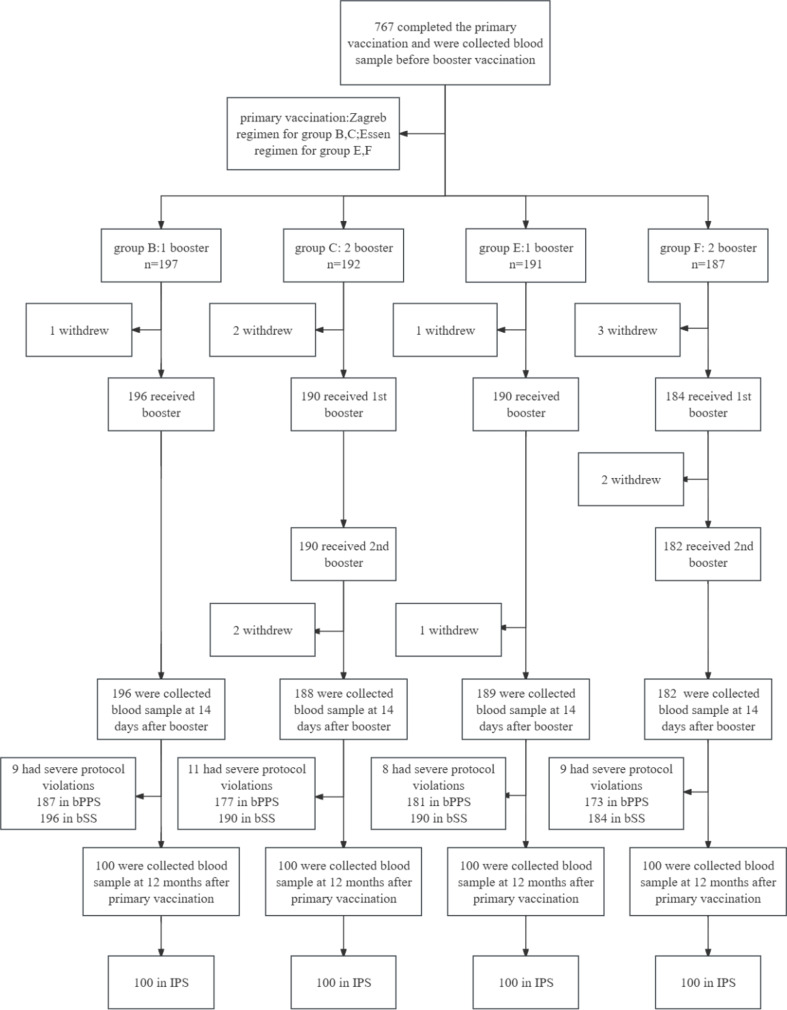
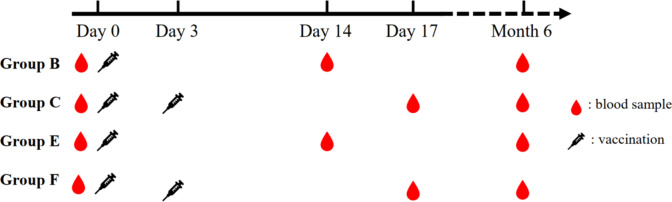
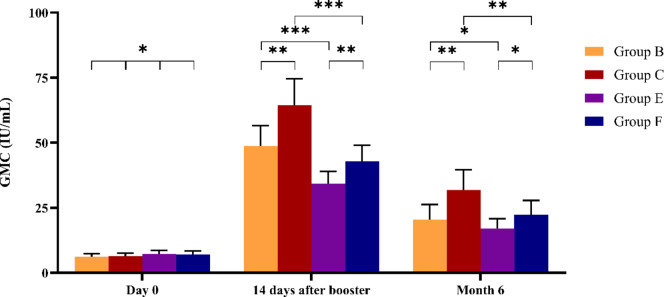
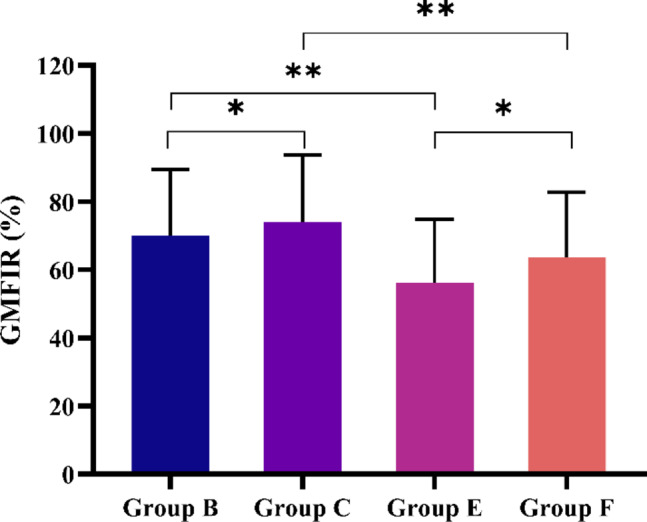
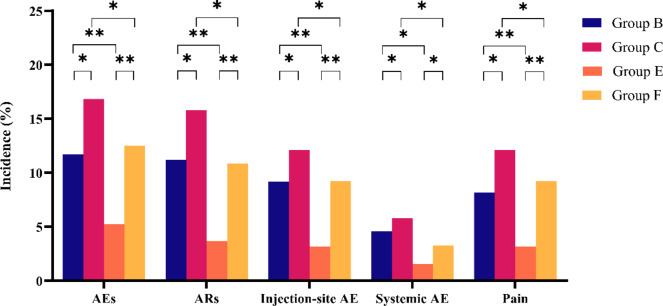
The Zagreb and Essen regimens are comparable in terms of immunogenicity; however, how these regimens impact the immunogenicity of booster vaccination remains unknown. We conducted a clinical trial to assess the immunogenicity of booster vaccination with a purified Vero cell rabies vaccine after primary vaccination with the Zagreb or Essen regimens. This randomized, open-label, controlled, phase 3 trial, conducted in Shangyu City and Shengzhou City, Zhejiang Province, China, was divided into the primary and booster vaccination phases. After screening, all eligible participants were allocated to groups A, B, C, D, E, or F. Groups A, B, and C received the Zagreb regimen as the primary vaccine, while groups D, E, and F received the Essen regimen. The booster vaccination was conducted 6 months after the primary vaccination. Groups B and E received one dose of the booster, while groups C and F received two doses. Blood samples were collected before the booster, at 14 days after the booster, and at approximately 6 months after the booster. Safety was assessed from the first booster dose to 6 months after the final dose. A total of 718 participants completed the booster vaccination. The antibody positive rate (APR) of groups B, C, E, and F after the booster was 100%. The antibody titer rose significantly even after one booster, and was much higher in groups B (48.80 IU/ml) and C (64.38 IU/ml) (receiving Zagreb) than in groups E (34.25 IU/ml) and F (42.89 IU/ml) (receiving Essen). Although the incidence of ARs was higher in groups B (11.22%) and C (15.79%) than in groups E (3.68%) and F (10.87%), they were all mild and short-lived. No serious adverse events (SAEs) associated with vaccination were reported. The immunogenicity of booster vaccination after the Zagreb regimen was significantly higher than that after the Essen regimen. One booster may be sufficient to raise the antibody titer above the 0.5 IU/mL target.Clinical trial registration: This trial is registered at http://www.chinadrugtrials.org.cn/index.html under the registration number CTR20210426 at 08/03/2021.
萨格勒布方案和埃森方案在免疫原性方面具有可比性;然而,这些方案如何影响加强免疫的免疫原性仍不清楚。我们开展了一项临床试验,以评估在采用萨格勒布或埃森方案进行初次疫苗接种后,使用纯化的Vero细胞狂犬病疫苗进行加强免疫的免疫原性。这项在中国浙江省上虞市和嵊州市进行的随机、开放标签、对照3期试验分为初次疫苗接种阶段和加强免疫阶段。筛选后,所有符合条件的参与者被分配到A、B、C、D、E或F组。A、B和C组接受萨格勒布方案作为初次疫苗,而D、E和F组接受埃森方案。在初次疫苗接种6个月后进行加强免疫。B组和E组接受一剂加强疫苗,而C组和F组接受两剂。在加强免疫前、加强免疫后14天以及加强免疫后约6个月采集血样。从第一剂加强疫苗到最后一剂疫苗后6个月评估安全性。共有718名参与者完成了加强免疫。加强免疫后,B、C、E和F组的抗体阳性率(APR)为100%。即使只进行一次加强免疫,抗体滴度也显著升高,并且接受萨格勒布方案的B组(48.80 IU/ml)和C组(64.38 IU/ml)的抗体滴度远高于接受埃森方案的E组(34.25 IU/ml)和F组(42.89 IU/ml)。虽然B组(发生率为11.22%)和C组(发生率为15.79%)的不良反应发生率高于E组(发生率为3.68%)和F组(发生率为10.87%),但均为轻度且持续时间短。未报告与疫苗接种相关的严重不良事件(SAE)。萨格勒布方案后的加强免疫免疫原性显著高于埃森方案。一次加强免疫可能足以使抗体滴度升至0.5 IU/mL目标值以上。临床试验注册:本试验于2021年3月8日在http://www.chinadrugtrials.org.cn/index.html注册,注册号为CTR20210426。