Richardson Elizabeth, McCartney Gerry, Taulbut Martin, Douglas Margaret, Craig Neil
Place and Wellbeing Directorate, Public Health Scotland, Edinburgh, UK.
School of Social and Political Sciences, University of Glasgow, Glasgow, UK.
BMJ Public Health. 2023 Jul 25;1(1):e000097. doi: 10.1136/bmjph-2023-000097. eCollection 2023 Nov.
To inform policymaking, it is important to understand the population health impacts of recent increased inflation, and of measures implemented to mitigate these.
We used scenario modelling to estimate (a) how recent increased inflation would affect household incomes in Scotland, (b) how mitigation measures would modify these effects and (c) how mortality outcomes and inequalities in these would change as a result. Against a long-term average inflation scenario (baseline), we compared unmitigated recent inflation and inflation mitigated by UK Government support policies. We estimated differential price inflation by income quintile, based on the proportion of household spending on different goods and services. Using differential inflation rates, we estimated change in spending power (real income) for 2704 Scottish households in the 2015/16 Family Resources Survey, both with and without mitigating UK Government policies, and scaled these to the Scottish population. We estimated mortality effects using a cross-sectional relationship between household income and mortality, by deprivation quintile.
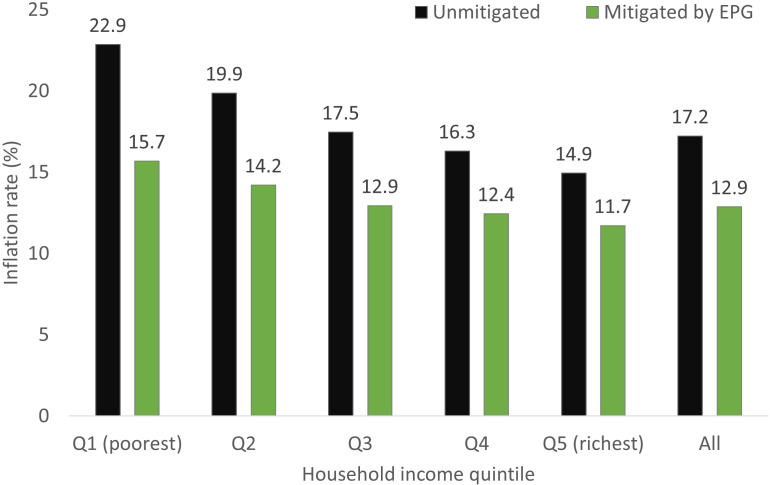
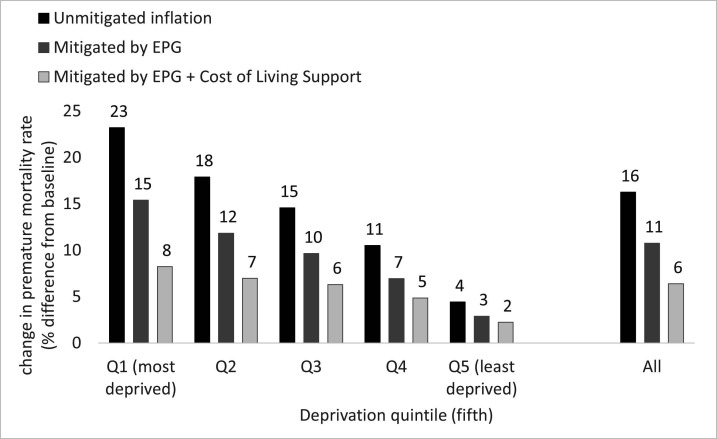
Unmitigated price inflation was 14.9% for the highest income quintile and 22.9% for the lowest. UK Government policies partially mitigated impacts of the rising cost of living on real incomes, although households in the most deprived areas of Scotland would still be £1400 per year worse off than at baseline. As a result, even with mitigating measures in place, premature mortality was estimated to increase by up to 6.4%, and life expectancy to decrease by up to 0.9%. Effects would be greater in more deprived areas, and health inequalities would increase as a result.
Large and inequitable impacts on mortality in Scotland are predicted if real-terms income reductions are sustained. Progressive Cost of Living Support payments are not sufficient to offset the mortality impacts of the greater real income reductions in deprived areas.
为了为政策制定提供依据,了解近期通货膨胀加剧对人口健康的影响以及为缓解这些影响而采取的措施非常重要。
我们使用情景建模来估计(a)近期通货膨胀加剧将如何影响苏格兰的家庭收入,(b)缓解措施将如何改变这些影响,以及(c)死亡率结果及其不平等将因此如何变化。与长期平均通货膨胀情景(基线)相比,我们比较了未缓解的近期通货膨胀和英国政府支持政策缓解后的通货膨胀。我们根据家庭在不同商品和服务上的支出比例,估计了按收入五分位数划分的差异价格通货膨胀。利用差异通货膨胀率,我们估计了2015/16年家庭资源调查中2704个苏格兰家庭在有和没有英国政府缓解政策情况下的支出能力(实际收入)变化,并将这些变化按比例扩大到苏格兰人口。我们利用家庭收入与死亡率之间的横断面关系,按贫困五分位数估计了死亡率影响。
最高收入五分位数的未缓解价格通货膨胀率为14.9%,最低收入五分位数为22.9%。英国政府的政策部分缓解了生活成本上升对实际收入的影响,尽管苏格兰最贫困地区的家庭每年仍比基线水平少1400英镑。因此,即使采取了缓解措施,预计过早死亡率仍将上升高达6.4%,预期寿命将下降高达0.9%。在更贫困地区,影响会更大,健康不平等也会因此加剧。
如果实际收入持续下降,预计将对苏格兰的死亡率产生巨大且不公平的影响。逐步的生活成本支持付款不足以抵消贫困地区实际收入大幅下降对死亡率的影响。