Saputra Rhyan Darma, Kusuma Dita Anggara, Kaldani Fathih, Fahmi Khoirul
Orthopaedic and Traumatology Department, Faculty of Medicine, Sebelas Maret University, Indonesia.
Orthopaedic and Traumatology Department, Moewardi General Hospital, Indonesia.
J Bone Oncol. 2025 Feb 8;51:100663. doi: 10.1016/j.jbo.2025.100663. eCollection 2025 Apr.
Giant cell tumor of bone (GCTB) is among the most prevalent benign primary bone tumors, characterized by its potential for aggressive local recurrence, soft tissue invasion, and, though rare, lung metastasis. Emerging evidence suggests unique behavioral patterns of GCTB in extremities. This study seeks to rigorously compare the aggressiveness of GCTB in the upper versus lower extremities, centering on recurrence rates.
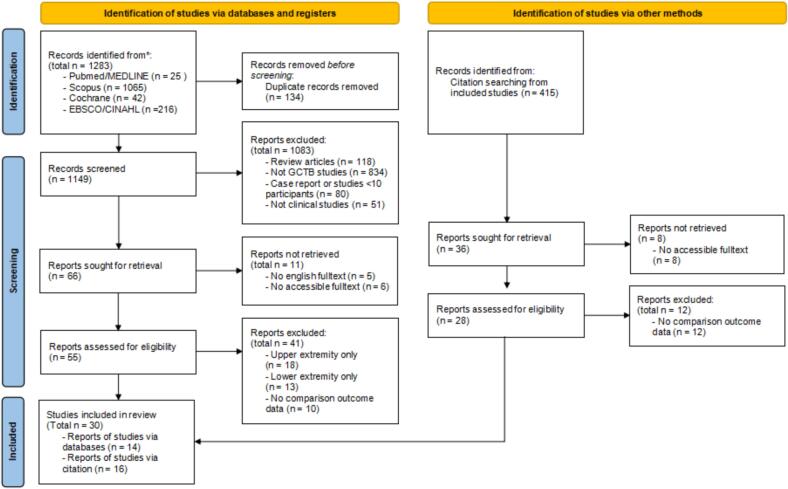
This systematic review and meta-analysis, conducted in accordance with PRISMA guidelines, sourced data from MEDLINE/PubMed, Cochrane, Scopus, CINAHL/EBSCO, and reference lists of pertinent studies. Two independent reviewers screened studies, with discrepancies resolved by discussion. Eligible studies included a minimum of 10 participants. Data extraction and analysis were performed by an additional team of two researchers.
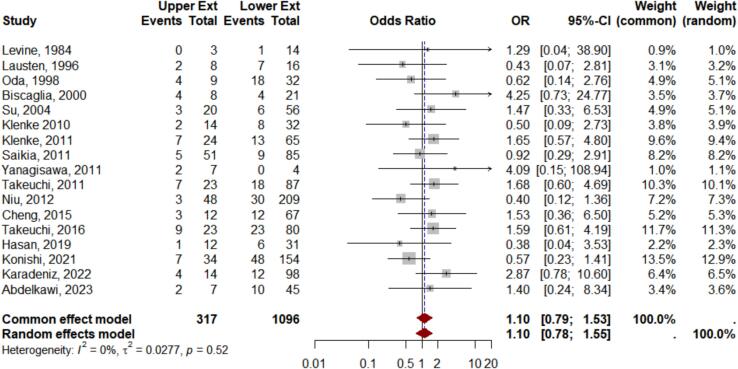
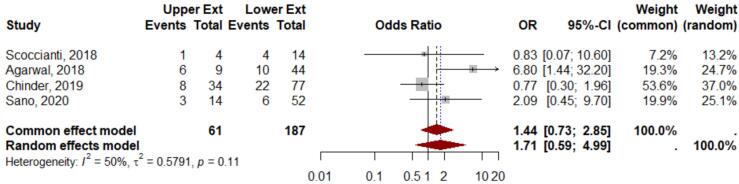
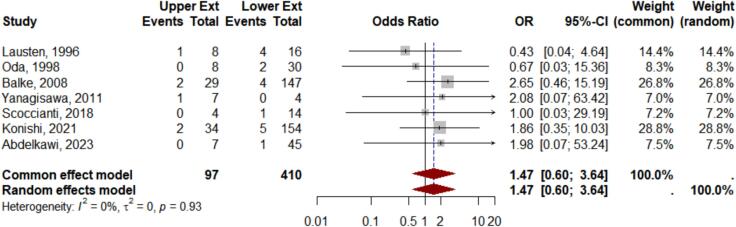
Out of 1,283 studies spanning from 1984 to 2023, 30 met eligibility, encompassing 2,672 participants. The mean age was 32.77 ± 12.99 years, with an average follow-up of 75.53 ± 65.88 months. GCTB predominantly affected the lower extremities, accounting for 1,937 cases. Notably, comparisons of aggressiveness between upper and lower extremity GCTB revealed no statistically significant difference (OR = 1.10, p = 0.56 for Surgery Group; OR = 1.16, p = 0.45 for Local Adjuvant Group; and OR = 1.71, p = 0.32 for Drug/Denosumab Group).
This analysis underscores the lower extremities as the primary site for GCTB but finds no significant difference in aggressiveness between upper and lower extremities. These findings challenge assumptions about GCTB behavior based on tumor location and highlight the need for further investigation to fully elucidate the complex biology of extremity GCTB.
骨巨细胞瘤(GCTB)是最常见的原发性良性骨肿瘤之一,其特点是具有局部侵袭性复发、软组织侵犯的可能性,以及虽罕见但会发生肺转移。新出现的证据表明肢体GCTB具有独特的行为模式。本研究旨在严格比较上肢与下肢GCTB的侵袭性,重点关注复发率。
本系统评价和荟萃分析按照PRISMA指南进行,从MEDLINE/PubMed、Cochrane、Scopus、CINAHL/EBSCO以及相关研究的参考文献列表中获取数据。两名独立评审员筛选研究,如有分歧通过讨论解决。符合条件的研究至少有10名参与者。另外由两名研究人员组成的团队进行数据提取和分析。
在1984年至2023年的1283项研究中,30项符合纳入标准,涵盖2672名参与者。平均年龄为32.77±12.99岁,平均随访时间为75.53±65.88个月。GCTB主要累及下肢,共1937例。值得注意的是,上肢与下肢GCTB侵袭性的比较显示,差异无统计学意义(手术组:OR = 1.10,p = 0.56;局部辅助治疗组:OR = 1.16,p = 0.45;药物/地诺单抗组:OR = 1.71,p = 0.32)。
本分析强调下肢是GCTB的主要发病部位,但上肢和下肢GCTB在侵袭性方面无显著差异。这些发现挑战了基于肿瘤位置对GCTB行为的假设,并突出了进一步研究以充分阐明肢体GCTB复杂生物学特性的必要性。