Tu Chih-Han, Ruan Shengfeng, Holt Michelle, Bourne Christina R
Department of Chemistry and Biochemistry, University of Oklahoma, Norman, Oklahoma, USA.
J Bacteriol. 2025 Mar 20;207(3):e0041624. doi: 10.1128/jb.00416-24. Epub 2025 Mar 3.
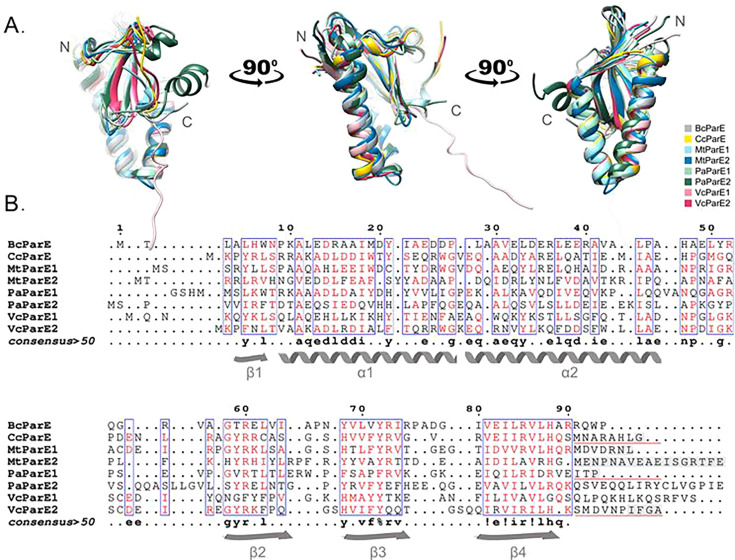
DNA gyrase is an essential bacterial-specific type IIA topoisomerase that corrects DNA overwinding during transcription and replication. Compounds capable of stabilizing gyrase-mediated double-strand DNA breaks are valuable antibacterials; however, these can trigger error-prone repair, potentially inducing DNA mutations leading to antimicrobial resistance. ParE toxin proteins, which belong to a family of type II toxin-antitoxin systems, inhibit DNA gyrase and promote the persistence of double-strand DNA breaks. However, it is unclear if the ParE-induced gyrase inhibition is equivalent for all ParE family members, or if any mutations arise and can accumulate to cause antibiotic resistance. Selected chromosomal ParE toxins were examined for toxicity to their native bacterial hosts, and the frequency of mutations and impact on susceptibility to selected antibiotics were assessed. Our results show that ParE toxins from , , , and exert potent toxicities toward the native cells, whereas one tested ParE toxin from was not toxic. The contribution to toxicity of the ParE toxin C-terminal amino acid sequences was examined using two lab-generated chimeric ParE toxins; our results demonstrate that this region did not impact the toxicity level. Our study finds that the relative potency of individual ParE toxins correlates with increases in mutation frequency. While some ParE toxins induced limited collateral sensitivity to selected antibiotics, no increases in MIC values were found. Overall, this study demonstrates the relative toxicity of different ParE toxins. Importantly, the toxicity appears to result in loss of viability before productive resistance-inducing mutations can accumulate.
Toxin-antitoxin (TA) systems can halt growth or kill cells when the toxin protein engages with the host cell target. In the ParDE TA system, the toxin ParE inhibits DNA gyrase, resulting in loss of viability that phenocopies fluoroquinolone antibiotics. Our study demonstrates that ParE toxins increase the frequency of mutations, presumably by a mechanism similar to fluoroquinolone antibiotics. These increases scale to the resulting toxicity, and importantly, these mutations do not accumulate into productive antibacterial resistance. This suggests that ParE toxins are not intrinsic drivers of resistance and, if the molecular mechanism can be harnessed, could generate a new class of gyrase inhibitors.
DNA促旋酶是一种必需的细菌特异性IIA型拓扑异构酶,可在转录和复制过程中纠正DNA过度缠绕。能够稳定促旋酶介导的双链DNA断裂的化合物是有价值的抗菌剂;然而,这些化合物可引发易出错的修复,可能诱导DNA突变,导致抗菌药物耐药性。属于II型毒素-抗毒素系统家族的ParE毒素蛋白可抑制DNA促旋酶,并促进双链DNA断裂的持续存在。然而,尚不清楚ParE诱导的促旋酶抑制作用对所有ParE家族成员是否相同,或者是否会出现任何突变并积累导致抗生素耐药性。对选定的染色体ParE毒素对其天然细菌宿主的毒性进行了检测,并评估了突变频率以及对选定抗生素敏感性的影响。我们的结果表明,来自[具体细菌名称1]、[具体细菌名称2]、[具体细菌名称3]和[具体细菌名称4]的ParE毒素对天然细胞具有强大的毒性,而测试的一种来自[具体细菌名称5]的ParE毒素则没有毒性。使用两种实验室生成的嵌合ParE毒素检测了ParE毒素C末端氨基酸序列对毒性的贡献;我们的结果表明,该区域不影响毒性水平。我们的研究发现,单个ParE毒素的相对效力与突变频率的增加相关。虽然一些ParE毒素对选定抗生素诱导的旁系敏感性有限,但未发现最低抑菌浓度(MIC)值增加。总体而言,本研究证明了不同ParE毒素的相对毒性。重要的是,这种毒性似乎在导致耐药性的有效突变积累之前就导致了细胞活力丧失。
当毒素蛋白与宿主细胞靶点结合时,毒素-抗毒素(TA)系统可阻止生长或杀死细胞。在ParDE TA系统中,毒素ParE抑制DNA促旋酶,导致细胞活力丧失,其表型类似于氟喹诺酮类抗生素。我们的研究表明,ParE毒素增加了突变频率,推测其机制与氟喹诺酮类抗生素类似。这些增加与产生的毒性成比例,重要的是,这些突变不会积累形成有效的抗菌药物耐药性。这表明ParE毒素不是耐药性的内在驱动因素,如果能够利用其分子机制,可能会产生一类新的促旋酶抑制剂。