Sinimeri Deili, Childs Caroline, Golm Dennis
School of Psychology, Faculty of Environmental and Life Sciences, Centre for Innovation in Mental Health, University of Southampton, Southampton, UK.
School of Human Development and Health, Faculty of Medicine, University of Southampton, Southampton, UK.
Nutr Bull. 2025 Jun;50(2):239-249. doi: 10.1111/nbu.12734. Epub 2025 Mar 4.
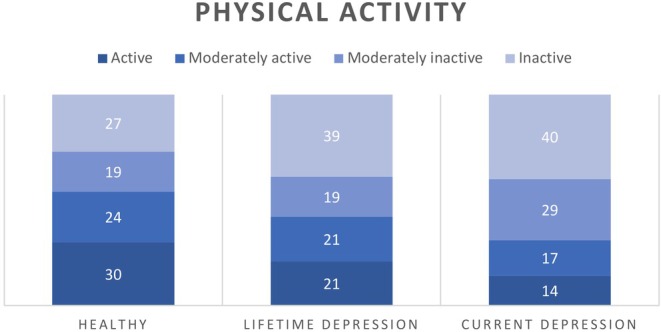
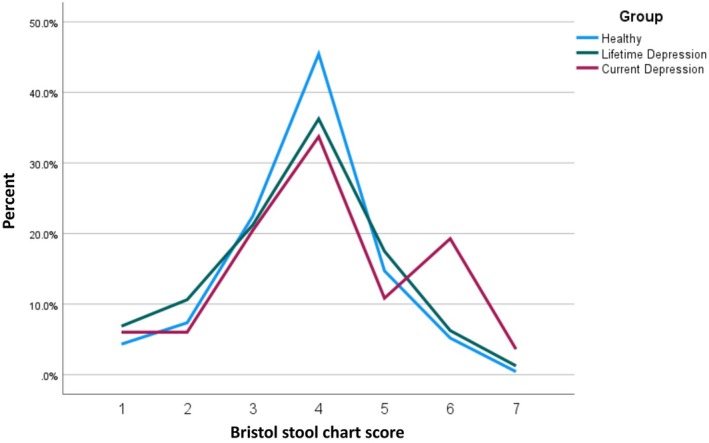
Lifestyle factors such as diet and physical activity are involved in the development and maintenance of depression, but the mechanism by which these factors influence mental health remains unclear. The aim of this study was to investigate whether gastrointestinal health helps explain some of the relationship between these lifestyle factors and depression. The study used a cross-sectional design to compare dietary intake, physical activity and gastrointestinal health in three groups, healthy (n = 235), lifetime depression (n = 161) and current depression (n = 86). Dietary intake was measured by the Fruit And Vegetable VAriety index, N-3 PUFA Food Frequency Questionnaire and Prebiotic and Probiotic Food Frequency Questionnaire. Analysis of variance, Pearson correlations and Hayes PROCESS macro mediation analysis were used to compare the groups and examine the relationships. Physical activity and gastrointestinal health differed significantly between the groups with no differences in overall fruit and vegetable, omega-3 and probiotic food intake. Bootstrapped correlations showed that higher fruit and vegetable and omega-3 intake were associated with lower gastrointestinal symptom and depression scores, but effects were weak. Furthermore, higher occurrence of gastrointestinal symptoms was moderately associated with higher depression scores. Results from a series of exploratory mediation analyses suggested that gastrointestinal symptoms mediated the relationship between lifestyle factors and depression status. These data indicate that the effects of lifestyle factors on depression might partly work through the gastrointestinal system. The findings of this study help further understand the mechanisms between dietary intake and physical activity, and depression and can inform future longitudinal and experimental studies.
饮食和体育活动等生活方式因素与抑郁症的发生和维持有关,但这些因素影响心理健康的机制尚不清楚。本研究的目的是调查胃肠道健康是否有助于解释这些生活方式因素与抑郁症之间的部分关系。该研究采用横断面设计,比较了三组人群的饮食摄入、体育活动和胃肠道健康状况,分别为健康组(n = 235)、终生患抑郁症组(n = 161)和当前患抑郁症组(n = 86)。饮食摄入通过果蔬种类指数、n-3多不饱和脂肪酸食物频率问卷以及益生元和益生菌食物频率问卷进行测量。采用方差分析、Pearson相关性分析和Hayes PROCESS宏中介分析来比较各组并检验相关关系。各组之间的体育活动和胃肠道健康存在显著差异,而总体果蔬、ω-3和益生菌食物摄入量无差异。自抽样相关性分析表明,较高的果蔬和ω-3摄入量与较低的胃肠道症状和抑郁评分相关,但影响较弱。此外,较高的胃肠道症状发生率与较高的抑郁评分中度相关。一系列探索性中介分析的结果表明,胃肠道症状介导了生活方式因素与抑郁状态之间的关系。这些数据表明,生活方式因素对抑郁症的影响可能部分通过胃肠道系统起作用。本研究结果有助于进一步理解饮食摄入和体育活动与抑郁症之间的机制,并可为未来的纵向研究和实验研究提供参考。