Siddiq Bilal S, Mun Jeffrey S, Dean Michael C, Gillinov Stephen M, Lee Jonathan S, Dowley Kieran S, Cherian Nathan J, Martin Scott D
Sports Medicine, Department of Orthopaedic Surgery, Massachusetts General Hospital, Boston, Massachusetts, U.S.A.
Arthrosc Sports Med Rehabil. 2024 Oct 15;7(1):101026. doi: 10.1016/j.asmr.2024.101026. eCollection 2025 Feb.
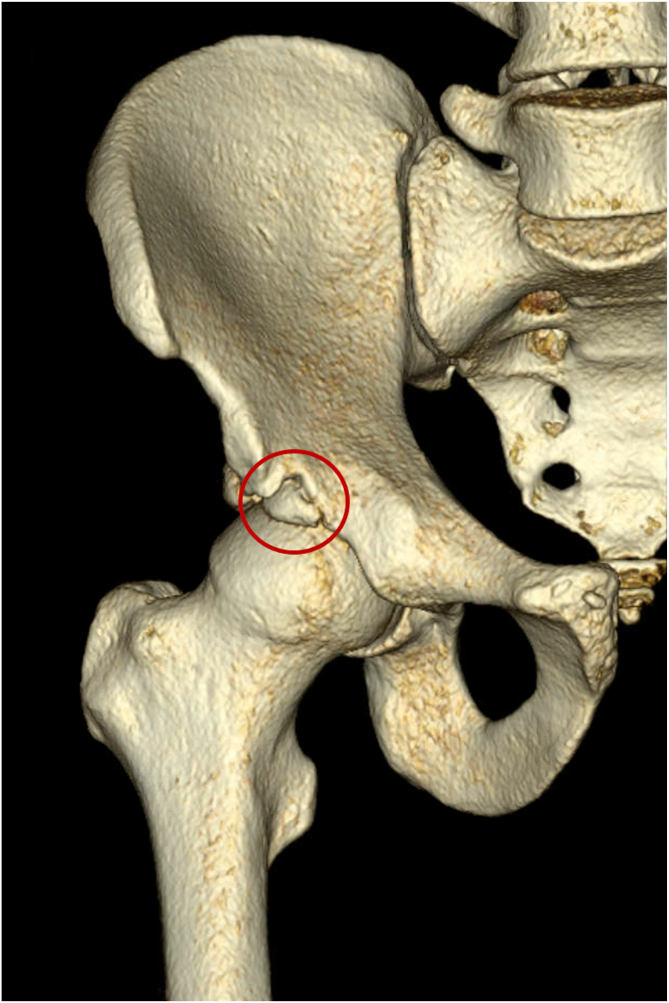
To investigate whether os acetabuli identified preoperatively influence functional outcomes 2 years after an arthroscopic acetabular labral reconstruction.
Retrospective study with prospectively collected data of patients undergoing primary hip arthroscopy by a single, fellowship-trained surgeon at a single institution were retrospectively reviewed. Inclusion criteria included age ≥18 years and completion of patient-reported outcome measures (PROMs) preoperatively and at 3-month, 6-month, 12-month, and last follow-up timepoints. Exclusion criteria included labral debridement, hip dysplasia, advanced hip osteoarthritis (Tonnis >1), or previous surgery on the ipsilateral hip. Patients were divided into two cohorts based on the presence of os acetabuli (OA) or the absence of os acetabuli (NOA). Primary outcomes collected included the International Hip Outcome Tool (iHOT-33) and modified Harris Hip Score (mHHS). Secondary outcomes were the Hip Outcome Score-Activities of Daily Living, Hip Outcome Score-Sports Subscale, Non-Arthritic Hip Score, and visual analog pain scale. Inter-cohort outcomes were compared using linear mixed-effects and Fisher's exact tests. Nonlinear improvement trajectories were accounted for by sensitivity analyses.
193 hips (49.2% female; mean ± SD age: 35.9 ± 11.0) were included in the final analyses. Of these, 25 (13.0%) had an os acetabulum. No significant differences between patients with and without os acetabuli were found throughout the minimum 2-year follow-up period in terms of iHOT-33 scores (weighted difference: 0.09; 95% CI: -6.81, 6.98; = .98), mHHS (weighted difference: 2.93; 95% CI: -2.13, 7.98; = .26), or any secondary outcomes. Additionally, there were no significant differences in any queried clinically meaningful outcomes ( > .05 for all), revision arthroscopy ( =.342), rates of formation of heterotopic ossification ( > .999), or conversion to total hip arthroplasty ( > .999). These results were upheld across sensitivity analyses.
Patients with os acetabuli undergoing arthroscopic labral reconstruction had similar 2-year functional outcomes compared to those without os acetabuli.
Level III, Retrospective cohort study.
探讨术前发现的髋臼骨块是否会影响关节镜下髋臼盂唇重建术后2年的功能结局。
对由一名在单一机构接受过专科培训的外科医生进行的初次髋关节镜检查患者的前瞻性收集数据进行回顾性研究。纳入标准包括年龄≥18岁,以及术前、术后3个月、6个月、12个月和最后随访时间点完成患者报告的结局指标(PROMs)。排除标准包括盂唇清创术、髋关节发育不良、晚期髋关节骨关节炎(Tonnis>1)或同侧髋关节既往手术史。根据髋臼骨块(OA)的存在与否将患者分为两个队列。收集的主要结局指标包括国际髋关节结局工具(iHOT-33)和改良Harris髋关节评分(mHHS)。次要结局指标为髋关节结局评分-日常生活活动、髋关节结局评分-运动亚量表、非关节炎髋关节评分和视觉模拟疼痛量表。使用线性混合效应和Fisher精确检验比较队列间结局。通过敏感性分析考虑非线性改善轨迹。
193例髋关节(49.2%为女性;平均±标准差年龄:35.9±11.0)纳入最终分析。其中,25例(13.0%)有髋臼骨块。在至少2年的随访期内,有髋臼骨块和无髋臼骨块的患者在iHOT-33评分(加权差异:0.09;95%CI:-6.81,6.98;P = 0.98)、mHHS(加权差异:2.93;95%CI:-2.13,7.98;P = 0.26)或任何次要结局方面均未发现显著差异。此外,在任何询问的具有临床意义的结局(所有P>0.05)、翻修关节镜检查(P = 0.342)、异位骨化形成率(P>0.999)或转换为全髋关节置换术(P>0.999)方面也没有显著差异。这些结果在敏感性分析中得到了支持。
与无髋臼骨块的患者相比,接受关节镜下盂唇重建的有髋臼骨块患者在2年时具有相似的功能结局。
III级,回顾性队列研究。