Ma Baoqiang, De Biase Alessia, Guo Jiapan, van Dijk Lisanne V, Langendijk Johannes A, Both Stefan, van Ooijen Peter M A, Sijtsema Nanna M
Department of Radiation Oncology, University of Groningen, University Medical Centre Groningen (UMCG), Groningen, the Netherlands.
Data Science Centre in Health (DASH), Groningen, the Netherlands.
Phys Imaging Radiat Oncol. 2025 Feb 14;33:100733. doi: 10.1016/j.phro.2025.100733. eCollection 2025 Jan.
Deep learning (DL) models can extract prognostic image features from pre-treatment PET/CT scans. The study objective was to explore the potential benefits of incorporating pathologic lymph node (PL) spatial information in addition to that of the primary tumor (PT) in DL-based models for predicting local control (LC), regional control (RC), distant-metastasis-free survival (DMFS), and overall survival (OS) in oropharyngeal cancer (OPC) patients.
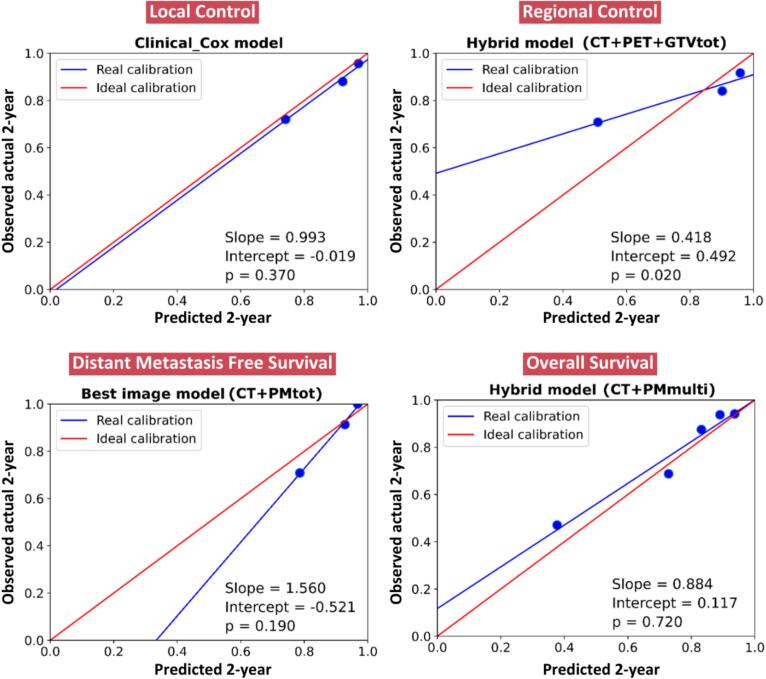
The study included 409 OPC patients treated with definitive (chemo)radiotherapy between 2010 and 2022. Patient data, including PET/CT scans, manually contoured PT (GTVp) and PL (GTVln) structures, clinical variables, and endpoints, were collected. Firstly, a DL-based method was employed to segment tumours in PET/CT, resulting in predicted probability maps for PT (TPMp) and PL (TPMln). Secondly, different combinations of CT, PET, manual contours and probability maps from 300 patients were used to train DL-based outcome prediction models for each endpoint through 5-fold cross validation. Model performance, assessed by concordance index (C-index), was evaluated using a test set of 100 patients.
Including PL improved the C-index results for all endpoints except LC. For LC, comparable C-indices (around 0.66) were observed between models trained using only PT and those incorporating PL as additional structure. Models trained using PT and PL combined into a single structure achieved the highest C-index of 0.65 and 0.80 for RC and DMFS prediction, respectively. Models trained using these target structures as separate entities achieved the highest C-index of 0.70 for OS.
Incorporating lymph node spatial information improved the prediction performance for RC, DMFS, and OS.
深度学习(DL)模型可从治疗前的PET/CT扫描中提取预后图像特征。本研究的目的是探讨在基于DL的模型中,除了原发性肿瘤(PT)的空间信息外,纳入病理淋巴结(PL)空间信息对预测口咽癌(OPC)患者的局部控制(LC)、区域控制(RC)、无远处转移生存期(DMFS)和总生存期(OS)的潜在益处。
本研究纳入了2010年至2022年间接受确定性(化疗)放疗的409例OPC患者。收集了患者数据,包括PET/CT扫描、手动勾勒的PT(GTVp)和PL(GTVln)结构、临床变量及终点指标。首先,采用基于DL的方法对PET/CT中的肿瘤进行分割,得到PT(TPMp)和PL(TPMln)的预测概率图。其次,利用300例患者的CT、PET、手动轮廓和概率图的不同组合,通过5折交叉验证为每个终点指标训练基于DL的结局预测模型。使用100例患者的测试集评估模型性能,评估指标为一致性指数(C指数)。
纳入PL可改善除LC外所有终点指标的C指数结果。对于LC,仅使用PT训练的模型与纳入PL作为附加结构的模型之间观察到相当的C指数(约0.66)。将PT和PL组合成单一结构训练的模型在RC和DMFS预测中分别达到了最高的C指数0.65和0.80。将这些靶结构作为单独实体训练的模型在OS预测中达到了最高的C指数0.70。
纳入淋巴结空间信息可改善RC、DMFS和OS的预测性能。