Iulini Martina, Bettinsoli Valeria, Maddalon Ambra, Galbiati Valentina, Janssen Aafke W F, Beekmann Karsten, Russo Giulia, Pappalardo Francesco, Fragki Styliani, Paini Alicia, Corsini Emanuela
Laboratory of Toxicology, Department of Pharmacological and Biomolecular Sciences "Rodolfo Paoletti", Università degli Studi di Milano, Via Balzaretti 9, 20133, Milan, Italy.
Department of Pharmacy, Università degli Studi di Napoli Federico II, Napoli, Italy.
Arch Toxicol. 2025 May;99(5):2075-2086. doi: 10.1007/s00204-025-03993-6. Epub 2025 Mar 6.
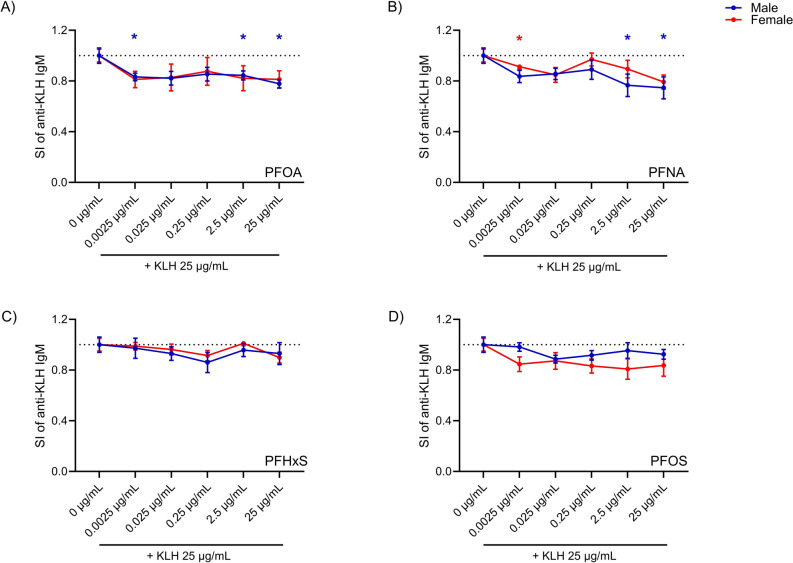
The increasing variety and quantity of new chemical substances have raised concerns about their potential immunotoxic effects, making it essential to assess their impact on human health. One key concern is the reduction of antibody production, as seen with per- and poly-fluoroalkyl substances (PFASs), commonly known as "forever chemicals." Both in vivo and epidemiological data show that PFASs have immunosuppressive effects, leading to reduced antibody responses, particularly following vaccination. In animal studies, the T cell-dependent (TD) antibody response is the gold standard for assessing chemical effects on immune function. This study utilized two in vitro approaches to investigate the effects of chemicals on antibody production using human peripheral blood mononuclear cells. Initial tests used unstimulated, negative (vehicle), and positive (rapamycin) controls to confirm the robustness of the models. Subsequently, four long-chain PFASs (PFOA, PFOS, PFNA, and PFHxS) were tested. Keyhole limpet hemocyanin (KLH) was used to mimic the TD response, while a TLR9 agonist and IL-2 activated B cells for T cell-independent (TI) immunoglobulin production. The results demonstrated the ability to reproduce TD and TI responses in vitro with robust, reproducible outcomes across a cohort of 20 human donors. The data, consistent with existing literature, showed a significant reduction in anti-KLH IgM production, especially for PFOA in male donors. Similar trends were observed for all PFASs in suppressing total TI IgG and IgM production. These methods closely replicated in vivo conditions, offering a potential alternative to animal models in immunotoxicity assessments.
新化学物质的种类和数量不断增加,引发了人们对其潜在免疫毒性作用的担忧,因此评估它们对人类健康的影响至关重要。一个关键问题是抗体产生的减少,全氟和多氟烷基物质(PFASs),即通常所说的“永久化学物质”,就出现了这种情况。体内和流行病学数据均表明,PFASs具有免疫抑制作用,会导致抗体反应降低,尤其是在接种疫苗后。在动物研究中,T细胞依赖性(TD)抗体反应是评估化学物质对免疫功能影响的金标准。本研究采用两种体外方法,利用人外周血单个核细胞来研究化学物质对抗体产生的影响。初始测试使用未刺激的、阴性(赋形剂)和阳性(雷帕霉素)对照来确认模型的稳健性。随后,对四种长链PFASs(全氟辛酸(PFOA)、全氟辛烷磺酸(PFOS)、全氟壬酸(PFNA)和全氟己烷磺酸(PFHxS))进行了测试。钥孔戚血蓝蛋白(KLH)用于模拟TD反应,而Toll样受体9(TLR9)激动剂和白细胞介素-2(IL-2)激活B细胞以产生T细胞非依赖性(TI)免疫球蛋白。结果表明,在20名人类供体的队列中,能够在体外重现TD和TI反应,且结果稳健、可重复。与现有文献一致的数据显示,抗KLH IgM的产生显著减少,尤其是男性供体中的PFOA。在抑制总TI IgG和IgM产生方面,所有PFASs都观察到了类似趋势。这些方法紧密复制了体内条件,为免疫毒性评估中的动物模型提供了一种潜在替代方案。