Zeng Peter Y F, Lin R Jun, Fung Kevin, Khan Halema, Cecchini Matthew J, Woo Elissa, Hu Amanda, Anderson Jennifer, MacInnis Patrick, Jarycki Laura, Karimi Amir, Ying Shengjie, Al Jawhri MohdWessam, Lin Sherman, Shaikh Mushfiq, Pan Harrison, Coburn Bryan, Mymryk Joe S, Inculet Richard, Barrett John W, Nichols Anthony C
Department of Otolaryngology - Head & Neck Surgery, Western University, London, Ontario, Canada; Department of Pathology and Laboratory Medicine, Western University, London, Ontario, Canada.
Department of Otolaryngology - Head & Neck Surgery, Temerty Faculty of Medicine, University of Toronto, Unity Health Toronto, St. Michael's Hospital, Toronto, Ontario, Canada.
EBioMedicine. 2025 Apr;114:105631. doi: 10.1016/j.ebiom.2025.105631. Epub 2025 Mar 5.
The larynx consists of the supraglottis, glottis, and subglottis and each differ in tissue composition, lymphatic drainage, ability to counter infections, and response to injuries. However, the cellular mechanisms driving laryngeal homoeostasis remain largely unexplored. As a result, understanding disease pathogenesis within the larynx including idiopathic subglottic stenosis (iSGS) and intubation-related traumatic stenosis has been challenging. Here, we sought to characterise the cellular processes governing laryngeal health and disease.
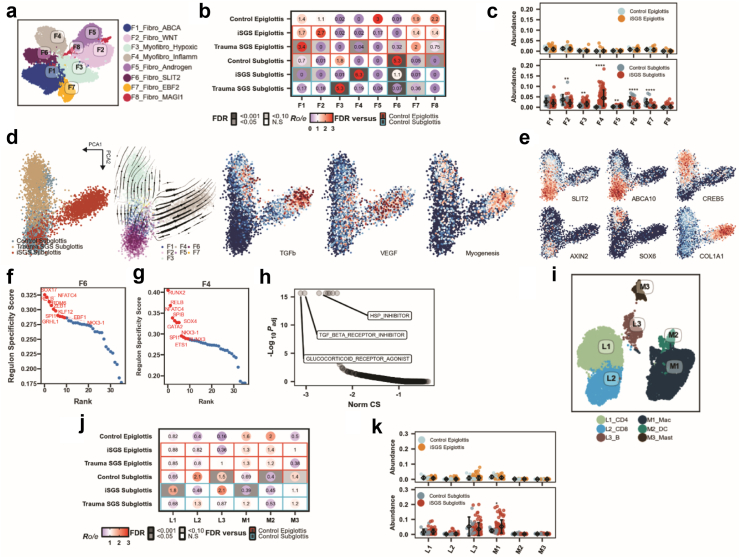
As part of the prospective Canadian Airways Research (CARE) iSGS study, we characterised 122,004 high-quality transcriptomes using single nucleus RNA-sequencing to profile 11 human epiglottis and 17 human subglottis biopsies across three different conditions: control, iSGS, and intubation-related traumatic stenosis to define cell populations and pathways associated with disease. We validated our results using cohort-level bulk transcriptomics using 114 human epiglottis and 121 human subglottis.
We defined the single-cell taxonomy of the human subglottis and epiglottis using single-nucleus sequencing in both healthy and disease states. Mechanistically, we discovered the presence of unique epithelial and fibroblast progenitor subsets within the control subglottis but not within the anatomically adjacent epiglottis. The uncontrolled proliferation of these cellular subsets exhibited skewed sex hormone signalling and orchestrated a fibro-inflammatory cascade. We leveraged cohort-level bulk transcriptomics to define hallmarks of iSGS associated with disease covariates and introduced the first biomarker associated with recurrent relapse. Longitudinal sampling demonstrated that the subglottic microenvironment in patients with iSGS is changing dynamically with and without therapeutic intervention.
Together, our data refines our understanding of laryngeal biology, nominates candidate compounds for iSGS treatment, and serves as a transformative platform for future clinical investigations to further precision laryngology.
This study was funded by a grant from the American Laryngology Association (#1082), an Academic Medical Organisation of Southwestern Ontario innovation fund grant (INN21-016), grant support from the Departments of Otolaryngology-Head and Neck Surgery at University of Toronto, Canada and Western University, Canada. ACN was supported by the Wolfe Surgical Research Professorship in the Biology of Head and Neck Cancers Fund. PYFZ was supported by a Vanier Canada Graduate Scholarship and PSI Foundation fellowship.
喉由声门上区、声门区和声门下区组成,各区在组织构成、淋巴引流、抗感染能力及对损伤的反应等方面存在差异。然而,驱动喉内稳态的细胞机制在很大程度上仍未得到探索。因此,了解喉内疾病的发病机制,包括特发性声门下狭窄(iSGS)和插管相关创伤性狭窄,一直具有挑战性。在此,我们试图描述调控喉健康和疾病的细胞过程。
作为前瞻性加拿大气道研究(CARE)iSGS研究的一部分,我们使用单核RNA测序对122,004个高质量转录组进行了特征分析,以描绘11例人类会厌和17例人类声门下组织活检样本在三种不同情况下的特征:对照、iSGS和插管相关创伤性狭窄,从而确定与疾病相关的细胞群和信号通路。我们使用114例人类会厌和121例人类声门下组织的队列水平批量转录组学对结果进行了验证。
我们通过单核测序确定了健康和疾病状态下人类声门下区与会厌的单细胞分类。从机制上讲,我们发现在对照声门下区存在独特的上皮和成纤维细胞祖细胞亚群,而在解剖学上相邻的会厌中则不存在。这些细胞亚群的不受控制的增殖表现出性激素信号传导异常,并引发了纤维炎症级联反应。我们利用队列水平批量转录组学确定了与疾病协变量相关的iSGS特征,并引入了首个与复发相关的生物标志物。纵向采样表明,iSGS患者的声门下微环境在有或没有治疗干预的情况下都在动态变化。
总之,我们的数据深化了我们对喉生物学的理解,为iSGS治疗提名了候选化合物,并为未来进一步精准喉科学的临床研究提供了一个变革性平台。
本研究由美国喉科学会(#1082)、安大略西南部学术医学组织创新基金资助(INN21 - 016)、加拿大多伦多大学和加拿大韦仕敦大学耳鼻咽喉 - 头颈外科系的资助支持。ACN得到了头颈癌生物学沃尔夫外科研究教授基金的支持。PYFZ得到了加拿大瓦尼尔研究生奖学金和PSI基金会奖学金的支持。