Bargheet Ahmed, Noordzij Hanna Theodora, Ponsero Alise J, Jian Ching, Korpela Katri, Valles-Colomer Mireia, Debelius Justine, Kurilshikov Alexander, Pettersen Veronika Kuchařová
Host-Microbe Interaction Research Group, Department of Medical Biology, UiT The Arctic University of Norway, Tromsø, Norway; Center for New Antibacterial Strategies, UiT The Arctic University of Norway, Tromsø, Norway.
Centre for Ecological and Evolutionary Synthesis, Department of Biosciences, University of Oslo, Norway.
EBioMedicine. 2025 Apr;114:105630. doi: 10.1016/j.ebiom.2025.105630. Epub 2025 Mar 5.
The gut microbiota of infants harbours a higher proportion of antibiotic resistance genes (ARGs) compared to adults, even in infants never exposed to antibiotics. Our study aims to elucidate this phenomenon by analysing how different perinatal factors influence the presence of ARGs, mobile genetic elements (MGEs), and their bacterial hosts in the infant gut.
We searched MEDLINE and Embase up to April 3rd, 2023, for studies reporting infant cohorts with shotgun metagenomic sequencing of stool samples. The systematic search identified 14 longitudinal infant cohorts from 10 countries across three continents, featuring publicly available sequencing data with corresponding metadata. For subsequent integrative bioinformatic analyses, we used 3981 high-quality metagenomic samples from 1270 infants and 415 mothers.
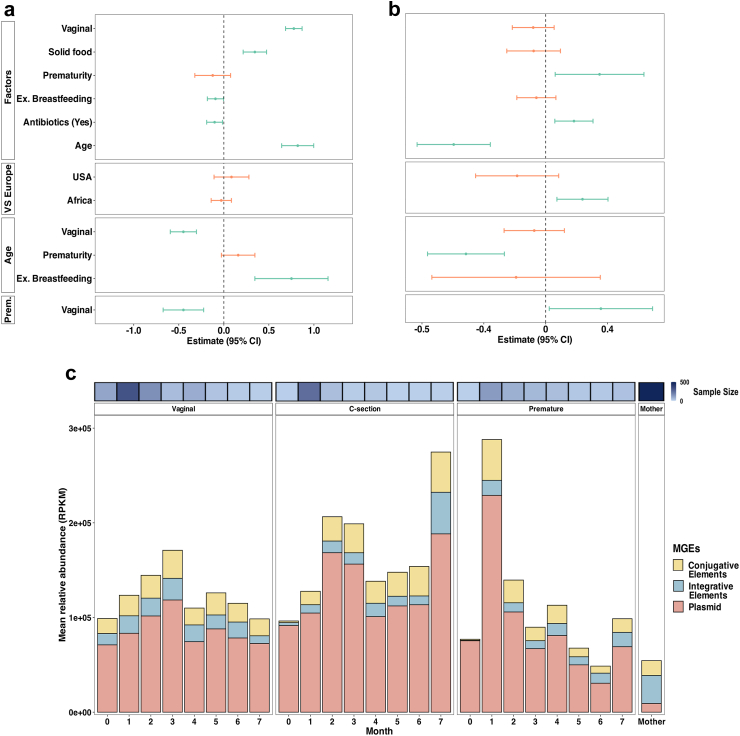
We identified distinct trajectories of the resistome and mobilome associated with birth mode, gestational age, antibiotic use, and geographical location. Geographical variation was exemplified by differences between cohorts from Europe, Southern Africa, and Northern America, which showed variation in both diversity and abundance of ARGs. On the other hand, we did not detect a significant impact of breastfeeding on the infants' gut resistome. More than half of detected ARGs co-localised with plasmids in key bacterial hosts, such as Escherichia coli and Enterococcus faecalis. These ARG-associated plasmids were gradually lost during infancy. We also demonstrate that E. coli role as a primary modulator of the infant gut resistome and mobilome is facilitated by its increased abundance and strain diversity compared to adults.
Birth mode, gestational age, antibiotic exposure, and geographical location significantly influence the development of the infant gut resistome and mobilome. A reduction in E. coli relative abundance over time appears as a key factor driving the decrease in both resistome and plasmid relative abundance as infants grow.
Centre for Advanced Study in Oslo, Norway. Centre for New Antibacterial Strategies through the Tromsø Research Foundation, Norway.
与成年人相比,婴儿肠道微生物群中抗生素耐药基因(ARG)的比例更高,即使是从未接触过抗生素的婴儿也是如此。我们的研究旨在通过分析不同的围产期因素如何影响婴儿肠道中ARG、移动遗传元件(MGE)及其细菌宿主的存在来阐明这一现象。
我们检索了截至2023年4月3日的MEDLINE和Embase数据库,查找报告了对粪便样本进行鸟枪法宏基因组测序的婴儿队列的研究。系统检索确定了来自三大洲10个国家的14个纵向婴儿队列,其具有公开可用的测序数据及相应的元数据。对于后续的综合生物信息学分析,我们使用了来自1270名婴儿和415名母亲的3981个高质量宏基因组样本。
我们确定了与出生方式、胎龄、抗生素使用和地理位置相关的独特的耐药基因组和可移动基因组轨迹。欧洲、南部非洲和北美洲队列之间的差异体现了地理差异,这些差异显示出ARG的多样性和丰度均有所不同。另一方面,我们未检测到母乳喂养对婴儿肠道耐药基因组有显著影响。在关键细菌宿主(如大肠杆菌和粪肠球菌)中,超过一半的检测到的ARG与质粒共定位。这些与ARG相关的质粒在婴儿期逐渐丢失。我们还证明,与成年人相比,大肠杆菌作为婴儿肠道耐药基因组和可移动基因组的主要调节因子的作用,是通过其丰度增加和菌株多样性增加来实现的。
出生方式、胎龄、抗生素暴露和地理位置显著影响婴儿肠道耐药基因组和可移动基因组的发育。随着婴儿成长,大肠杆菌相对丰度的下降似乎是导致耐药基因组和质粒相对丰度降低的关键因素。
挪威奥斯陆高级研究中心。挪威通过特罗姆瑟研究基金会设立的新型抗菌策略中心。