Ganie Mohammad Ashraf, Malhotra Neena, Jabbar Puthiyaveetil Khadar, Aggarwal Sarita, Rozati Roya, Sahay Rakesh, Chowdhary Subhankar, Kamboj Saloni, Wani Imtiyaz Ahmad, Arora Taruna, Bhattacharya Prasanta Kumar, Rather Khalid Ul Islam
SKIMS, Srinagar, India.
Department of Obstetrics & Gynaecology, AIIMS, Delhi, India.
BMC Womens Health. 2025 Mar 8;25(1):106. doi: 10.1186/s12905-025-03617-2.
To study the cardiometabolic markers in women in with polycystic ovary syndrome (PCOS) across all phenotypes and its correlation with serum anti-mullerian hormone (AMH) levels.
In cross-sectional community-based study aimed to determine the prevalence of PCOS among women aged 19-39 years over 5 years (2018-2022), 10,109 women were found to be eligible from 14,061 approached through a pre validated questionnaire. Out of this cohort, 201 women were diagnosed prior, and from the 2314 probable cases on detailed clinical, ultrasound and hormonal evaluation as per Rotterdam criteria, 860 were true cases. Healthy women from the same community matched for age and BMI, were taken as controls (1174). Both PCOS and healthy controls were assessed for cardio-metabolic indices, including anthropometry (BMI, Waist Circumference (WC), Waist to Hip Ratio (WHR), biochemistry (OGTT with 75 g glucose, lipid profile, Homeostatic Model Assessment for Insulin Resistance (HOMA-IR), visceral adiposity index [VAI], lipid accumulation product [LAP]) and fasting and post prandial insulin. Other hormone assays and AMH levels were also assessed in PCOS and controls. Correlation between serum AMH and cardiometabolic indices was calculated for cases using Pearson's method. Data was analysed using STATA version 18.
MAIN OUTCOME MEASURE(S): Cardio-metabolic profile including obesity/overweight, hypertension, insulin resistance, dyslipidemia among PCOS women and their different phenotypes, comparison with controls and correlation with serum AMH levels in cases.
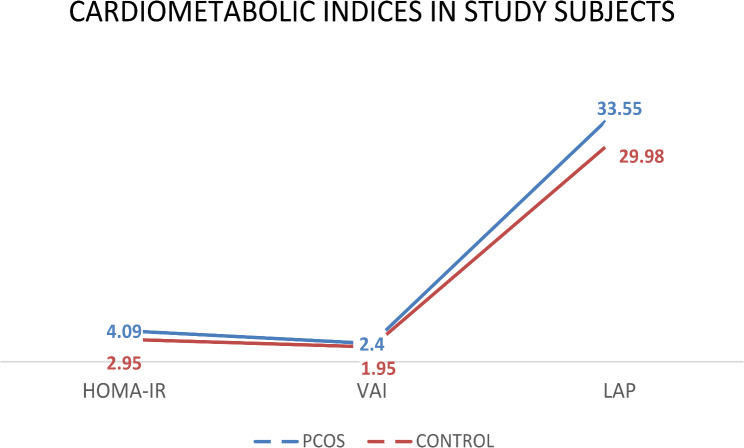
RESULT(S): In the baseline characteristics, PCOS group had higher systolic and diastolic blood pressure, fasting blood sugar, 2 h oral glucose tolerance test (OGTT), fasting, 30 min and two hours post OGTT insulin levels than control group. In lipid profile, PCOS group had lower High Density Lipoprotein-Cholestrol (HDL-C) and higher low Density Lipoprotein-Cholestrol (LDL-C) levels. HOMA-IR, VAI, LAP were significantly higher in PCOS group. When AMH was correlated with various cardio-metabolic indices in women with PCOS, significant positive correlation was found with BMI, waist circumference, triglycerides and very low Density Lipoprotein cholestrol (VLDL-C) VLDL levels. While correlating AMH with cardio-metabolic indices in different phenotypes, PCOS phenotype A, C, and D suggested a significant positive correlation with BMI, waist circumference, post -prandial blood sugar at 30 min and VLDL-C, while phenotype B correlated only with BMI and VLDL levels.
CONCLUSION(S): A positive correlation could be seen between serum AMH and anthropometric and lipid profile parameters in Indian PCOS women. No such correlation can be established between other insulin resistance markers.
研究多囊卵巢综合征(PCOS)所有表型女性的心脏代谢标志物及其与血清抗苗勒管激素(AMH)水平的相关性。
在一项基于社区的横断面研究中,旨在确定5年(2018 - 2022年)内19 - 39岁女性中PCOS的患病率,通过预先验证的问卷从14061名女性中筛选出10109名符合条件者。在该队列中,201名女性先前已被诊断,根据鹿特丹标准对2314例疑似病例进行详细的临床、超声和激素评估后,860例为确诊病例。选取来自同一社区年龄和BMI相匹配的健康女性作为对照(1174例)。对PCOS患者和健康对照者均进行心脏代谢指标评估,包括人体测量学指标(BMI、腰围(WC)、腰臀比(WHR))、生化指标(75g葡萄糖口服葡萄糖耐量试验(OGTT)、血脂谱、胰岛素抵抗稳态模型评估(HOMA - IR)、内脏脂肪指数[VAI]、脂质积聚产物[LAP])以及空腹和餐后胰岛素水平。还对PCOS患者和对照者进行了其他激素检测及AMH水平测定。采用Pearson方法计算病例组血清AMH与心脏代谢指标之间的相关性。使用STATA 18版软件进行数据分析。
PCOS女性及其不同表型的心脏代谢特征,包括肥胖/超重、高血压、胰岛素抵抗、血脂异常,与对照组进行比较,并分析病例组中血清AMH水平与上述指标的相关性。
在基线特征方面,PCOS组的收缩压和舒张压、空腹血糖、2小时口服葡萄糖耐量试验(OGTT)、空腹、OGTT后30分钟和2小时的胰岛素水平均高于对照组。在血脂谱方面,PCOS组的高密度脂蛋白胆固醇(HDL - C)水平较低,低密度脂蛋白胆固醇(LDL - C)水平较高。PCOS组的HOMA - IR、VAI、LAP显著更高。当AMH与PCOS女性的各种心脏代谢指标相关联时,发现其与BMI、腰围、甘油三酯和极低密度脂蛋白胆固醇(VLDL - C)水平呈显著正相关。在将AMH与不同表型的心脏代谢指标进行关联分析时,PCOS A、C和D型与BMI、腰围、餐后30分钟血糖和VLDL - C呈显著正相关,而B型仅与BMI和VLDL水平相关。
在印度PCOS女性中,血清AMH与人体测量学指标和血脂谱参数之间存在正相关。在其他胰岛素抵抗标志物之间未发现此类相关性。