Fuller Harriett, Agasaro Orietta P, Darst Burcu F
Public Health Sciences, Fred Hutchinson Cancer Center, Seattle, Washington, USA.
Department of Epidemiology, University of Washington, Seattle, Washington, USA.
medRxiv. 2025 Feb 28:2025.02.27.25321444. doi: 10.1101/2025.02.27.25321444.
Metabolomic dysregulation contributes to prostate cancer (PCa) pathogenesis, and studies suggest that circulating metabolites have strong clinical potential to act as biomarkers. However, evidence of circulating metabolite associations has not been quantitively aggregated.
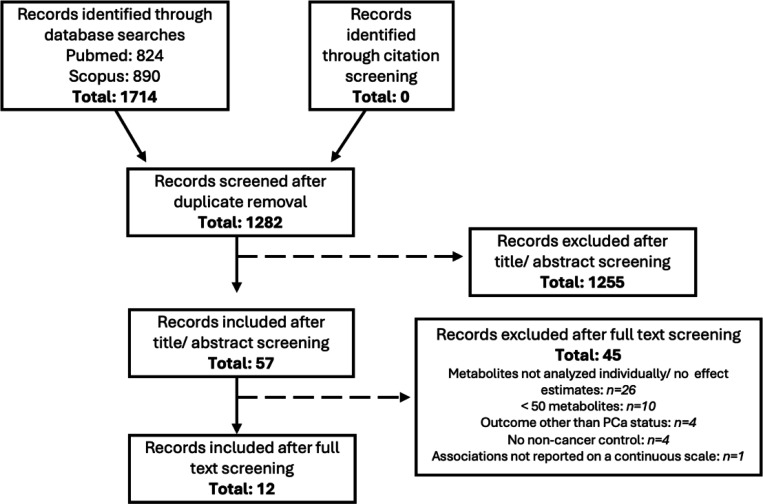
Systematic searches were performed in PubMed and Embase (October 17, 2024) to identify pre-diagnostic untargeted serum metabolomic studies of PCa risk. After harmonizing metabolite names across studies, restricted maximum likelihood was used to conduct meta-analyses to quantify associations between metabolites and risk of overall PCa, low- to intermediate-risk PCa, high- to very high-risk PCa and lethal PCa, as defined by the NCCN. Statistical significance was defined as FDR-adjusted P<0.05. Enrichment analyses were conducted on significant metabolites to identify biologically relevant pathways. Correlation of effect estimates between PCa outcomes was assessed via Pearson correlation.
We identified 12 untargeted pre-diagnostic circulating metabolomic studies in a systematic review and meta-analyzed associations between up to 408 metabolites with four PCa outcomes. Three, eleven and nineteen metabolites were significantly associated with risk of overall, high/very high-risk and lethal PCa, respectively. Metabolites associated with high/very high-risk PCa were significantly enriched for lipids. Limited evidence of correlation between metabolite effects across outcomes was identified, highlighting potentially unique metabolite drivers of high-risk and lethal PCa. Follow-up analyses found that 13 of the significant metabolites were drug and/or dietary modifiable.
These findings suggest the strong potential for metabolites to inform risk of lethal PCa, which could inform risk-stratified screening strategies and facilitate the identification of targets for PCa prevention.
代谢组学失调促进前列腺癌(PCa)的发病机制,并且研究表明循环代谢物作为生物标志物具有很强的临床潜力。然而,循环代谢物关联的证据尚未进行定量汇总。
于2024年10月17日在PubMed和Embase中进行系统检索,以识别PCa风险的诊断前非靶向血清代谢组学研究。在统一各研究中的代谢物名称后,使用限制最大似然法进行荟萃分析,以量化代谢物与总体PCa、低至中风险PCa、高至极高风险PCa和致命PCa风险之间的关联,这些风险由美国国立综合癌症网络(NCCN)定义。统计学显著性定义为经FDR校正的P<0.05。对显著代谢物进行富集分析,以识别生物学相关途径。通过Pearson相关性评估PCa结局之间效应估计值的相关性。
在一项系统评价中,我们识别出12项诊断前非靶向循环代谢组学研究,并对多达408种代谢物与四种PCa结局之间的关联进行了荟萃分析。分别有3种、11种和19种代谢物与总体、高/极高风险和致命PCa的风险显著相关。与高/极高风险PCa相关的代谢物在脂质方面显著富集。在各结局的代谢物效应之间发现了有限的相关性证据,突出了高风险和致命PCa潜在的独特代谢物驱动因素。后续分析发现,13种显著代谢物可通过药物和/或饮食调节。
这些发现表明代谢物在提示致命PCa风险方面具有强大潜力,这可为风险分层筛查策略提供信息,并有助于确定PCa预防靶点。