Matta Nubia E, Gaitán-Albarracín Felipe Andrés, Fuentes-Rodríguez Gustavo Andrés, Rodríguez-Fandiño Óscar Andrés, Calixto-Botía Iván F, Correa-Higuera Lady Johana
Laboratory Host-parasite relationship, Departamento de Biología, Facultad de Ciencias, Universidad Nacional de Colombia, Bogotá, Colombia.
Laboratory of molecular studies of the Orinoquian region- LEMO, Facultad de Ciencias, Universidad Internacional del Trópico Americano, Universidad Internacional del Trópico Americano, Yopal, Colombia.
Front Microbiol. 2025 Feb 25;16:1548538. doi: 10.3389/fmicb.2025.1548538. eCollection 2025.
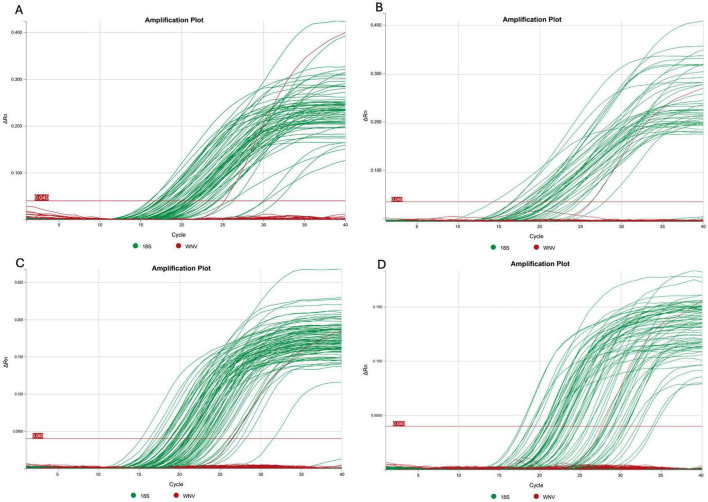
Studies focused on the epidemiological surveillance of arboviruses that cause potentially zoonotic diseases, such as dengue, Zika, or emerging viruses like West Nile virus (WNV), are critical due to their significant impact on public health. Although research on these infectious agents is increasing in Colombia, regions remain where the presence of zoonotic agents is still unknown. To address this knowledge gap, the present study aimed to investigate the current status of WNV circulation in wildlife in two municipalities of the department of Casanare (El Yopal and Paz de Ariporo) from the Colombian region of Orinoquia. Since the arrival of WNV in Colombia, reported in 2004, its detection has typically relied on antibody screening using ELISA. While informative, this technique needs to offer a sufficiently precise time frame to confirm active virus circulation. We employed a molecular approach to overcome this limitation, detecting WNV using qPCR, which provides greater specificity and a narrower time window. A total of 2,553 swab samples were collected from a broad sampling covering 142 birds, 19 mammals, and eight reptile species during 2023 and 2024 across four sampling events conducted during both the dry and wet seasons. The sampling included species with ecological or symbolic value to the region and those with economic importance, such as species used for human consumption (bushmeat). No evidence of WNV was detected in the evaluated species, indicating that these species were not infected with the virus during the sampling periods or that viral loads were below the detection threshold. Our results underscore the importance of further studies, including complementary diagnostic methods, such as antibody detection, to better understand the broader temporal infections and provide a more complete understanding of virus circulation.
对导致潜在人畜共患病的虫媒病毒进行流行病学监测的研究至关重要,例如登革热、寨卡病毒,或像西尼罗河病毒(WNV)这样的新兴病毒,因为它们对公共卫生有重大影响。尽管哥伦比亚对这些传染源的研究在不断增加,但仍有一些地区人畜共患病原体的存在情况尚不清楚。为了填补这一知识空白,本研究旨在调查哥伦比亚奥里诺科地区卡萨纳雷省两个市(耶帕尔和阿雷波罗港)野生动物中WNV的传播现状。自2004年WNV在哥伦比亚出现以来,其检测通常依赖于使用ELISA进行抗体筛查。虽然这种技术提供了信息,但需要提供足够精确的时间框架来确认病毒的活跃传播。我们采用分子方法来克服这一局限性,使用qPCR检测WNV,该方法具有更高的特异性和更窄的时间窗口。在2023年和2024年期间,在旱季和雨季进行的四次采样活动中,共采集了2553份拭子样本,采样范围广泛,涵盖142种鸟类、19种哺乳动物和8种爬行动物。采样包括对该地区具有生态或象征价值的物种以及具有经济重要性的物种,例如用于人类消费的物种(丛林肉)。在所评估的物种中未检测到WNV的证据,这表明这些物种在采样期间未感染该病毒,或者病毒载量低于检测阈值。我们的结果强调了进一步研究的重要性,包括使用抗体检测等补充诊断方法,以更好地了解更广泛的时间感染情况,并更全面地了解病毒传播。