Williamson Alivia, Heydarshahi Behnam, Finley-Abboud Diadora, Massac Lili, Jacobson Lindsay, Christophe Naicha, Joseph Judeline, Futter Allison, Hoeppner Susanne S, Hoeppner Bettina B
Health through Flourishing, Department of Psychiatry, Massachusetts General Hospital, 125 Nashua Street, Boston, MA, 02114, USA.
Google, 1600 Amphitheatre Parkway, Mountain View, CA, 94043, USA.
Addict Sci Clin Pract. 2025 Mar 13;20(1):26. doi: 10.1186/s13722-025-00549-y.
An estimated 84,181 people died due to opioid overdose in 2022 alone [1]. Mobile technologies may offer an additional pathway to provide support to people seeking recovery from opioid use disorder (OUD). To this end, we conducted a content analysis of opioid-related apps to determine to what extent apps exist that provide support to people seeking or in recovery from OUD. For apps specifically targeting OUD recovery, we identified the tools these apps offer to users seeking support in their recovery.
Our team conducted a content analysis of publicly available opioid-related apps identified via web-scraping in the Apple and Google app stores. Using a two-step qualitative coding process, we first identified which apps were meaningfully related to OUD recovery and second identified what tools, if any, these apps provided.
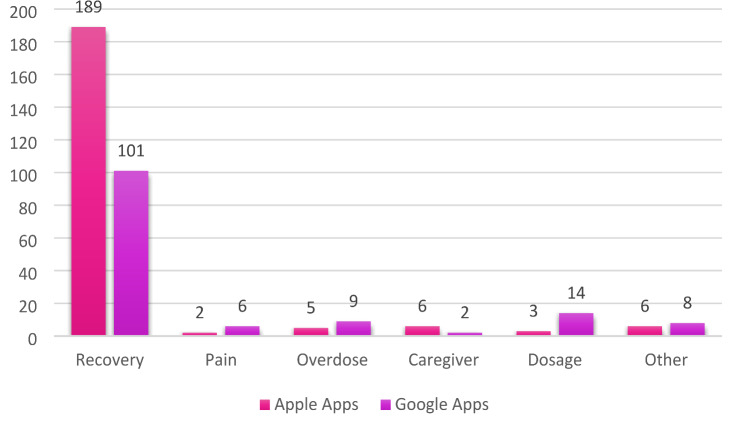
Web-scraping identified 1,136 apps from the Apple App Store (n = 247) and Google Play (n = 889). Of those, 290 apps were specific to OUD recovery (65% of iOS apps, 35% of Android apps). Of those, 161 apps were included in our final analysis. The most common type of tools provided support for motivation (65.2%) and accountability (65.8%). Many apps (53%) also supported linkage to recovery support (e.g., meeting finder, telehealth). Surprisingly, fewer apps provided information about OUD recovery (43.5%) or tools for cravings (33.5%). 42.9% of apps had limited accessibility (e.g., paywalls, private invite).
Our results show a substantial increase in the number of apps designed to support OUD recovery. Nevertheless, there remains a need for apps that provide empirically supported information and tools. Furthermore, restrictions in accessibility (i.e., findability, cost, private) may limit the impact of available apps.
仅在2022年,估计就有84181人死于阿片类药物过量使用[1]。移动技术可能为向寻求从阿片类药物使用障碍(OUD)中康复的人提供支持提供一条额外途径。为此,我们对与阿片类药物相关的应用程序进行了内容分析,以确定存在哪些应用程序为寻求OUD康复或正在康复的人提供支持。对于专门针对OUD康复的应用程序,我们确定了这些应用程序为寻求康复支持的用户提供的工具。
我们的团队对通过在苹果和谷歌应用商店进行网络抓取识别出的公开可用的与阿片类药物相关的应用程序进行了内容分析。使用两步定性编码过程,我们首先确定哪些应用程序与OUD康复有意义相关,其次确定这些应用程序提供了哪些工具(如果有的话)。
网络抓取从苹果应用商店(n = 247)和谷歌应用商店(n = 889)中识别出1136个应用程序。其中,290个应用程序专门针对OUD康复(iOS应用程序的65%,安卓应用程序的35%)。在这些应用程序中,161个应用程序被纳入我们的最终分析。最常见的工具类型提供了动机支持(65.2%)和责任追究支持(65.8%)。许多应用程序(53%)还支持与康复支持建立联系(例如,会议查找器、远程医疗)。令人惊讶的是,提供关于OUD康复信息的应用程序较少(43.5%),提供应对渴望工具的应用程序也较少(33.5%)。42.9%的应用程序可访问性有限(例如,付费墙、私人邀请)。
我们的结果表明,旨在支持OUD康复的应用程序数量大幅增加。然而,仍然需要提供经实证支持的信息和工具的应用程序。此外,可访问性方面的限制(即可查找性、成本、隐私性)可能会限制现有应用程序的影响。