Hsu Michael, Martin Bianca, Ahmed Saeed, Torous John, Suzuki Joji
Department of Psychiatry, Brigham and Women's Hospital, Boston, MA, United States.
West Ridge Center, Rutland Regional Medical Center, Rutland, VT, United States.
JMIR Form Res. 2022 Jul 7;6(7):e38684. doi: 10.2196/38684.
In recent years, there has been increasing interest in implementing digital technologies to diagnose, monitor, and intervene in substance use disorders. Smartphones are now a vehicle for facilitating telepsychiatry visits, measuring health metrics, and communicating with health care professionals. In light of the COVID-19 pandemic and the movement toward web-based and hybrid clinic visits and meetings, it has become especially salient to assess phone ownership among individuals with substance use disorders and their comfort in navigating phone functionality and using phones for mental health purposes.
The aims of this study were to summarize the current literature around smartphone ownership, smartphone utilization, and the acceptability of using smartphones for mental health purposes and assess these variables across two disparate substance use treatment sites.
We performed a focused literature review via a search of two academic databases (PubMed and Google Scholar) for publications since 2007 on the topics of smartphone ownership, smartphone utilization, and the acceptability of using mobile apps for mental health purposes among the substance use population. Additionally, we conducted a cross-sectional survey study that included 51 participants across two sites in New England-an inpatient detoxification unit that predominantly treats patients with alcohol use disorder and an outpatient methadone maintenance treatment clinic.
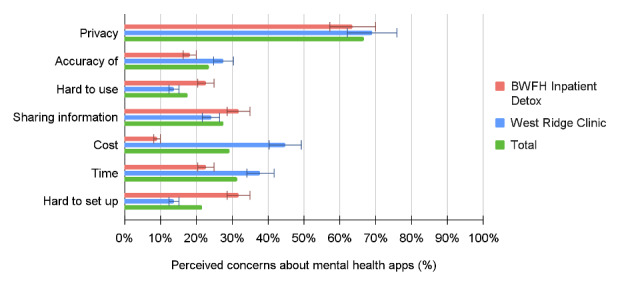
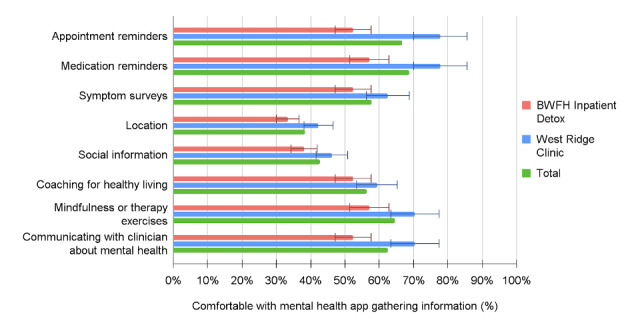
Prior studies indicated that mobile phone ownership among the substance use population between 2013 and 2019 ranged from 83% to 94%, while smartphone ownership ranged from 57% to 94%. The results from our study across the two sites indicated 96% (49/51) mobile phone ownership and 92% (47/51) smartphone ownership among the substance use population. Although most (43/49, 88%) patients across both sites reported currently using apps on their phone, a minority (19/48, 40%) reported previously using any apps for mental health purposes. More than half of the participants reported feeling at least neutrally comfortable with a mental health app gathering information regarding appointment reminders (32/48, 67%), medication reminders (33/48, 69%), and symptom surveys (26/45, 58%). Most patients were concerned about privacy (34/51, 67%) and felt uncomfortable with an app gathering location (29/47, 62%) and social (27/47, 57%) information for health care purposes.
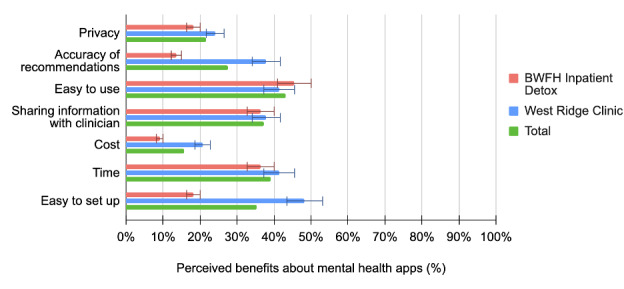
The majority of respondents reported owning a mobile phone (49/51, 96%) and smartphone (47/51, 92%), consistent with prior studies. Many respondents felt comfortable with mental health apps gathering most forms of personal information and with communicating with their clinician about their mental health. The differential results from the two sites, namely greater concerns about the cost of mental health apps among the methadone maintenance treatment cohort and less experience with downloading apps among the older inpatient detoxification cohort, may indicate that clinicians should tailor technological interventions based on local demographics and practice sites and that there is likely not a one-size-fits-all digital psychiatry solution.
近年来,人们对利用数字技术诊断、监测和干预物质使用障碍的兴趣日益浓厚。智能手机如今成为了促进远程精神病学问诊、测量健康指标以及与医疗保健专业人员沟通的工具。鉴于新冠疫情以及向基于网络和混合式门诊就诊及会议的转变,评估物质使用障碍患者的手机拥有情况以及他们对操作手机功能和将手机用于心理健康目的的舒适度变得尤为重要。
本研究的目的是总结当前关于智能手机拥有情况、智能手机使用情况以及将智能手机用于心理健康目的的可接受性的文献,并在两个不同的物质使用治疗场所评估这些变量。
我们通过搜索两个学术数据库(PubMed和谷歌学术)进行了一项针对性的文献综述,以查找2007年以来关于物质使用人群中智能手机拥有情况、智能手机使用情况以及使用移动应用程序用于心理健康目的的可接受性的出版物。此外,我们开展了一项横断面调查研究,纳入了新英格兰两个场所的51名参与者——一个主要治疗酒精使用障碍患者的住院戒毒单元和一个门诊美沙酮维持治疗诊所。
先前的研究表明,2013年至2019年间物质使用人群中的手机拥有率在83%至94%之间,而智能手机拥有率在57%至94%之间。我们在两个场所的研究结果表明,物质使用人群中手机拥有率为96%(49/51),智能手机拥有率为92%(47/51)。尽管两个场所的大多数(43/49,88%)患者报告目前在使用手机上的应用程序,但少数(19/48,40%)患者报告此前曾使用任何应用程序用于心理健康目的。超过一半的参与者表示,对于心理健康应用程序收集预约提醒(32/48,67%)、用药提醒(就33/48,69%)和症状调查(26/45,58%)等信息至少感觉中立舒适。大多数患者担心隐私问题(34/51,67%),并且对于应用程序为医疗保健目的收集位置(29/47,62%)和社交(27/47,57%)信息感到不舒服。
大多数受访者报告拥有手机(49/51,96%)和智能手机(47/51,92%),这与先前的研究一致。许多受访者对于心理健康应用程序收集大多数形式的个人信息以及与临床医生就其心理健康进行沟通感到舒适。两个场所的不同结果,即美沙酮维持治疗队列中对心理健康应用程序成本的担忧更大,以及老年住院戒毒队列中下载应用程序的经验较少,可能表明临床医生应根据当地人口统计学和实践场所调整技术干预措施,并且可能不存在适用于所有人的数字精神病学解决方案。