Okwor Vitalis C, Okwor Juliet C, Ukwuoma Maryjane K, Mitha Sara B, Nweke Martins C
Department of Radiation and Clinical Oncology, University of Nigeria Teaching Hospital, Ituku-Ozalla, Enugu, Nigeria.
Department of Chemical Pathology, College of Medicine, University of Nigeria Ituku-Ozalla Campus, Enugu, Nigeria.
Med Princ Pract. 2025 Mar 17:1-22. doi: 10.1159/000545264.
Breast cancer (BC) cells exhibit mutations over time, conferring resistance to therapeutic approaches. We attempted to ascertain the efficacy of selected hormonal therapy for advanced BC.
This is a systematic review and meta-analysis of clinical trials. We searched Medline, PubMed, Cochrane Library, Web of Science, and others. Studies that investigated the effectiveness of hormonal therapy for HR positive (HR+) advanced BC were included. The outcomes were progression-free survival (PFS), overall survival (OS), and objective response rate (ORR). A random-effect meta-analysis model was employed. The study protocol was registered with the International Prospective Register of Systematic Reviews: CRD42023431939.
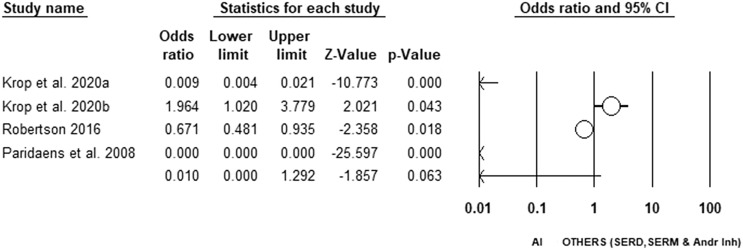
Twenty-one studies were included in the meta-analysis with an overall sample size of 8,482. ORR and PFS between aromatase inhibitors (AIs) and other hormonal therapies: selective oestrogen receptor degrader, selective oestrogen modulator (SERM) and androgen inhibitors showed no significant difference (OR = 1.122 [0.917-1.374], p = 0.263; OR = 0.010 [0.000-1.292], p = 0.063), respectively. Subgroup analysis showed a statistically significant difference in ORR in favour of patients who received SERM compared to AI (OR = 1.362 [1.033-1.795], p = 0.028). For OS, no significant difference was observed among anastrozole, letrozole, and exemestane recepients (OR = 1.718 [0.021-139.128], p = 0.809).
Given the above findings, clinical decisions could be based on factors such as the line of cancer treatment, adverse events, drug dosing, and individual drug benefits. Although newer combination therapies are being adopted, the agents explored in this review are still widely used in clinical practice for HR+ BC.
乳腺癌(BC)细胞会随着时间推移发生突变,从而对治疗方法产生抗性。我们试图确定所选激素疗法对晚期BC的疗效。
这是一项对临床试验的系统评价和荟萃分析。我们检索了Medline、PubMed、Cochrane图书馆、科学网等。纳入了研究激素疗法对HR阳性(HR+)晚期BC有效性的研究。结局指标为无进展生存期(PFS)、总生存期(OS)和客观缓解率(ORR)。采用随机效应荟萃分析模型。该研究方案已在国际前瞻性系统评价注册库注册:CRD42023431939。
荟萃分析纳入了21项研究,总样本量为8482。芳香化酶抑制剂(AIs)与其他激素疗法(选择性雌激素受体降解剂、选择性雌激素调节剂(SERM)和雄激素抑制剂)之间的ORR和PFS均无显著差异(OR分别为1.122 [0.917 - 1.374],p = 0.263;OR为0.010 [0.000 - 1.292],p = 0.063)。亚组分析显示,与AI相比,接受SERM的患者ORR有统计学显著差异(OR = 1.362 [1.033 - 1.795],p = 0.028)。对于OS,阿那曲唑、来曲唑和依西美坦接受者之间未观察到显著差异(OR = 1.718 [0.021 - 139.128],p = 0.809)。
鉴于上述发现,临床决策可基于癌症治疗线数、不良事件、药物剂量和个体药物益处等因素。尽管正在采用更新的联合疗法,但本综述中探讨的药物在临床实践中仍广泛用于HR+ BC。