• 文献检索
  • 文档翻译
  • 深度研究
  • 学术资讯
  • Suppr Zotero 插件Zotero 插件
  • 邀请有礼
  • 套餐&价格
  • 历史记录
应用&插件
Suppr Zotero 插件Zotero 插件浏览器插件Mac 客户端Windows 客户端微信小程序
定价
高级版会员购买积分包购买API积分包
服务
文献检索文档翻译深度研究API 文档MCP 服务
关于我们
关于 Suppr公司介绍联系我们用户协议隐私条款
关注我们

Suppr 超能文献

核心技术专利:CN118964589B侵权必究
粤ICP备2023148730 号-1Suppr @ 2026

文献检索

告别复杂PubMed语法,用中文像聊天一样搜索,搜遍4000万医学文献。AI智能推荐,让科研检索更轻松。

立即免费搜索

文件翻译

保留排版,准确专业,支持PDF/Word/PPT等文件格式,支持 12+语言互译。

免费翻译文档

深度研究

AI帮你快速写综述,25分钟生成高质量综述,智能提取关键信息,辅助科研写作。

立即免费体验

南极冰盖上大量且多样的藻类使表面变暗。

Surface darkening by abundant and diverse algae on an Antarctic ice cap.

作者信息

Thomson Alex Innes, Gray Andrew, Colesie Claudia, Thomas Naomi, Moulton Hannah, Convey Peter, Smith Alison G, Fretwell Peter, Peck Lloyd, Davey Matthew P

机构信息

Scottish Association for Marine Science (SAMS), Oban, UK.

Global Change Institute, School of GeoSciences, University of Edinburgh, Edinburgh, UK.

出版信息

Nat Commun. 2025 Mar 18;16(1):2647. doi: 10.1038/s41467-025-57725-6.

DOI:10.1038/s41467-025-57725-6
PMID:40102384
原文链接:https://pmc.ncbi.nlm.nih.gov/articles/PMC11920422/
Abstract

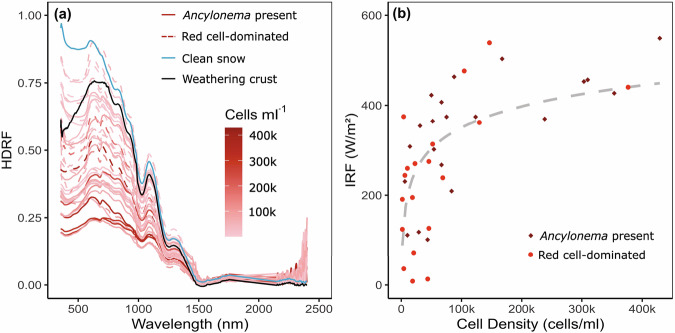
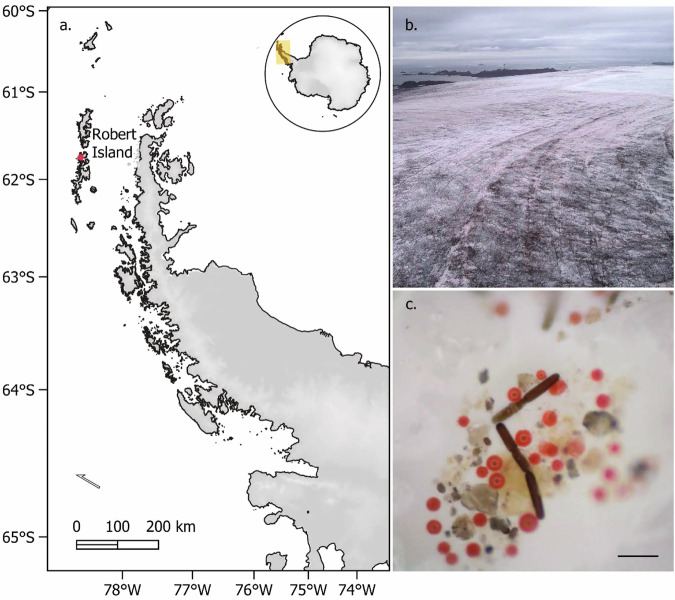
Algal blooms play important roles in physical and biological processes on glacial surfaces. Despite this, their occurrence and impacts within an Antarctic context remain understudied. Here, we present evidence of the large-scale presence, diversity and bioalbedo effects of algal blooms on Antarctic ice cap systems based on fieldwork conducted on Robert Island (South Shetland Islands, Antarctica). Algal blooms are observed covering up to 2.7 km (~20%) of the measured area of the Robert Island ice cap, with cell densities of up to 1.4 × 10 cells ml. Spectral characterisation reveal that these blooms increase melting of the ice cap surface, contributing up to 2.4% of total melt under the observed conditions. Blooms are composed of typical cryoflora taxa, dominated by co-occurring Chlorophyceae, Trebouxiophyceae, and Ancylonema. However, morphological variation and genetic diversity in Ancylonema highlight the influence of regional endemism and point to a large and under-characterised diversity in Antarctic cryoflora.

摘要

藻华在冰川表面的物理和生物过程中发挥着重要作用。尽管如此,它们在南极环境中的发生情况和影响仍未得到充分研究。在此,我们基于在罗伯特岛(南极南设得兰群岛)开展的实地考察,展示了藻华在南极冰盖系统中的大规模存在、多样性及生物反照率效应的证据。观测到藻华覆盖了罗伯特岛冰盖测量区域的2.7千米(约20%),细胞密度高达1.4×10个/毫升。光谱特征表明,这些藻华增加了冰盖表面的融化,在观测条件下对总融水量的贡献高达2.4%。藻华由典型的低温植物类群组成,主要是同时出现的绿藻纲、小球藻纲和Ancylonema。然而,Ancylonema的形态变异和遗传多样性凸显了区域特有性的影响,并表明南极低温植物存在大量特征不明的多样性。
https://cdn.ncbi.nlm.nih.gov/pmc/blobs/6205/11920422/2c7ad9475f22/41467_2025_57725_Fig7_HTML.jpg
https://cdn.ncbi.nlm.nih.gov/pmc/blobs/6205/11920422/9ff27175a914/41467_2025_57725_Fig1_HTML.jpg
https://cdn.ncbi.nlm.nih.gov/pmc/blobs/6205/11920422/c8904942efeb/41467_2025_57725_Fig2_HTML.jpg
https://cdn.ncbi.nlm.nih.gov/pmc/blobs/6205/11920422/ea1085c23f52/41467_2025_57725_Fig3_HTML.jpg
https://cdn.ncbi.nlm.nih.gov/pmc/blobs/6205/11920422/a81701e40800/41467_2025_57725_Fig4_HTML.jpg
https://cdn.ncbi.nlm.nih.gov/pmc/blobs/6205/11920422/8cb9b516c2f8/41467_2025_57725_Fig5_HTML.jpg
https://cdn.ncbi.nlm.nih.gov/pmc/blobs/6205/11920422/9682af6e095f/41467_2025_57725_Fig6_HTML.jpg
https://cdn.ncbi.nlm.nih.gov/pmc/blobs/6205/11920422/2c7ad9475f22/41467_2025_57725_Fig7_HTML.jpg
https://cdn.ncbi.nlm.nih.gov/pmc/blobs/6205/11920422/9ff27175a914/41467_2025_57725_Fig1_HTML.jpg
https://cdn.ncbi.nlm.nih.gov/pmc/blobs/6205/11920422/c8904942efeb/41467_2025_57725_Fig2_HTML.jpg
https://cdn.ncbi.nlm.nih.gov/pmc/blobs/6205/11920422/ea1085c23f52/41467_2025_57725_Fig3_HTML.jpg
https://cdn.ncbi.nlm.nih.gov/pmc/blobs/6205/11920422/a81701e40800/41467_2025_57725_Fig4_HTML.jpg
https://cdn.ncbi.nlm.nih.gov/pmc/blobs/6205/11920422/8cb9b516c2f8/41467_2025_57725_Fig5_HTML.jpg
https://cdn.ncbi.nlm.nih.gov/pmc/blobs/6205/11920422/9682af6e095f/41467_2025_57725_Fig6_HTML.jpg
https://cdn.ncbi.nlm.nih.gov/pmc/blobs/6205/11920422/2c7ad9475f22/41467_2025_57725_Fig7_HTML.jpg

相似文献

1
Surface darkening by abundant and diverse algae on an Antarctic ice cap.南极冰盖上大量且多样的藻类使表面变暗。
Nat Commun. 2025 Mar 18;16(1):2647. doi: 10.1038/s41467-025-57725-6.
2
The diversity of ice algal communities on the Greenland Ice Sheet as revealed by oligotyping.寡聚型分析揭示的格陵兰冰盖上的冰藻群落多样性。
Microb Genom. 2018 Mar;4(3). doi: 10.1099/mgen.0.000159. Epub 2018 Mar 16.
3
Using metabarcoding to assess Viridiplantae sequence diversity present in Antarctic glacial ice.利用代谢条形码评估南极冰川冰中存在的 Viridiplantae 序列多样性。
An Acad Bras Cienc. 2022 Feb 28;94(suppl 1):e20201736. doi: 10.1590/0001-3765202220201736. eCollection 2022.
4
Functional filtering and random processes affect the assembly of microbial communities of snow algae blooms at Maritime Antarctic.功能过滤和随机过程影响着南极海洋的雪藻花微生物群落的组装。
Sci Total Environ. 2022 Jan 20;805:150305. doi: 10.1016/j.scitotenv.2021.150305. Epub 2021 Sep 11.
5
Dynamics of organic matter in algal blooms on the Greenland ice sheet.格陵兰冰原藻华中有机物的动态变化。
Sci Rep. 2025 Mar 10;15(1):8288. doi: 10.1038/s41598-025-92182-7.
6
Bioavailability of Mineral-Bound Iron to a Snow Algal-Bacterial Coculture and Implications for Albedo-Altering Snow Algal Blooms.矿物结合铁对雪藻-细菌共培养物的生物可利用性及其对反照率改变的雪藻水华的影响。
Appl Environ Microbiol. 2018 Mar 19;84(7). doi: 10.1128/AEM.02322-17. Print 2018 Apr 1.
7
Phytoplankton Blooms Below the Antarctic Landfast Ice During the Melt Season Between Late Spring and Early Summer.在春季末至初夏的融冰季节,南极定冰带下方出现浮游植物水华。
J Phycol. 2021 Apr;57(2):541-550. doi: 10.1111/jpy.13112. Epub 2021 Jan 29.
8
Algal photophysiology drives darkening and melt of the Greenland Ice Sheet.藻类光合生理学驱动格陵兰冰盖的变暗和融化。
Proc Natl Acad Sci U S A. 2020 Mar 17;117(11):5694-5705. doi: 10.1073/pnas.1918412117. Epub 2020 Feb 24.
9
Potential macroalgal expansion and blue carbon gains with northern Antarctic Peninsula glacial retreat.随着南极半岛北部冰川消退,大型藻类可能扩张,蓝碳增加。
Mar Environ Res. 2023 Jul;189:106056. doi: 10.1016/j.marenvres.2023.106056. Epub 2023 Jun 24.
10
Novel insights in cryptic diversity of snow and glacier ice algae communities combining 18S rRNA gene and ITS2 amplicon sequencing.结合 18S rRNA 基因和 ITS2 扩增子测序揭示雪和冰川冰中藻类群落隐秘多样性的新见解。
FEMS Microbiol Ecol. 2023 Nov 13;99(12). doi: 10.1093/femsec/fiad134.

本文引用的文献

1
A mesophilic relative of common glacier algae, Ancylonema palustre sp. nov., provides insights into the induction of vacuolar pigments in zygnematophytes.一种嗜温的普通冰川藻类的近缘种,Ancylonema palustre sp. nov.,为探讨织线藻属植物液泡色素的诱导提供了线索。
Environ Microbiol. 2024 Jul;26(8):e16680. doi: 10.1111/1462-2920.16680.
2
ShetlandsUAVmetry: unmanned aerial vehicle-based photogrammetric dataset for Antarctic environmental research.设得兰群岛无人机测绘学:基于无人机的摄影测量数据集,用于南极环境研究。
Sci Data. 2024 Feb 14;11(1):202. doi: 10.1038/s41597-024-03045-1.
3
Higher Antarctic ice sheet accumulation and surface melt rates revealed at 2 km resolution.
以2公里分辨率揭示了南极冰盖更高的积累率和表面融化率。
Nat Commun. 2023 Dec 1;14(1):7949. doi: 10.1038/s41467-023-43584-6.
4
Polar lake microbiomes have distinct evolutionary histories.极地湖泊微生物组具有独特的进化历史。
Sci Adv. 2023 Nov 15;9(46):eade7130. doi: 10.1126/sciadv.ade7130. Epub 2023 Nov 17.
5
Novel insights in cryptic diversity of snow and glacier ice algae communities combining 18S rRNA gene and ITS2 amplicon sequencing.结合 18S rRNA 基因和 ITS2 扩增子测序揭示雪和冰川冰中藻类群落隐秘多样性的新见解。
FEMS Microbiol Ecol. 2023 Nov 13;99(12). doi: 10.1093/femsec/fiad134.
6
Antarctic snow algae: unraveling the processes underlying microbial community assembly during blooms formation.南极雪藻:解析形成水华过程中微生物群落组装的背后过程。
Microbiome. 2023 Sep 5;11(1):200. doi: 10.1186/s40168-023-01643-6.
7
Climate change and extreme events are changing the biology of Polar Regions.气候变化和极端事件正在改变极地的生物学特性。
Glob Chang Biol. 2022 Oct;28(20):5861-5864. doi: 10.1111/gcb.16309. Epub 2022 Jul 12.
8
Seasonality of Glacial Snow and Ice Microbial Communities.冰川冰雪微生物群落的季节性
Front Microbiol. 2022 May 16;13:876848. doi: 10.3389/fmicb.2022.876848. eCollection 2022.
9
Remote Sensing Phenology of Antarctic Green and Red Snow Algae Using WorldView Satellites.利用WorldView卫星对南极绿雪藻和红雪藻进行遥感物候研究
Front Plant Sci. 2021 Jun 16;12:671981. doi: 10.3389/fpls.2021.671981. eCollection 2021.
10
Unicellular versus Filamentous: The Glacial Alga comb. et stat. nov. and Its Ecophysiological Relatedness to (Zygnematophyceae, Streptophyta).单细胞与丝状:冰川藻新组合及新状态及其与(双星藻纲,链形植物门)的生态生理相关性
Microorganisms. 2021 May 20;9(5):1103. doi: 10.3390/microorganisms9051103.