Sasayama Kensaku, Yasunebe Jin, Adachi Minoru
Faculty of Education, Mie University, 1577, Kurimamachiya-cho, Tsu, 514-8507, Mie, Japan.
Faculty of Education, Okayama University, 3-1-1, Tsushima-naka, Kita-ku, Okayama, 700-8530, Japan.
BMC Public Health. 2025 Mar 18;25(1):1041. doi: 10.1186/s12889-025-22256-8.
There is little evidence on the tracking of physical activity during school hours. In addition, tracking physical activity in schools provides important evidence for understanding children's physical activity and conducting intervention studies. Therefore, this study examined longitudinal changes and tracking of in-school physical activity in primary school children.
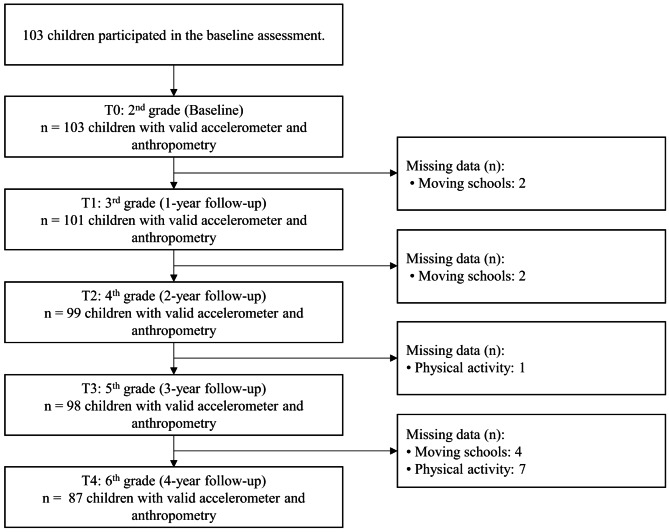
In this study, physical activity was investigated longitudinally in primary school children for 4 years. The baseline participants consisted of 103 second-grade students (7-8 years old) who participated. Step counts and moderate-to-vigorous physical activity (MVPA) in school and during first recess and lunch/second recess were examined using an accelerometer (Kenz Lifecorder GS 4-second version; Suzuken Co. Ltd, Nagoya, Japan).
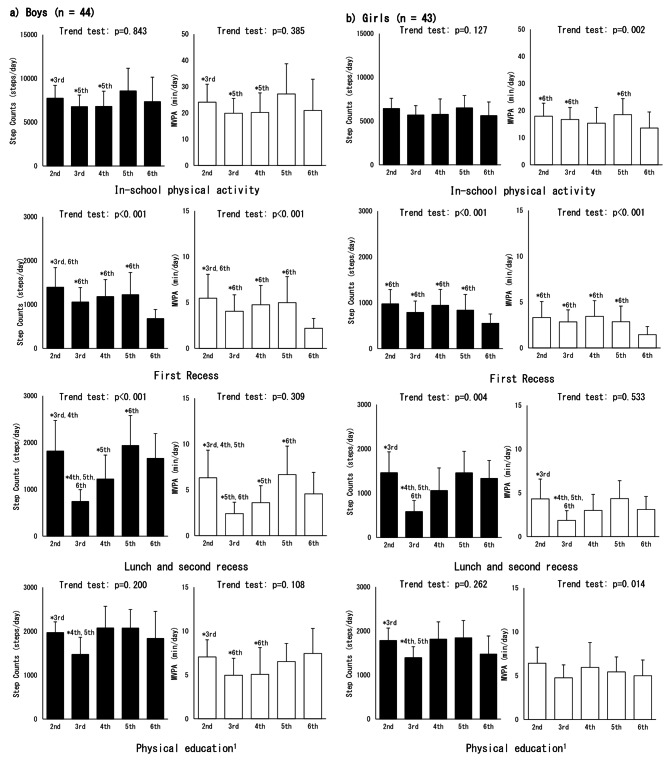
After excluding missing data (moving school; n = 8, physical activity; n = 8), 87 (43 boys and 44 girls) of whom were included in the final analysis. Step counts and MVPA during school and physical education in boys did not decrease across the school years. By contrast, in girls, step counts during school did not decrease across the school years, however MVPA did decrease. In addition, for both sexes, step counts and MVPA during first recess decrease across the school years. During lunch/second recess, only step counts decrease across the school years in both sexes. In addition, the tracking coefficients for step counts and MVPA for boys in school and during first recess and lunch/second recess were found across many school years. Contrarily, girls had fewer significant tracking coefficients between school years than boys. There were also few significant tracking coefficients between grades for physical education step counts and MVPA for both boys and girls.
Our results suggested that in-school step counts for both boys and girls does not decrease across the school years. However, given that girls demonstrated reduced levels of in-school MVPA across the school years, it is important to promote strategies to increase MVPA in this group.
关于在校期间身体活动追踪的证据很少。此外,在学校追踪身体活动为了解儿童身体活动情况和开展干预研究提供了重要证据。因此,本研究调查了小学儿童在校身体活动的纵向变化及追踪情况。
在本研究中,对小学儿童的身体活动进行了为期4年的纵向调查。基线参与者包括103名参与研究的二年级学生(7-8岁)。使用加速度计(Kenz Lifecorder GS 4秒版本;日本名古屋铃木健株式会社)测量在校期间、第一次课间休息和午餐/第二次课间休息时的步数以及中等到剧烈身体活动(MVPA)。
在排除缺失数据(转学;n = 8,身体活动数据缺失;n = 8)后,最终分析纳入了87名儿童(43名男孩和44名女孩)。男孩在校期间和体育课上的步数及MVPA在各学年均未减少。相比之下,女孩在校期间的步数在各学年未减少,但MVPA有所下降。此外,对于两性而言,第一次课间休息时的步数和MVPA在各学年均下降。在午餐/第二次课间休息时,只有两性的步数在各学年下降。此外,在多个学年中发现了男孩在校期间、第一次课间休息和午餐/第二次课间休息时步数及MVPA的追踪系数。相反,女孩各学年之间的显著追踪系数比男孩少。男孩和女孩体育课步数及MVPA在各年级之间的显著追踪系数也很少。
我们的结果表明,男孩和女孩在校步数在各学年均未减少。然而,鉴于女孩在校MVPA水平在各学年有所下降,促进该群体增加MVPA的策略很重要。