Speranza B E, Do M, Hill A T, Donaldson P H, Enticott P G, Kirkovski M
Cognitive Neuroscience Unit, School of Psychology, Deakin University, Burwood, VIC, Australia.
Institute for Health and Sport, Victoria University, Melbourne, Australia.
BMC Psychol. 2025 Mar 18;13(1):271. doi: 10.1186/s40359-024-02218-2.
Right-hemisphere brain regions are strongly implicated in facial emotion processing (FEP), a phenomenon termed right-hemispheric bias. Variability in FEP hemispheric bias is thought to underpin differences in facial emotion recognition ability and has been associated with age, handedness, biological sex, and autistic traits. However, findings from research to date investigating factors associated with FEP hemispheric bias have been inconsistent.
To examine if FEP hemispheric bias can be predicted by individual factors such as age, biological sex, handedness, and autistic traits.
427 adults recruited from the general population aged 18-67 years completed the Autism-spectrum Quotient. We also assessed covariates previously linked with FEP hemispheric bias including age, handedness, and biological sex. FEP hemispheric bias was indexed using laterality quotients calculated from a Chimeric Faces Task, where participants indicated which of two identical (but mirrored) half-emotional half-neutral (no emotion) chimeric faces were more emotive.
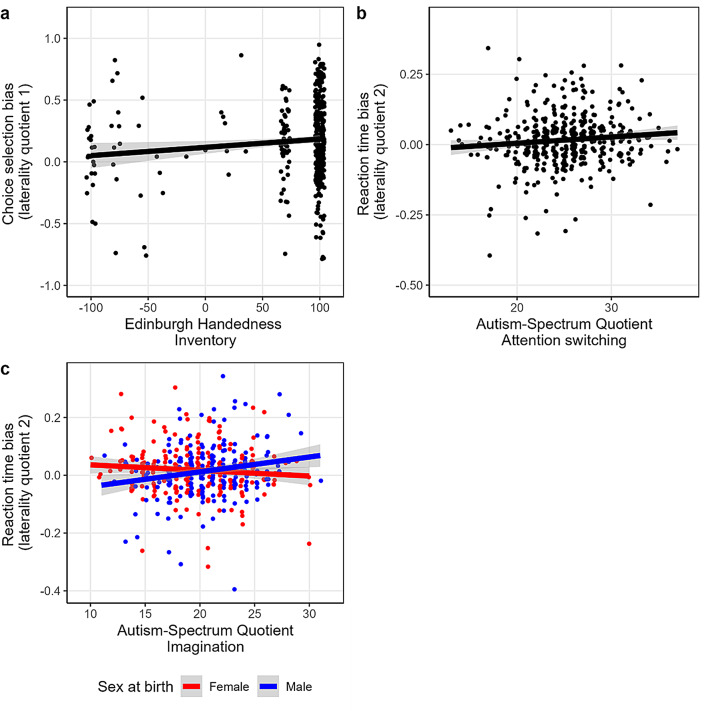
Linear regression models revealed that (1) handedness predicted FEP hemispheric choice bias, (2) the attention switching Autism-spectrum Quotient subscale predicted FEP hemispheric reaction time bias, and (3) the imagination Autism-spectrum Quotient subscale predicted FEP hemispheric reaction time bias for males, but not females.
These findings indicate that the relationship between autistic traits and FEP hemispheric bias is nuanced. Additionally, handedness influences hemispheric bias effects during FEP. Future research should endeavour to investigate if FEP hemispheric bias is dependent on the emotion being observed and consider using more direct measures of hemispheric bias.
右半球脑区与面部情绪加工(FEP)密切相关,这一现象被称为右半球偏向。FEP半球偏向的变异性被认为是面部情绪识别能力差异的基础,并且与年龄、利手、生物性别和自闭症特征有关。然而,迄今为止,研究与FEP半球偏向相关因素的研究结果并不一致。
研究FEP半球偏向是否可以通过年龄、生物性别、利手和自闭症特征等个体因素来预测。
从18 - 67岁的普通人群中招募了427名成年人,他们完成了自闭症谱系商数测试。我们还评估了先前与FEP半球偏向相关的协变量,包括年龄、利手和生物性别。FEP半球偏向通过从嵌合面孔任务计算得出的偏侧商数来衡量,参与者需要指出两个相同(但镜像)的半情绪化半中性(无情绪)嵌合面孔中哪一个更具情感性。
线性回归模型显示:(1)利手预测了FEP半球选择偏向;(2)注意力转换自闭症谱系商数子量表预测了FEP半球反应时间偏向;(3)想象力自闭症谱系商数子量表预测了男性的FEP半球反应时间偏向,而女性则不然。
这些发现表明自闭症特征与FEP半球偏向之间的关系是微妙的。此外,利手在FEP过程中影响半球偏向效应。未来的研究应致力于调查FEP半球偏向是否依赖于所观察的情绪,并考虑使用更直接的半球偏向测量方法。