Meilinda Iqra Mona, Sugiarto Sugiarto, Saleh Sofyan M, Achmad Ashfa
Doctoral Program, School of Engineering, Post Graduate Program, Syiah Kuala University, Banda Aceh, 23111, Indonesia.
Department of Civil Engineering, Universitas Syiah Kuala, Banda Aceh 23111, Indonesia.
MethodsX. 2025 Feb 22;14:103240. doi: 10.1016/j.mex.2025.103240. eCollection 2025 Jun.
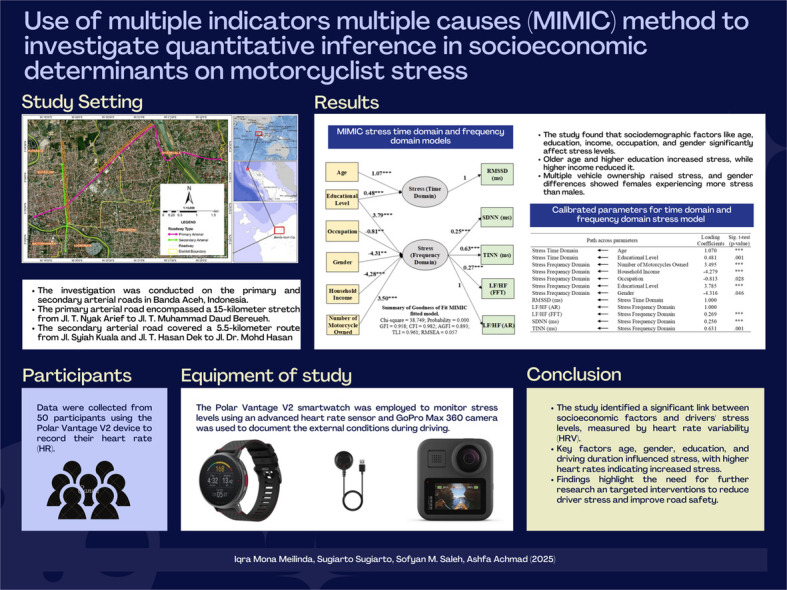
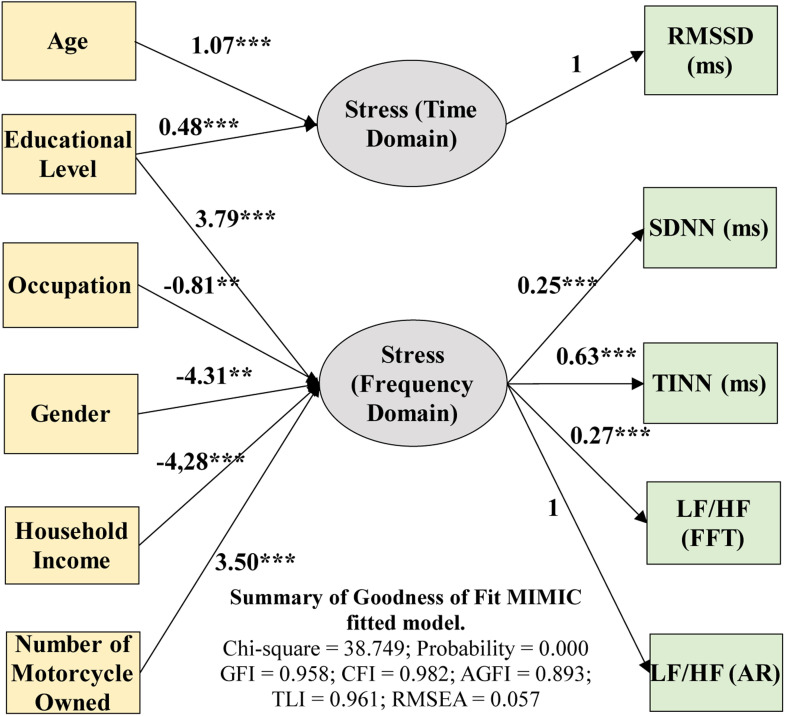
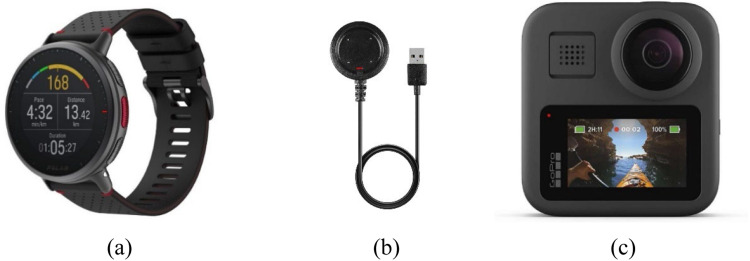
Research has shown that driving-related stress plays a significant role in causing traffic accidents, either directly or indirectly. Motorcyclists often engage in risky driving behaviors due to elevated stress levels. This study investigates the influence of socioeconomic factors on driving stress among motorcyclists. Data were gathered from 50 participants, with heart rate (HR) recorded using the Polar Vantage V2 device. Heart rate variability (HRV) was analyzed in both time and frequency domains using Kubios HRV software. The study employed the Multiple Indicators Multiple Causes (MIMIC) model to explore the associations between socioeconomic factors and driving stress. The results indicate that variables such as age, gender, education level, occupation, income, driving experience, and travel purpose significantly affect stress levels across both HRV domains. These findings highlight the importance of addressing motorcyclist stress through targeted interventions, including educational programs and policy measures that regulate driving duration. Such strategies are particularly vital in developing countries to reduce stress and improve road safety. This research provides a foundation for developing practical solutions aimed at minimizing driving stress and enhancing the well-being of motorcyclists in high-risk environments.•A MIMIC model was applied to analyze the relationship between stress variables in the time and frequency domains based on HRV data.•The model identified significant causal relationships, emphasizing the pivotal role of socioeconomic factors in influencing motorcyclists' driving stress.•The model demonstrated strong statistical performance with key indicators: chi-square = 38.749, GFI = 0.958, CFI = 0.982, AGFI = 0.893, TLI = 0.961, and RMSEA = 0.057, confirming its robustness and reliability.
研究表明,与驾驶相关的压力在直接或间接导致交通事故方面起着重要作用。由于压力水平升高,摩托车骑手经常会做出危险的驾驶行为。本研究调查了社会经济因素对摩托车骑手驾驶压力的影响。从50名参与者那里收集了数据,使用Polar Vantage V2设备记录心率(HR)。使用Kubios HRV软件在时域和频域分析心率变异性(HRV)。该研究采用多指标多原因(MIMIC)模型来探索社会经济因素与驾驶压力之间的关联。结果表明,年龄、性别、教育水平、职业、收入、驾驶经验和出行目的等变量在两个HRV领域均显著影响压力水平。这些发现凸显了通过有针对性的干预措施来解决摩托车骑手压力问题的重要性,包括教育项目和规范驾驶时长的政策措施。在发展中国家,此类策略对于减轻压力和改善道路安全尤为重要。本研究为制定切实可行的解决方案奠定了基础,旨在将高风险环境中摩托车骑手的驾驶压力降至最低,并提高他们的幸福感。
•应用MIMIC模型基于HRV数据分析时域和频域中压力变量之间的关系。
•该模型确定了显著的因果关系,强调了社会经济因素在影响摩托车骑手驾驶压力方面的关键作用。
•该模型在关键指标方面表现出强大的统计性能:卡方 = 38.749,GFI = 0.958,CFI = 0.982,AGFI = 0.893,TLI = 0.961,RMSEA = 0.057,证实了其稳健性和可靠性。