Long Juan, Xu Zhen-Yu, Ma Lang, Zong Hongying, Wu Jiali, Zhou Zhipeng, Qian Peijun, Wang Wenya, Feng Limeng, Yan Hao, Xiao Shuying, Yuan Yi, Hao Yuwan, Zhu Zelin, Li Shizhu, Zhao Qin-Ping
Department of Parasitology, School of Basic Medical Sciences, Wuhan University, Wuhan, Hubei, China.
Demonstration Center for Experimental Basic Medicine Education, Wuhan University, Wuhan, Hubei, China.
PLoS Negl Trop Dis. 2025 Mar 19;19(3):e0012931. doi: 10.1371/journal.pntd.0012931. eCollection 2025 Mar.
Schistosoma japonicum is a multi-host parasite, including asexual amplification in snail hosts and sexual reproduction in mammalian hosts. The genetic diversity of S. japonicum by host switching is less understood, which could help elucidate the genetic evolution of S. japonicum under host pressure and provide instruction for host sampling and the infection pattern to make S. japonicum infection models.
Different developmental stages of S. japonicum were collected and genotyped with 24 microsatellite loci, including 345 cercariae from naturally infected snails and 472 and 540 adult worms from artificially infected mice and rabbits, separately. The genetic distribution of S. japonicum within and among hosts by different sampling was assessed, and the genetic diversity and population structure were calculated at different population levels during host switching.
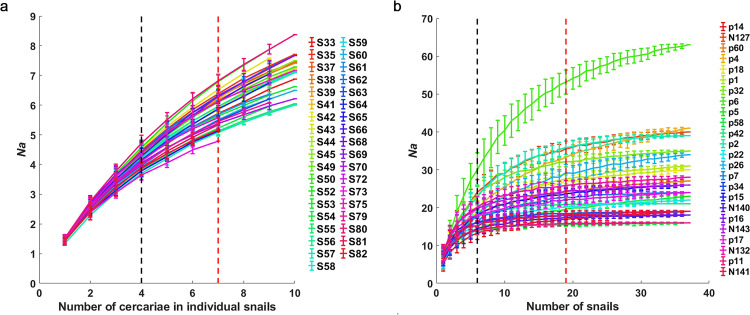
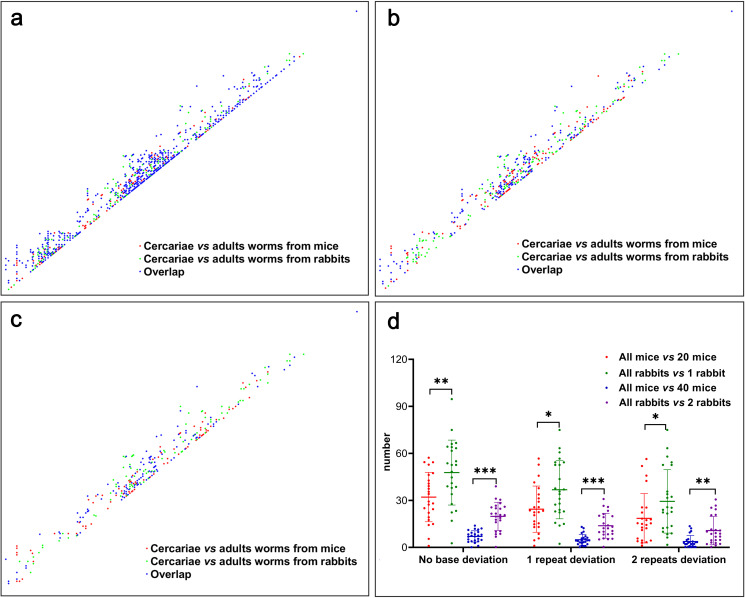
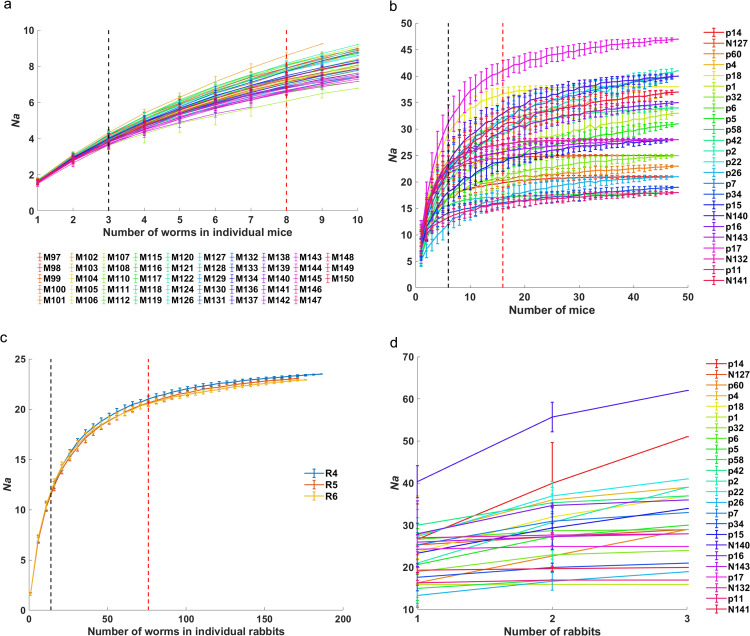
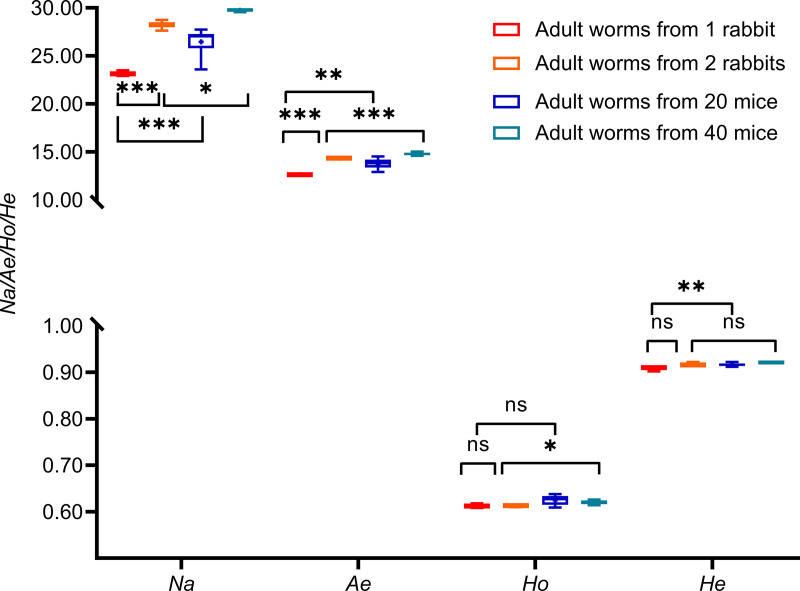
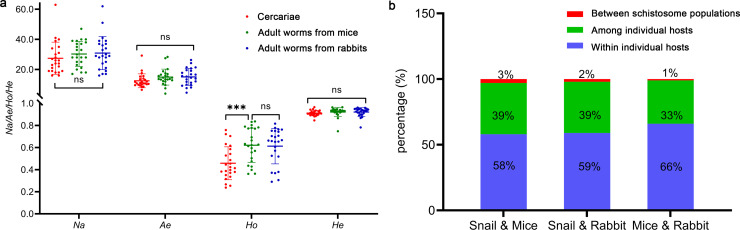
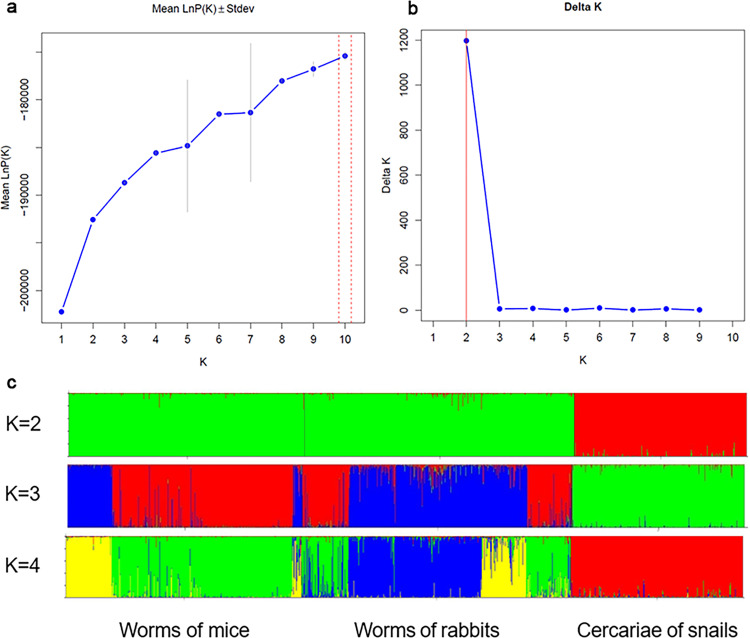
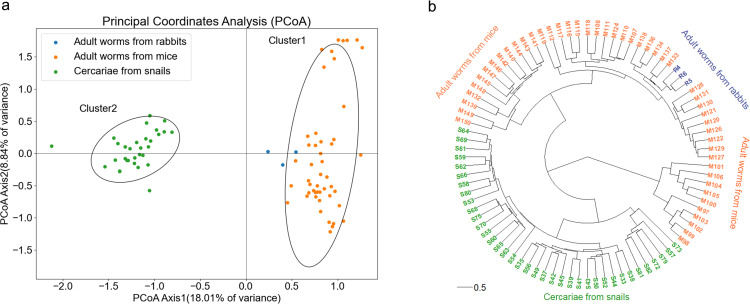
Seven cercariae were the minimum sample size to retrieve 85% of alleles for S. japonicum in each snail, and meanwhile, sampling parasites from 19 snails could recover 85% of the total Na of S. japonicum in all snails in this study. After infection in mice and rabbits, 8 worms per mouse and 76 worms per rabbit were the minimum samplings to retrieve 90% of alleles from each corresponding definitive host. Further, 16 mice and 2 rabbits were the least sampling size to recover 85% of the total Na of S. japonicum in all mice and rabbits, respectively. Although no significant difference was shown for S. japonicum between mice and rabbits at the suprapopulation level, it is clear that the genetic diversity of worms from 20 (or 40) mice was significantly higher than that from 1 (or 2) rabbits, especially when the host sampling was not sufficiently enough. The differentiation of worms at the infrapopulation level among mice is less than among rabbits. In addition, genetic differentiation was shown between cercaria and adult worms, which was considered to relate to allele loss after host switching.
The population genetic diversity of S. japonicum differs in different developmental stages. Host species and sampling number significantly affect the distribution pattern of alleles and the genetic structure of S. japonicum at the suprapopulation level.
日本血吸虫是一种多宿主寄生虫,包括在螺类宿主中的无性增殖和在哺乳动物宿主中的有性繁殖。对于日本血吸虫通过宿主转换产生的遗传多样性了解较少,这有助于阐明日本血吸虫在宿主压力下的遗传进化,并为宿主采样和感染模式提供指导,以建立日本血吸虫感染模型。
收集日本血吸虫不同发育阶段的样本,并用24个微卫星位点进行基因分型,分别包括来自自然感染螺类的345只尾蚴,以及来自人工感染小鼠和兔子的472只和540只成虫。评估不同采样方式下日本血吸虫在宿主内和宿主间的遗传分布,并计算宿主转换过程中不同种群水平的遗传多样性和种群结构。
在本研究中,7只尾蚴是在每个螺类中检索到日本血吸虫85%等位基因的最小样本量,同时,从19只螺类中采样寄生虫可回收所有螺类中日本血吸虫总等位基因数(Na)的85%。在小鼠和兔子中感染后,每只小鼠8条虫和每只兔子76条虫是从每个相应终宿主中检索到90%等位基因的最小采样量。此外,16只小鼠和2只兔子分别是回收所有小鼠和兔子中日本血吸虫总Na的85%的最小采样量。虽然在总体水平上小鼠和兔子之间的日本血吸虫没有显著差异,但很明显,来自20只(或40只)小鼠的虫体遗传多样性显著高于来自1只(或2只)兔子的虫体,尤其是当宿主采样不够充分时。小鼠群体内虫体的分化小于兔子群体内的分化。此外,尾蚴和成虫之间存在遗传分化,这被认为与宿主转换后的等位基因丢失有关。
日本血吸虫的群体遗传多样性在不同发育阶段有所不同。宿主物种和采样数量在总体水平上显著影响日本血吸虫等位基因的分布模式和遗传结构。