Munoz-Lopez Carlos, Lewis Kieran, Rathi Nityam, Maina Eran, Kazama Akira, Wong Anne, Bartholomew Angelica, Attawettayanon Worapat, Ye Yunlin, Zhang Zhiling, Dong Wen, Campbell Rebecca A, Heller Nicholas, Remer Erick, Weight Christopher, Campbell Steven C
Glickman Urological and Kidney Institute, Cleveland Clinic Cleveland OH USA.
Department of Urology, Division of Molecular Oncology, Graduate School of Medical and Dental Sciences Niigata University Japan.
BJUI Compass. 2025 Mar 19;6(3):e70013. doi: 10.1002/bco2.70013. eCollection 2025 Mar.
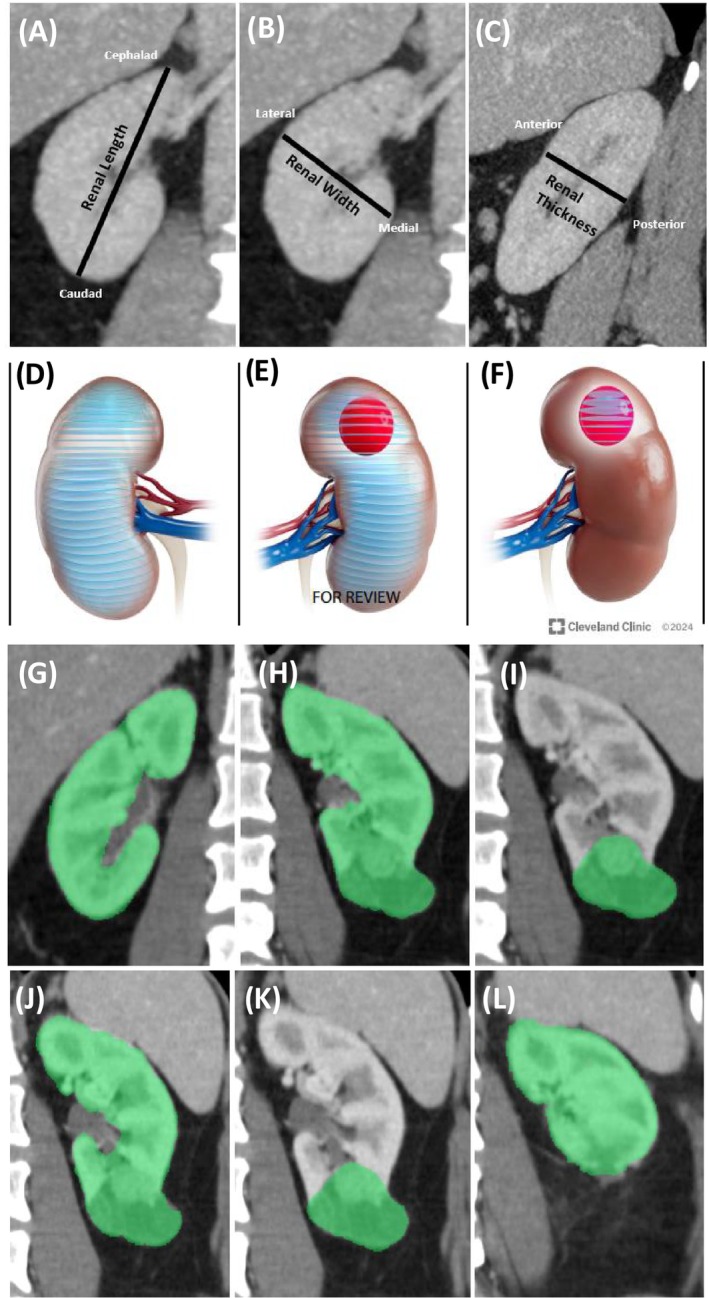
In most patients, the renal parenchymal volumes in each kidney directly correlate with function and can be used as a proxy to determine split renal function (SRF). This simple principle forms the basis for parenchymal volume analysis (PVA) with semiautomated software, which can be leveraged to predict SRF and new-baseline glomerular filtration rate (NBGFR) following nephrectomy. PVA was originally used to evaluate renal transplantation donors and has replaced nuclear renal scans (NRS) in this domain. PVA has subsequently been explored for the management of patients with kidney cancer for whom difficult decisions about radical versus partial nephrectomy can be influenced by accurate prediction of NBGFR. Our objective is to present a comprehensive review of the applications of PVA in urology including their clinical and research implications.
Key articles utilizing renal PVA to improve clinical care and facilitate urologic research were reviewed with special emphasis on take-home points of clinical relevance and their contributions to progress in the field.
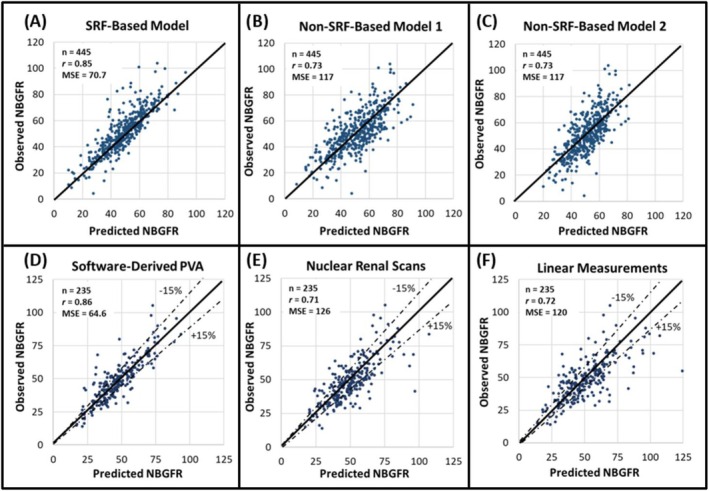
There have been considerable advances in renal PVA over the past 15 years, which is now established as a reference standard for the prediction of functional outcomes after renal surgery. PVA provides improved accuracy when compared to NRS-based estimates or non-SRF-based algorithms. PVA can be performed in minutes using routine preoperative cross-sectional imaging and can be readily applied at the point of care. Additionally, PVA has important research applications, enabling the precise study of the determinants of functional recovery after partial nephrectomy, which can affect surgical approaches to this procedure.
Despite the wide availability of PVA, primarily for use in renal transplantation, it has not been widely implemented for other urologic purposes at most centres. Our hope is that this narrative review will increase PVA utilization in urology and facilitate further progress in the field.
在大多数患者中,每个肾脏的肾实质体积与功能直接相关,可作为确定分肾功能(SRF)的替代指标。这一简单原理构成了使用半自动软件进行实质体积分析(PVA)的基础,该分析可用于预测肾切除术后的SRF和新基线肾小球滤过率(NBGFR)。PVA最初用于评估肾移植供体,在这一领域已取代核肾扫描(NRS)。随后,人们对PVA在肾癌患者管理中的应用进行了探索,对于这类患者,关于根治性肾切除术与部分肾切除术的艰难决策可能会受到NBGFR准确预测的影响。我们的目的是对PVA在泌尿外科中的应用进行全面综述,包括其临床和研究意义。
对利用肾脏PVA改善临床护理并促进泌尿外科研究的关键文章进行了综述,特别强调了具有临床相关性的要点及其对该领域进展的贡献。
在过去15年中,肾脏PVA取得了显著进展,现已成为预测肾脏手术后功能结局的参考标准。与基于NRS的估计或基于非SRF的算法相比,PVA提供了更高的准确性。使用常规术前横断面成像,PVA可在几分钟内完成,并且可以在护理点轻松应用。此外,PVA具有重要的研究应用,能够精确研究部分肾切除术后功能恢复的决定因素,这可能会影响该手术的手术方法。
尽管PVA广泛可用,主要用于肾移植,但在大多数中心,它尚未广泛应用于其他泌尿外科目的。我们希望这篇叙述性综述将增加PVA在泌尿外科中的应用,并促进该领域的进一步发展。