Nguyen Yem Van, Bui Trang Minh, Pham Vinh Nguyen, Vu Vu Hoang, Nguyen Khang Duong, Chau Hoa Ngoc
Heart Institute of Ho Chi Minh City, Ho Chi Minh City, Vietnam.
Cardiology Department, Tam Anh Hospital, Ho Chi Minh City, Vietnam.
Cardiovasc Diagn Ther. 2025 Feb 28;15(1):148-162. doi: 10.21037/cdt-24-408. Epub 2025 Feb 25.
Multiple studies have demonstrated that cardiac resynchronization therapy (CRT) effectively improves the prognosis of heart failure. CRT has been proven to improve patients' quality of life and reduce the risk of readmission and death in selected patients. Nevertheless, a notable proportion of individuals undergoing CRT showed no response. Therefore, we conducted this study to describe CRT characteristics and reported the outcomes 1 year after discharge in Vietnam, along with predictors of non-response to CRT.
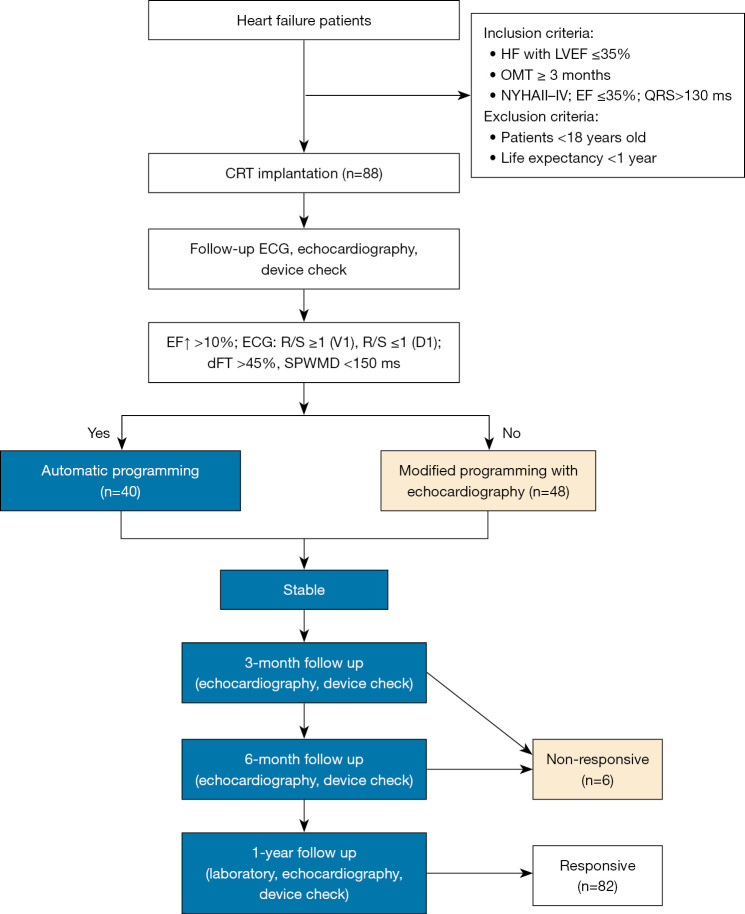
This was a multicenter, ambispective cohort study that enrolled all CRT implantation patients at five hospitals in Ho Chi Minh City: University Medical Center Ho Chi Minh City, Heart Institute of Ho Chi Minh City, Tam Duc Heart Hospital, Thong Nhat Hospital, and Vinmec Central Park Hospital. All patients received treatment according to established guidelines and were monitored for up to 1 year after being discharged. Primary outcomes included rehospitalization and mortality rate 1 year after discharge. Secondary outcomes included early and late complications related to the procedure.
Between April 2016 and April 2020, 88 cases of successful CRT implantation from five hospitals were enrolled. The majority of the population was male (68.2%), mean age was 62.5±13.4 years old, New York Heart Association (NYHA) III/IV at admission (98.9%), and the mean left ventricular ejection fraction (LVEF) was 24%±5.9%. The incidence of early complications was 9.1%. The overall mortality rate was 12.5%, with 6.8% occurring within the 1-year follow-up period. The population experienced a significant decrease in readmission rate within 1 year after discharge (P=0.001). Additionally, there was a notable improvement in the NYHA function (P<0.001) and an enhancement in the quality of life (P=0.001). Five characteristics correlated with the lack of response to CRT were history of dobutamine usage, QRS interval (QRS) length before implantation, severe ventricular arrhythmias before implantation, atrial fibrillation after implantation, and severe ventricular arrhythmias after implantation.
Properly used CRT device improves heart failure symptoms, mortality, and readmissions. There are several predictors of cardiac resynchronization treatment failure. This information helps us comprehend the restricted patient group and develop better treatments, especially in low-income countries.
多项研究表明,心脏再同步治疗(CRT)可有效改善心力衰竭的预后。CRT已被证明可改善患者的生活质量,并降低特定患者再次入院和死亡的风险。然而,相当一部分接受CRT治疗的患者并无反应。因此,我们开展了本研究,以描述CRT的特点,并报告越南患者出院1年后的结局以及CRT无反应的预测因素。
这是一项多中心、双向队列研究,纳入了胡志明市五家医院的所有CRT植入患者:胡志明市大学医学中心、胡志明市心脏研究所、潭德心脏医院、统一医院和Vinmec中央公园医院。所有患者均按照既定指南接受治疗,并在出院后接受长达1年的监测。主要结局包括出院1年后的再住院率和死亡率。次要结局包括与手术相关的早期和晚期并发症。
2016年4月至2020年4月期间,五家医院共有88例CRT植入成功的病例被纳入研究。研究对象以男性为主(68.2%),平均年龄为62.5±13.4岁,入院时纽约心脏协会(NYHA)心功能分级为III/IV级的患者占98.9%,平均左心室射血分数(LVEF)为24%±5.9%。早期并发症的发生率为9.1%。总死亡率为12.5%,其中6.8%发生在1年随访期内。研究对象出院后1年内的再住院率显著降低(P=0.001)。此外,NYHA心功能分级有显著改善(P<0.001),生活质量也有所提高(P=0.001)。与CRT无反应相关的五个特征为多巴酚丁胺使用史、植入前QRS间期(QRS)长度、植入前严重室性心律失常、植入后心房颤动以及植入后严重室性心律失常。
正确使用CRT设备可改善心力衰竭症状、降低死亡率和再住院率。心脏再同步治疗失败有多种预测因素。这些信息有助于我们了解受限的患者群体,并开发更好的治疗方法,尤其是在低收入国家。