Chen Yi-Chun, Bäck Nils E, Zhen Jenicia, Xiong Lena, Komba Mitsuhiro, Gloyn Anna L, MacDonald Patrick E, Mains Richard E, Eipper Betty A, Verchere C Bruce
Department of Surgery, Faculty of Medicine, University of British Columbia & BC Children's Hospital Research Institute, 950 West 28th Avenue, Vancouver, BC, V5Z 4H4, Canada.
Department of Anatomy, Faculty of Medicine, University of Helsinki, PO Box 63 (Haartmaninkatu 8), 00014 University of Helsinki, Finland.
Mol Metab. 2025 Jun;96:102123. doi: 10.1016/j.molmet.2025.102123. Epub 2025 Mar 20.
Carriers of PAM (peptidylglycine alpha-amidating monooxygenase) coding variant alleles have reduced insulinogenic index, higher risk of developing type 2 diabetes (T2D), and islets from heterozygous carriers of the PAM p.Asp563Gly variant display reduced insulin secretion. Exactly how global PAM deficiency contributes to hyperglycemia remains unclear. PAM is the only enzyme capable of converting glycine-extended peptide hormones into amidated products. Like neuropeptide Y (NPY), α-melanocyte stimulating hormone (αMSH), and glucagon-like peptide 1 (GLP-1), islet amyloid polypeptide (IAPP), a beta cell peptide that forms islet amyloid in type 2 diabetes, is a PAM substrate. We hypothesized that Pam deficiency limited to beta cells would lead to reduced insulin secretion, prevent the production of amidated IAPP, and reveal the extent to which loss of Pam in β-cells could accelerate the onset of hyperglycemia in mice.
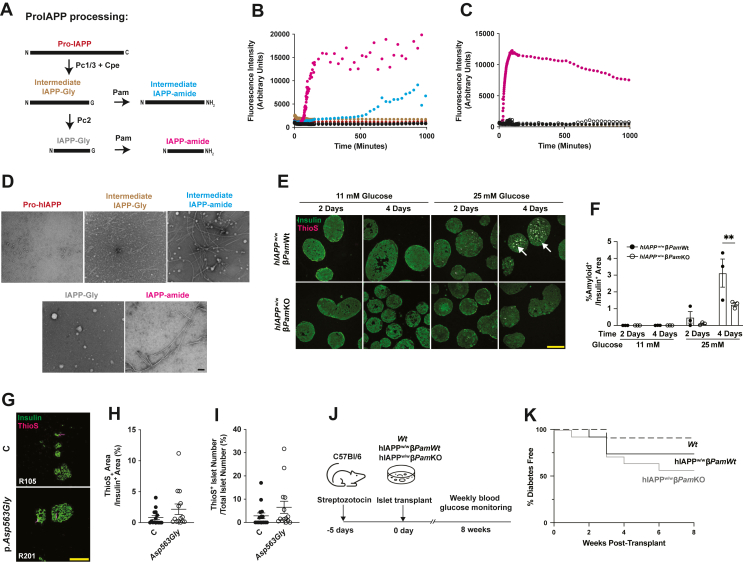
PAM activity was assessed in human islets from donors based on their PAM genotype. We generated beta cell-specific Pam knockout (Ins1, Pam; βPamKO) mice and performed islet culture, histological, and metabolic assays to evaluate the physiological roles of Pam in beta cells. We analyzed human IAPP (hIAPP) amyloid fibril forming kinetics using synthetic amidated and non-amidated hIAPP peptides, and generated hIAPP knock-in beta cell-specific Pam knockout (hIAPP βPamKO) mice to determine the impact of hIAPP amidation on islet amyloid burden, islet graft survival, and glucose tolerance.
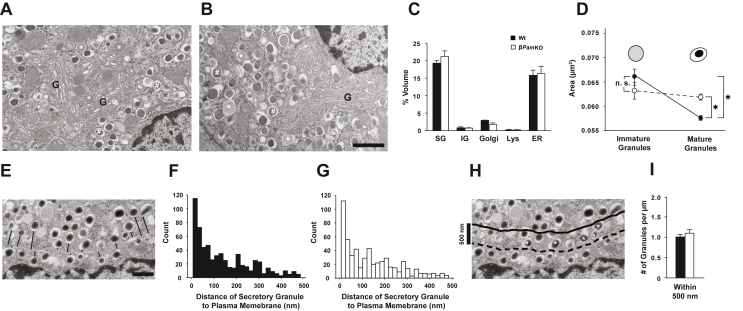
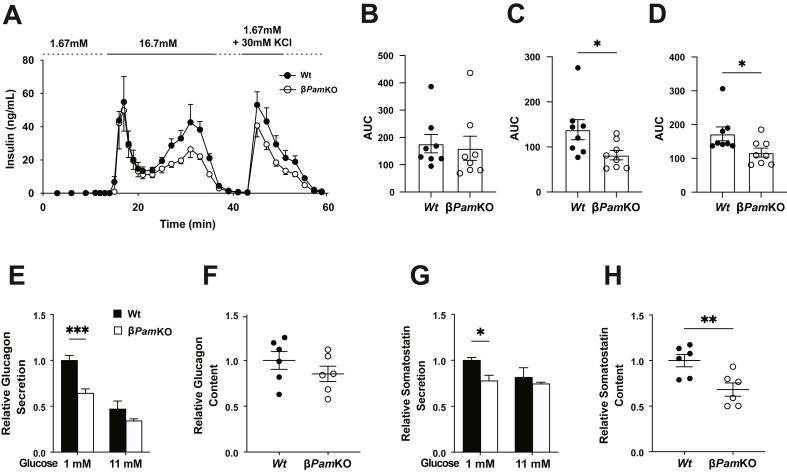
PAM enzyme activity was significantly reduced in islets from donors with the PAM p. Asp563Gly T2D-risk allele. Islets from βPamKO mice had impaired second-phase glucose- and KCl-induced insulin secretion. Beta cells from βPamKO mice had larger dense-core granules and fewer and shorter cilia. Interestingly, non-amidated hIAPP was less fibrillogenic in vitro, and high glucose-treated hIAPP βPamKO islets had reduced amyloid burden. Despite these changes in beta cell function, βPamKO mice were not more susceptible to diet-induced hyperglycemia. In vitro beta cell death and in vivo islet graft survival remained comparable between hIAPP βPamKO and hIAPP islets. Surprisingly, aged hIAPP βPamKO mice had improved insulin secretion and glucose tolerance.
Eliminating Pam expression only in beta cells leads to morphological changes in insulin granules, reduced insulin secretion, reduced hIAPP amyloid burden and altered ciliogenesis. However, in mice beta-cell Pam deficiency has no impact on the development of diet- or hIAPP-induced hyperglycemia. Our data are consistent with current studies revealing ancient, highly conserved roles for peptidergic signaling in the coordination of the diverse signals needed to regulate fundamental processes such as glucose homeostasis.
PAM(肽基甘氨酸α-酰胺化单加氧酶)编码变异等位基因的携带者胰岛素生成指数降低,患2型糖尿病(T2D)的风险更高,PAM p.Asp563Gly变异杂合携带者的胰岛显示胰岛素分泌减少。PAM整体缺乏究竟如何导致高血糖尚不清楚。PAM是唯一能够将甘氨酸延伸的肽激素转化为酰胺化产物的酶。与神经肽Y(NPY)、α-黑素细胞刺激激素(αMSH)和胰高血糖素样肽1(GLP-1)一样,胰岛淀粉样多肽(IAPP)是一种在2型糖尿病中形成胰岛淀粉样蛋白的β细胞肽,也是PAM的底物。我们假设仅限于β细胞的Pam缺乏会导致胰岛素分泌减少,阻止酰胺化IAPP的产生,并揭示β细胞中Pam缺失可加速小鼠高血糖发作的程度。
根据供体的PAM基因型评估人胰岛中的PAM活性。我们构建了β细胞特异性Pam基因敲除(Ins1,Pam;βPamKO)小鼠,并进行胰岛培养、组织学和代谢分析,以评估Pam在β细胞中的生理作用。我们使用合成的酰胺化和非酰胺化hIAPP肽分析人IAPP(hIAPP)淀粉样纤维形成动力学,并构建hIAPP基因敲入β细胞特异性Pam基因敲除(hIAPP βPamKO)小鼠,以确定hIAPP酰胺化对胰岛淀粉样蛋白负荷、胰岛移植存活和葡萄糖耐量的影响。
携带PAM p.Asp563Gly T2D风险等位基因的供体的胰岛中PAM酶活性显著降低。βPamKO小鼠的胰岛在第二阶段葡萄糖和氯化钾诱导的胰岛素分泌受损。βPamKO小鼠的β细胞有更大的致密核心颗粒和更少、更短的纤毛。有趣的是,非酰胺化hIAPP在体外形成纤维的能力较低,高糖处理的hIAPP βPamKO胰岛的淀粉样蛋白负荷降低。尽管β细胞功能发生了这些变化,但βPamKO小鼠对饮食诱导的高血糖并不更敏感。hIAPP βPamKO和hIAPP胰岛之间的体外β细胞死亡和体内胰岛移植存活仍然相当。令人惊讶的是,老年hIAPP βPamKO小鼠的胰岛素分泌和葡萄糖耐量有所改善。
仅在β细胞中消除Pam表达会导致胰岛素颗粒的形态变化、胰岛素分泌减少、hIAPP淀粉样蛋白负荷降低和纤毛发生改变。然而,在小鼠中,β细胞Pam缺乏对饮食或hIAPP诱导的高血糖发展没有影响。我们的数据与当前的研究一致,这些研究揭示了肽能信号在协调调节葡萄糖稳态等基本过程所需的各种信号方面具有古老、高度保守的作用。