Parduzi Qendresa, Wermelinger Jonathan, Koller Simon Domingo, Sariyar Murat, Schneider Ulf, Raabe Andreas, Seidel Kathleen
Graduate School for Health Sciences, University of Bern, Bern, Switzerland.
Department of Neurosurgery, Inselspital, Bern University Hospital, University of Bern, Bern, Switzerland.
J Med Internet Res. 2025 Mar 24;27:e63937. doi: 10.2196/63937.
Intraoperative neurophysiological monitoring (IONM) guides the surgeon in ensuring motor pathway integrity during high-risk neurosurgical and orthopedic procedures. Although motor-evoked potentials (MEPs) are valuable for predicting motor outcomes, the key features of predictive signals are not well understood, and standardized warning criteria are lacking. Developing a muscle identification prediction model could increase patient safety while allowing the exploration of relevant features for the task.
The aim of this study is to expand the development of machine learning (ML) methods for muscle classification and evaluate them in a bicentric setup. Further, we aim to identify key features of MEP signals that contribute to accurate muscle classification using explainable artificial intelligence (XAI) techniques.
This study used ML and deep learning models, specifically random forest (RF) classifiers and convolutional neural networks (CNNs), to classify MEP signals from routine supratentorial neurosurgical procedures from two medical centers according to muscle identity of four muscles (extensor digitorum, abductor pollicis brevis, tibialis anterior, and abductor hallucis). The algorithms were trained and validated on a total of 36,992 MEPs from 151 surgeries in one center, and they were tested on 24,298 MEPs from 58 surgeries from the other center. Depending on the algorithm, time-series, feature-engineered, and time-frequency representations of the MEP data were used. XAI techniques, specifically Shapley Additive Explanation (SHAP) values and gradient class activation maps (Grad-CAM), were implemented to identify important signal features.
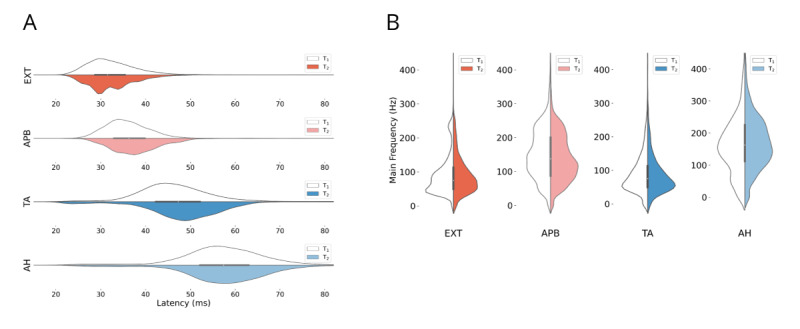
High classification accuracy was achieved with the RF classifier, reaching 87.9% accuracy on the validation set and 80% accuracy on the test set. The 1D- and 2D-CNNs demonstrated comparably strong performance. Our XAI findings indicate that frequency components and peak latencies are crucial for accurate MEP classification, providing insights that could inform intraoperative warning criteria.
This study demonstrates the effectiveness of ML techniques and the importance of XAI in enhancing trust in and reliability of artificial intelligence-driven IONM applications. Further, it may help to identify new intrinsic features of MEP signals so far overlooked in conventional warning criteria. By reducing the risk of muscle mislabeling and by providing the basis for possible new warning criteria, this study may help to increase patient safety during surgical procedures.
术中神经生理监测(IONM)可在高风险神经外科手术和骨科手术过程中指导外科医生确保运动通路的完整性。尽管运动诱发电位(MEP)对于预测运动结果很有价值,但预测信号的关键特征尚未得到充分理解,且缺乏标准化的预警标准。开发肌肉识别预测模型可以提高患者安全性,同时有助于探索该任务的相关特征。
本研究旨在扩展用于肌肉分类的机器学习(ML)方法的开发,并在双中心设置中对其进行评估。此外,我们旨在使用可解释人工智能(XAI)技术识别有助于准确肌肉分类的MEP信号的关键特征。
本研究使用ML和深度学习模型,特别是随机森林(RF)分类器和卷积神经网络(CNN),根据四块肌肉(指伸肌、拇短展肌、胫骨前肌和拇展肌)的肌肉特征对来自两个医疗中心的常规幕上神经外科手术的MEP信号进行分类。算法在一个中心的151例手术的总共36992个MEP上进行训练和验证,并在另一个中心的58例手术的24298个MEP上进行测试。根据算法,使用MEP数据的时间序列、特征工程和时频表示。实施XAI技术,特别是Shapley加法解释(SHAP)值和梯度类激活映射(Grad-CAM),以识别重要的信号特征。
RF分类器实现了较高的分类准确率,在验证集上达到87.9%的准确率,在测试集上达到80%的准确率。1D-CNN和2D-CNN表现出相当强的性能。我们的XAI研究结果表明,频率成分和峰值潜伏期对于准确的MEP分类至关重要,这为术中预警标准提供了参考。
本研究证明了ML技术的有效性以及XAI在增强对人工智能驱动的IONM应用的信任和可靠性方面的重要性。此外,它可能有助于识别传统预警标准中迄今被忽视的MEP信号的新内在特征。通过降低肌肉误标记的风险并为可能的新预警标准提供基础,本研究可能有助于提高手术过程中的患者安全性。