Ergan Mesut, Keskіn Tahir, Candan İbrahim Aydın, Erzurumlu Yalçın, Aşci Halil, Çömlekçı Selçuk, Başkurt Ferdi
Faculty of Health Sciences, Department of Physiotherapy and Rehabilitation, Süleyman Demirel University, Isparta, 32200, Turkey.
Faculty of Physical Therapy and Rehabilitation, Bingöl University, Bіngöl, 12000, Turkey.
BMC Musculoskelet Disord. 2025 Mar 24;26(1):289. doi: 10.1186/s12891-025-08442-0.
Pulsed electromagnetic fields (PEMF) and stretching exercises are safe and noninvasive methods that could have a therapeutic effect on tissue healing. This study aimed to assess the effectiveness of these methods in treatment of muscle injury (INJ).
Rats were divided into 5 groups (Control, INJ, INJ + Exercise, INJ + PEMF, INJ + Exercise + PEMF). At the end of the experiment, genetic, histopathological, and immunohistochemical evaluations were made in the muscle tissue.
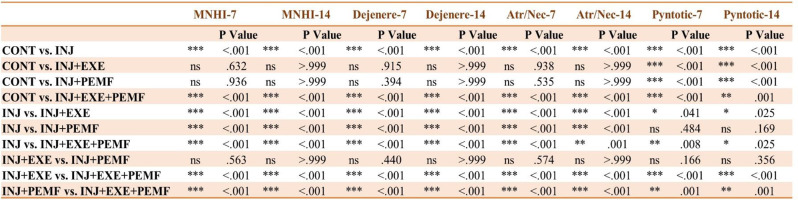
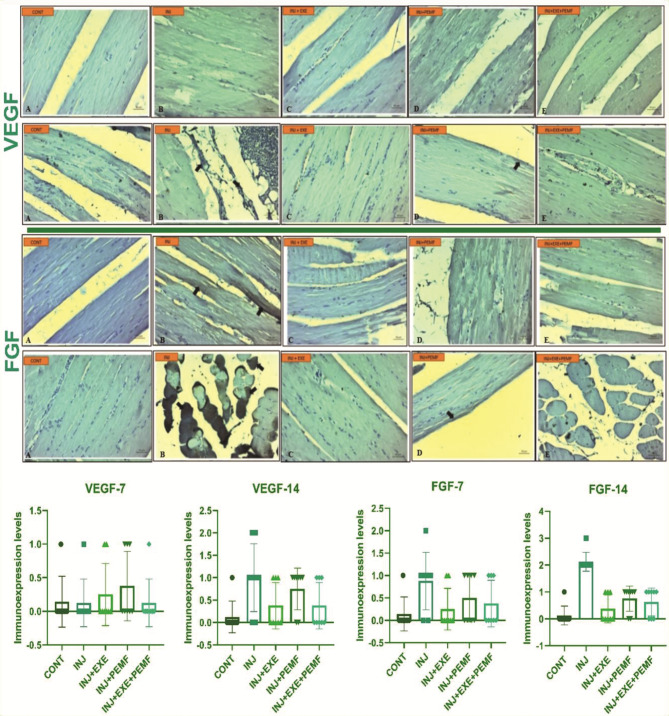
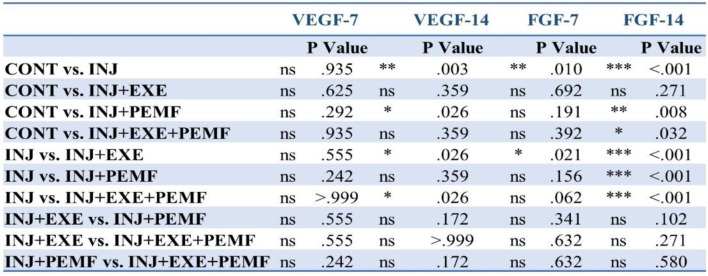
Mononuclear cell infiltration, muscle degeneration, atrophy, and necrosis were found to be higher in the INJ group than in all groups (p < 0.001). On the 7th day, fibroblast growth factor (FGF) was found to be higher in the INJ group compared to both the control and the INJ + Exercise group (p < 0.05). On the 14th day, Vascular endothelial growth factor values were found to be higher in the injury group than the other groups except for the PEMF group (p < 0.05), and FGF values were higher in the injury group compared to all groups (p < 0.001). The expressions of transforming growth factor beta 1 (TGF-β1) and endothelial nitric oxide synthase (eNOS) on the 7th and 14th days showed a significant increase in the INJ group compared to the other groups (p < 0.001).
In this study, it has been shown that PEMF and stretching exercise is effective in the treatment of muscle injuries as they balance the inflammatory process in the muscle, have a positive effect on muscle development, accelerate healing, prevent fibrosis development by reducing TGF-β1 signaling, and inhibit inflammatory-induced eNOS activity.
脉冲电磁场(PEMF)和伸展运动是安全且无创的方法,可能对组织愈合具有治疗作用。本研究旨在评估这些方法在治疗肌肉损伤(INJ)中的有效性。
将大鼠分为5组(对照组、损伤组、损伤+运动组、损伤+PEMF组、损伤+运动+PEMF组)。实验结束时,对肌肉组织进行基因、组织病理学和免疫组织化学评估。
发现损伤组的单核细胞浸润、肌肉变性、萎缩和坏死比所有其他组更高(p<0.001)。在第7天,发现损伤组的成纤维细胞生长因子(FGF)高于对照组和损伤+运动组(p<0.05)。在第14天,发现损伤组的血管内皮生长因子值高于除PEMF组外的其他组(p<0.05),并且损伤组的FGF值高于所有组(p<0.001)。与其他组相比,损伤组在第7天和第14天的转化生长因子β1(TGF-β1)和内皮型一氧化氮合酶(eNOS)表达显著增加(p<0.001)。
在本研究中,已表明PEMF和伸展运动在治疗肌肉损伤方面是有效的,因为它们平衡了肌肉中的炎症过程,对肌肉发育有积极作用,加速愈合,通过减少TGF-β1信号传导防止纤维化发展,并抑制炎症诱导的eNOS活性。