Ma Yingnan, Chen Haiyan, Lv Wenhua, Wei Siyu, Zou Yuping, Li Ruilin, Wang Jiacheng, She Wei, Yuan Linna, Tao Junxian, Guo Xuying, Bi Shuo, Tian Hongsheng, Ma Ye, Sun Hongmei, Sun Chen, Xu Jing, Dong Yu, Kang Jingxuan, Lv Hongchao, Zhang Mingming, Jiang Yongshuai
College of Bioinformatics Science and Technology, Harbin Medical University, 194 Xuefu Road, Nangang District Heilongjiang Province, Harbin, China.
RABC: Rheumatoid Arthritis Bioinformatics Center, Harbin, China.
Biomark Res. 2025 Mar 24;13(1):47. doi: 10.1186/s40364-025-00760-8.
To provide insights into rheumatoid arthritis (RA) epidemiological trends, including prevalence, incidence, disability-adjusted life years (DALYs), corresponding average annual percentage change (AAPC), gender disparities, regional variations, age-specific rates, socio-economic correlations, risk factors, and future projections.
Data were extracted from the Global Burden of Disease Study (GBD) 2021. AAPC was calculated by joinpoint regression and two-sample Mendelian randomization (MR) analysis was performed to verify the causal relationship between the smoking factor and RA. The future incidence trend was predicted by the Bayesian age-period-cohort (BAPC) model.
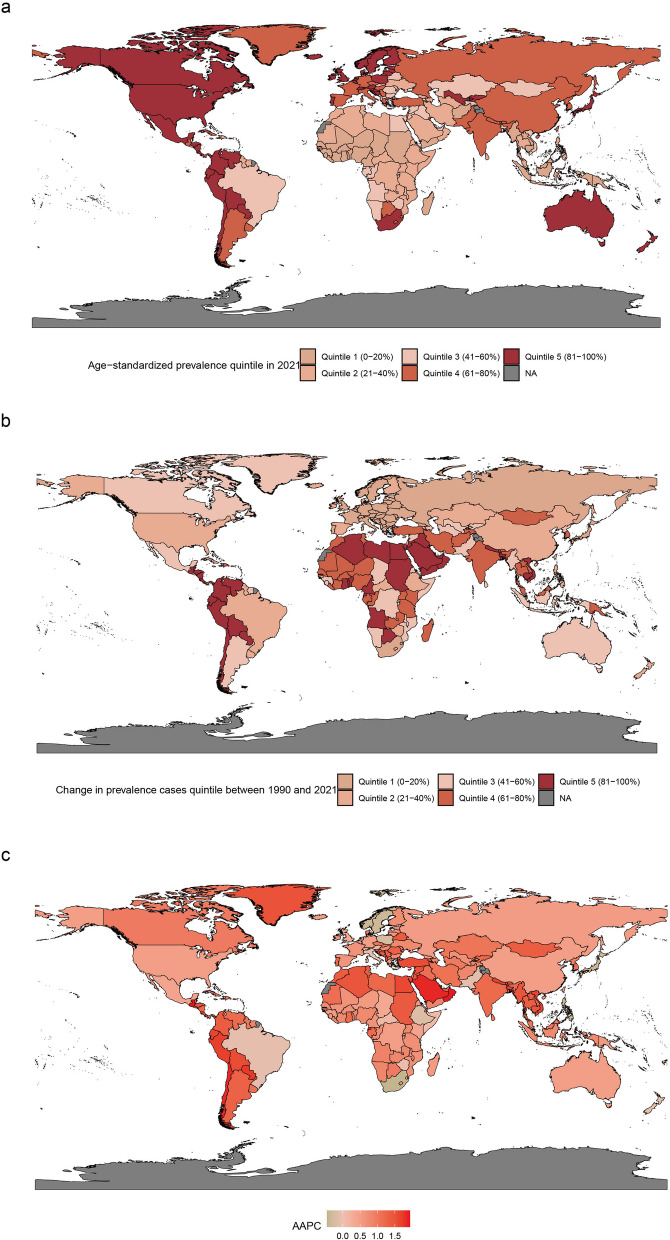
Global age-standardized prevalence rate (ASPR) and age-standardized incidence rate (ASIR) increased significantly while age-standardized DALYs rate (ASDR) decreased from 1990 to 2021. Regional variations were pronounced, with Andean Latin America reporting the highest burden. Females consistently exhibited higher age-standardized rate (ASR) across all metrics. Age-specific prevalence, incidence, and DALYs rates peaked at different age groups, highlighting complex demographic dynamics. Socio-demographic index (SDI) analysis demonstrated a positive correlation between RA burden and socio-economic development. The two-sample MR analysis confirmed a causal effect between smoking and RA. From 2022 to 2050, the ASIR will increase moderately.
The study underscores the escalating burden of RA globally, emphasizing the need for healthcare providers to be aware of the effects of aging populations and other societal factors on the risk of developing RA, and to develop targeted interventions, including smoking cessation programs, age- and gender-appropriate healthcare, and early diagnosis strategies.
深入了解类风湿关节炎(RA)的流行病学趋势,包括患病率、发病率、伤残调整生命年(DALYs)、相应的年均变化百分比(AAPC)、性别差异、地区差异、特定年龄发病率、社会经济相关性、风险因素以及未来预测。
数据取自《2021年全球疾病负担研究》(GBD)。通过连接点回归计算AAPC,并进行两样本孟德尔随机化(MR)分析以验证吸烟因素与RA之间的因果关系。采用贝叶斯年龄-时期-队列(BAPC)模型预测未来发病率趋势。
从1990年到2021年,全球年龄标准化患病率(ASPR)和年龄标准化发病率(ASIR)显著上升,而年龄标准化伤残调整生命年率(ASDR)下降。地区差异显著,安第斯拉丁美洲的负担最重。在所有指标中,女性的年龄标准化率(ASR)始终较高。特定年龄的患病率、发病率和伤残调整生命年率在不同年龄组达到峰值,凸显了复杂的人口动态。社会人口指数(SDI)分析表明RA负担与社会经济发展之间存在正相关。两样本MR分析证实吸烟与RA之间存在因果关系。从2022年到2050年,ASIR将适度上升。
该研究强调了全球范围内RA负担的不断升级,强调医疗保健提供者需要意识到老年人口和其他社会因素对患RA风险的影响,并制定有针对性的干预措施,包括戒烟计划、适合年龄和性别的医疗保健以及早期诊断策略。