Vo An Thuy, Ta Kim-Ngan Thi, Chuang Kai-Jen
Faculty of Public Health, University of Medicine and Pharmacy at Ho Chi Minh City, Ho Chi Minh, Viet Nam.
Department of Public Health, School of Medicine, College of Medicine, Taipei Medical University, New Taipei, Taiwan.
Asia Pac J Oncol Nurs. 2025 Feb 18;12:100671. doi: 10.1016/j.apjon.2025.100671. eCollection 2025 Dec.
This study aimed to evaluate and rank the effectiveness of pharmacological and non-pharmacological interventions for managing dyspnea severity, anxiety, exercise capacity, and health-related quality of life (HRQoL) in patients with advanced cancer.
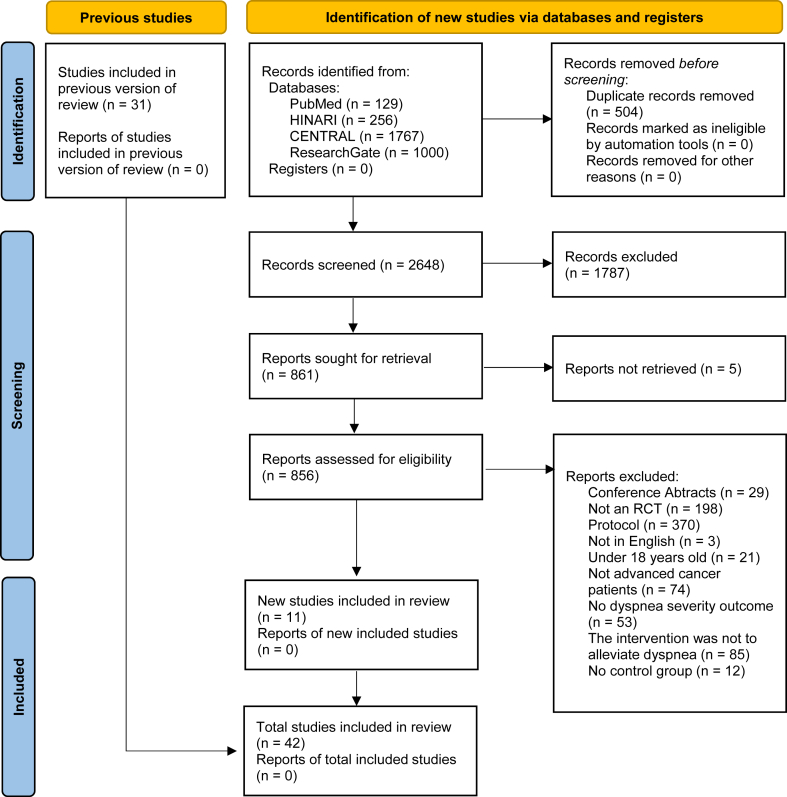
A comprehensive search of PUBMED, HINARI, CENTRAL, and ResearchGate was conducted to identify randomized controlled trials (RCTs) published up to March 2024. Network meta-analysis was performed to compare interventions, calculating mean differences (MD) and standardized mean differences (SMD) with 95% confidence intervals (CI). P-scores were used to rank the interventions. Risk of bias was assessed using the Cochrane tool, and the quality of evidence (QOE) was evaluated using the GRADE framework.
A total of 42 RCTs, encompassing 3,832 patients, were included in the analysis. Among the evaluated interventions, high-flow nasal cannula (HFNC) demonstrated the most significant improvement in dyspnea relief (SMD = -1.91; 95% CI: -3.32 to -0.49; QOE: moderate), followed by acupressure/reflexology (SMD = -1.04; 95% CI: -2.02 to -0.06; QOE: very low). Activity rehabilitation was the only intervention that significantly reduced anxiety compared to the control group (SMD = -0.64; 95% CI: -0.97 to -0.32; QOE: very low). While all interventions showed trends of improving exercise capacity, none reached statistical significance. Notably, acupressure/reflexology significantly enhanced HRQoL (SMD = 1.55; 95% CI: 0.22 to 2.88; QOE: moderate).
Non-pharmacological interventions, particularly HFNC and acupressure/reflexology, were more effective than pharmacological approaches in improving dyspnea relief and HRQoL. However, the low quality of evidence underscores the need for high-quality, large-scale trials to confirm these findings and refine treatment strategies for dyspnea management in advanced cancer patients.
PROSPERO CRD42023479041.
本研究旨在评估并对晚期癌症患者管理呼吸困难严重程度、焦虑、运动能力和健康相关生活质量(HRQoL)的药物和非药物干预措施的有效性进行排名。
对PUBMED、HINARI、CENTRAL和ResearchGate进行全面检索,以识别截至2024年3月发表的随机对照试验(RCT)。进行网络荟萃分析以比较干预措施,计算平均差(MD)和标准化平均差(SMD)以及95%置信区间(CI)。使用P值对干预措施进行排名。使用Cochrane工具评估偏倚风险,并使用GRADE框架评估证据质量(QOE)。
共有42项RCT(涵盖3832名患者)纳入分析。在评估的干预措施中,高流量鼻导管(HFNC)在缓解呼吸困难方面显示出最显著的改善(SMD = -1.91;95% CI:-3.32至-0.49;QOE:中等),其次是指压/反射疗法(SMD = -1.04;95% CI:-2.02至-0.06;QOE:极低)。与对照组相比,活动康复是唯一显著降低焦虑的干预措施(SMD = -0.64;95% CI:-0.97至-0.32;QOE:极低)。虽然所有干预措施都显示出改善运动能力的趋势,但均未达到统计学意义。值得注意的是,指压/反射疗法显著提高了HRQoL(SMD = 1.55;95% CI:0.22至2.88;QOE:中等)。
非药物干预措施,特别是HFNC和指压/反射疗法,在改善呼吸困难缓解和HRQoL方面比药物方法更有效。然而,证据质量较低凸显了需要进行高质量、大规模试验来证实这些发现并完善晚期癌症患者呼吸困难管理的治疗策略。
PROSPERO CRD42023479041。